

I was halfway through a bowl of cross-bridge noodles in Lijiang when I first saw it — a wall of thirteen snow-streaked peaks punching straight through a blue November sky, so close it felt like I could trip over it. That, my friends, was Jade Dragon Snow Mountain, and it is the single most absurdly photogenic thing looming over any town in China. The locals call it Yulong Xueshan, and the Naxi people consider it sacred. Within forty-eight hours I had ridden a cable car into thin alpine air, gasped at a glacier that has been here since the last ice age, and dipped my fingers in water so blue it looked Photoshopped. If you are building a Yunnan itinerary, this stop is not optional.
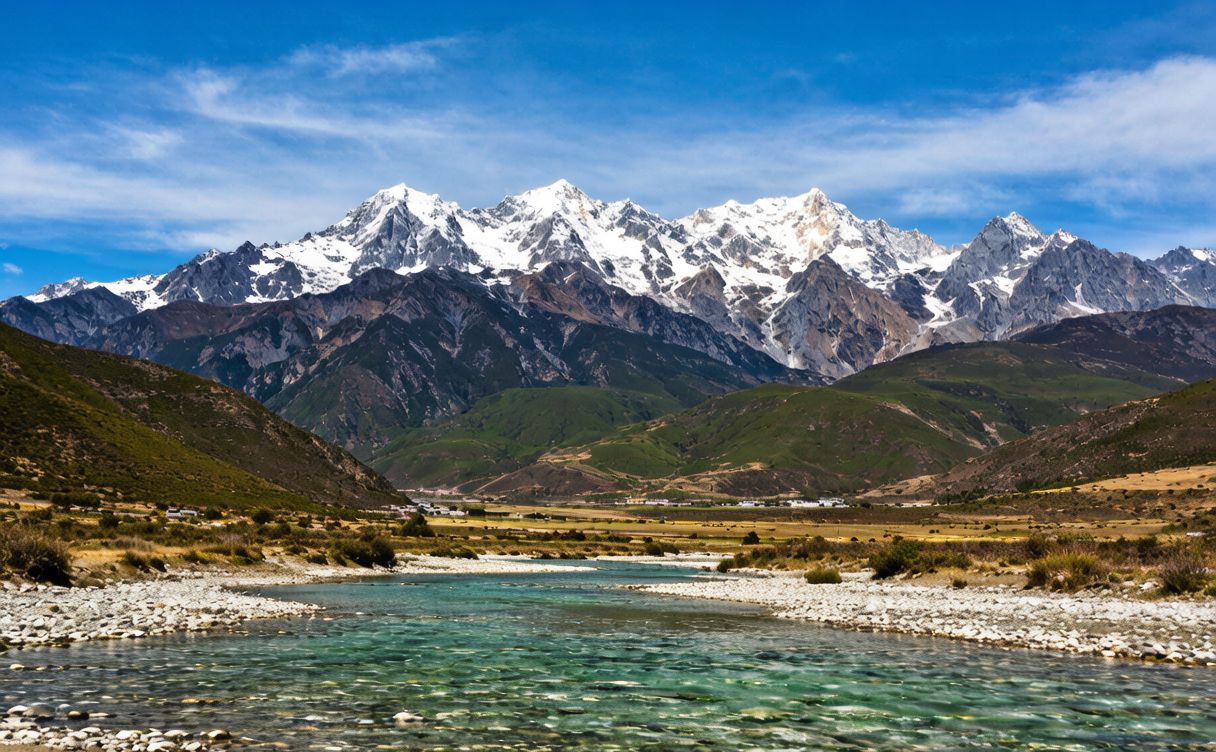
Why Jade Dragon Snow Mountain Owns the Lijiang Skyline
Jade Dragon Snow Mountain (Yulong Snow Mountain in pinyin) is a massif of thirteen connected peaks, the highest of which — Shanzidou — tops out at 5,596 meters (18,360 feet). What makes it special is the drama of the setting. The jade dragon mountain lijiang pairing is unusual: you get a genuine Himalayan-grade glacier range sitting just 15 kilometers north of an 800-year-old UNESCO old town at 2,400 meters. Most of the world’s great peaks are stranded in remote wilderness. This one shares a valley with noodle stalls and Naxi rooftops.
The range runs on a north–south ridge, and because it catches the moisture rolling off the Tibetan plateau, its upper slopes stay glaciated year-round while the foothills stay green. That contrast — tropical valley, arctic summit — is the whole magic. On a clear morning the snow glows a luminous blue-white, which is exactly why the Naxi named it “Jade Dragon.” From almost anywhere in Lijiang you can tip your head back and see the summit, a constant white punctuation mark above the tiled roofs.
Riding the Cable Car to Glacier Park
The smart way up is the big cable car to Glacier Park (Glacier Park Cableway), which climbs from about 3,300 meters to 4,506 meters in roughly thirty minutes. When the cable car rose above the clouds, the temperature dropped a full fifteen degrees and the cabin went silent — everyone was staring at the serried wall of ice outside the window. At the top there is a wooden boardwalk (no, you cannot hike to the summit from here) where you stand at 4,500 meters and look up at Shanzidou’s unclimbed face. From the cable car, Jade Dragon Snow Mountain reads less like a mountain and more like a frozen cathedral.
Bring the rented oxygen canister the ticket office pushes on you. I laughed at it. I then used all of it. At that altitude a gentle staircase feels like a marathon, and the thin air is no joke even for fit travelers. Wear the provided cape if it is windy; the wind up there has no manners.
The Impassable Peak and the Naxi Legend
Here is a fact that hooked me: Shanzidou, the main summit of Jade Dragon Snow Mountain, has never been climbed. Not once. A 1987 attempt by an American team ended in retreat, and local Naxi belief holds that the peak is the home of the gods and must never be stepped on. A Naxi guide told me, grinning, that the mountain “lets you look but does not let you touch” — and honestly, after breathing at 4,500 meters, I was happy to respect that boundary.
The Naxi are the cultural soul of this whole region. Their pictographic Dongba script is the only living hieroglyphic writing system on earth, and the mountain appears throughout their rituals as a protective spirit. You do not need to be an anthropologist to feel it: standing in the shadow of Yulong Xueshan, with prayer-flag-colored ridges and silence that swallows jet engines, the sacredness is just… obvious. The glaciers themselves are shrinking with the climate, which makes seeing Jade Dragon Snow Mountain sooner rather than later feel quietly urgent.
Blue Moon Valley: The Mountain’s Turquoise Mirror
Before you leave the park, do not miss Blue Moon Valley (Lanyue Gu), a series of terraced pools fed by meltwater at the foot of the range. The water is a calcium-carbonate turquoise so intense it looks like someone poured antifreeze into a limestone bath. On a sunny day the white peaks reflect in it and you understand the name — the Naxi say the valley turns silver-blue under a full moon.
I spent a ridiculous amount of time here just sitting. No altitude struggle, no cable car, just absurdly clear water and the snow behind it. If Glacier Park is the adrenaline half of Jade Dragon Snow Mountain, Blue Moon Valley is the spa half. Rent the electric cart if your legs are already tired from the boardwalk; the loop is longer than it looks.
Altitude, Acclimatization, and Staying Alive (Comfortably)
Let me be blunt, because I care about you more than about sounding poetic: altitude sickness is the real risk at Jade Dragon Snow Mountain, not the cold. The top of the cable car is higher than any ski resort in Europe. Play it smart:
- Sleep low. Spend a night or two in Lijiang (2,400 m) before ascending, so your body tunes up.
- Hydrate like it is your job. The air is dry and thin; you lose water fast.
- Go slow at the top. The boardwalk is short. Walk like you are late for nothing.
- Use the oxygen. No shame. The cans are cheap and effective.
- Watch for warning signs — a pounding headache, nausea, dizziness. If it worsens, descend. The mountain will wait.
I felt a light head rush at Glacier Park and was fine within minutes of sitting and breathing from the canister. Respect the elevation and it is a joy; ignore it and it will humble you.
How to Visit Jade Dragon Snow Mountain
Logistics are easy. The mountain sits about 30 minutes north of Lijiang Old Town by bus or didi. Most travelers buy a combined ticket (entry plus the Glacier Park cableway) at the tourist center, then take the park shuttle to the cable car base. Get there early — the cable car queues and the famous “sea of clouds” are both best before 11 a.m., and clear summit views vanish behind afternoon haze.
Dress in layers no matter the season. I went in late autumn in a t-shirt and a down jacket, and used both within the same hour. Sunglasses are mandatory: snow glare at altitude will cook your eyeballs. Plan a half day minimum, a full day if you want Blue Moon Valley, the cable car, and the outdoor Impression Lijiang song-and-dance show staged on a natural mountain backdrop.
Best Season to Go
Spring (March–May) and autumn (September–November) are the sweet spots for Jade Dragon Snow Mountain. Skies are clearest, the snow line is dramatic, and the crowds thin out compared with summer holidays. Winter is brutally cold but dazzlingly clear and nearly empty — my favorite for photography, if you pack correctly. Summer brings lush green valleys and frequent afternoon rain that socks the summit in cloud, so your glacier view is a gamble.
Whatever the season, mornings win. The peak is most visible before the heat of the day builds valley cloud, and the first cable car of the day is also the calmest. If you only have one rule, make it this: be at the base station when it opens.
Make It Part of a Yunnan Loop
Jade Dragon Snow Mountain is the headline act, but Lijiang is only one stop on a glorious northwest-Yunnan circuit. From here you can roll north to the Tibetan-flavored town of Shangri-La, east to the backpacker haven of Dali with its Erhai lake and ancient Bai architecture, or south to Kunming and the surreal Stone Forest. The mountain is the anchor; the rest is the chain.
For the record, the regional tourism board keeps solid practical updates on access and weather, and the encyclopedic background is worth a skim — see the overview at Wikipedia’s Jade Dragon Snow Mountain page for the geological and cultural context before you go.
If you take one thing from this: do not treat Jade Dragon Snow Mountain as a box to tick. Arrive slow, breathe the thin air, and let the jade dragon loom. It is the best free show in Yunnan — and the old Naxi were right to call it sacred.