

I have spent the better part of a decade crisscrossing China, and if there is one lesson I keep relearning, it is this: the date you land changes everything. Come in February and you may find half the country shuttered for Spring Festival; come in May and you will share the Great Wall with a million of your new closest friends. China runs on a festival calendar that foreign tourists rarely plan around, and that is a mistake. This is the practical, on-the-ground guide I wish someone had handed me before my first trip — when to go, when to duck, and how the big holidays and the smaller minority celebrations reshape crowds, prices, and the entire feel of a place.
The Big Six — When China Pauses and Celebrates
These are the festivals that move the entire country. Four are tied to the lunar calendar, so the Gregorian dates shift every year. Two are fixed national holidays.
Spring Festival (Chinese New Year)
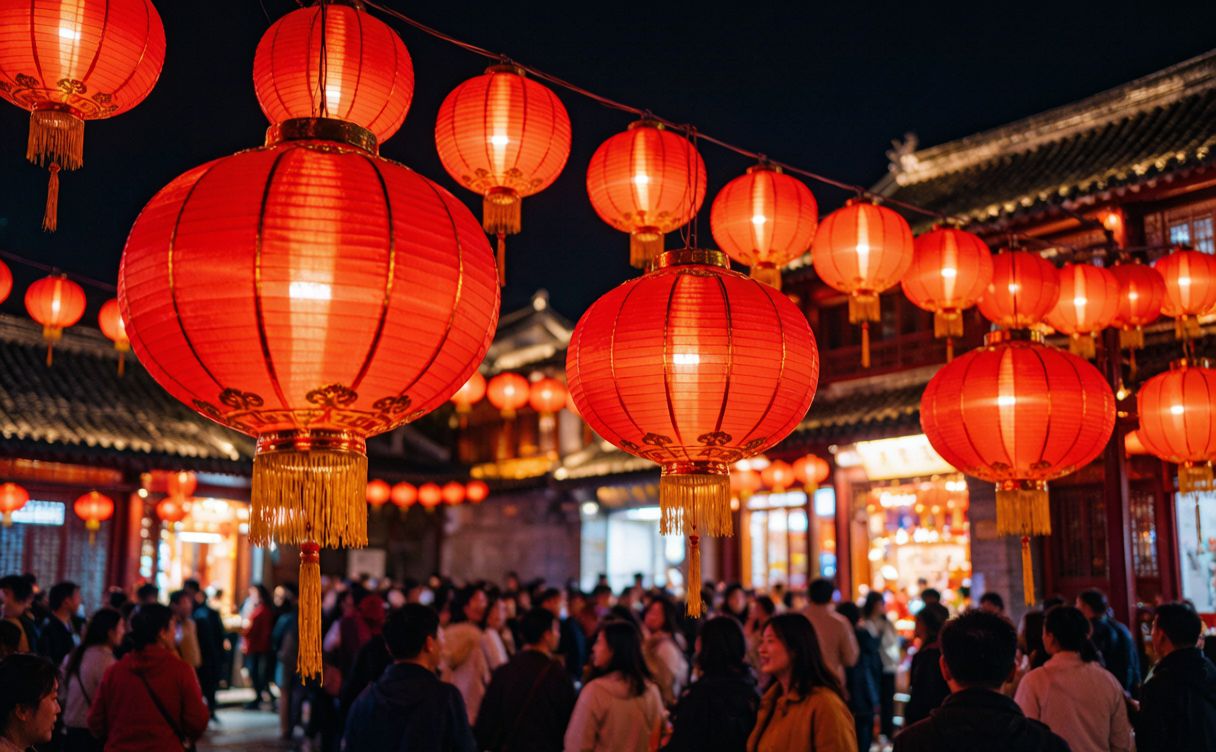
This is the one. Spring Festival, or Chunjie, is the world’s largest annual human migration — roughly three billion trips in a few weeks as people barrel home. In 2026 it falls in mid-February. I once arrived in Beijing on the second day of the new year and the city felt eerily empty: family restaurants closed, offices dark, the usual chaos replaced by firecracker smoke and red lanterns. The trade-off is real. Major tourist sites are quiet, but so is everything else — transport is booked solid in the days surrounding the holiday, and many small shops close for a week or more. If you want to see China at its most traditional and least crowded at the monuments, go early in the festival. If you want a functioning city, avoid the travel days entirely.
Lantern Festival
Falling on the fifteenth day of the first lunar month (about two weeks after Spring Festival), the Lantern Festival is my quiet favorite. Cities hang elaborate lantern displays, and in places like Pingyao or the old towns of Yunnan, the night skies fill with glowing riddles and sweet tangyuan dumplings. Crowds are local and gentle, and prices barely move. This is an easy, low-risk festival to travel around — a perfect bookend to a Spring Festival trip.
Qingming (Tomb-Sweeping Day)
Usually April 4–6. Qingming is when families visit ancestral graves, but for travelers it matters because it is a short public holiday — three days that trigger a mini travel rush to gardens, temples, and nearby nature spots. I have been caught in a Qingming crush at Hangzhou’s West Lake, and it was shoulder-to-shoulder. The festival itself is calm and green; the holiday weekend around it is not. Plan temple and park visits for the weekdays before or after.
Dragon Boat Festival (Duanwu)
Early summer, roughly June. The headline event is the dragon boat races — long, painted boats powered by chanting teams, best seen in the south (Guangzhou, the rivers around Guilin, or Hangzhou). Everyone eats zongzi, sticky rice wrapped in leaves. It is a single-day holiday, so the crowd spike is brief and local. I love timing a southern itinerary to catch a riverside race; it is loud, joyful, and deeply Chinese in a way the postcard sites are not.
Mid-Autumn Festival
September or early October. Families reunite under the full moon and share mooncakes — an acquired taste, frankly, but the atmosphere is lovely. It is a one-day holiday that often bridges into a weekend. Crowds at home, but tourist sites are only mildly affected. The real bonus: the harvest-season weather across much of China is at its best, and the moonrise over a lake or mountain is genuinely unforgettable.
National Day Golden Week
October 1–7. This is the monster. The whole country gets a week off and they all go somewhere. I made the error of visiting the Forbidden City during Golden Week once — never again. Ticket sites sell out in minutes, high-speed trains are gone within hours of release, and hotel prices in popular cities can double or triple. If your dates are flexible, skip the first week of October. If they are not, head to a less-famous corner and book every ticket and train seat the instant they open.
Minority Festivals — Yunnan, Tibet, and Beyond
The Han holidays get the headlines, but some of my most memorable days in China happened at minority festivals in the southwest and on the plateau. These are not national days off, so crowds stay regional and prices stay sane — but the experiences are world-class.
Yunnan’s Calendar of Color
Yunnan is China’s most ethnically layered province, and its festival rhythm is relentless. The Yi people’s Torch Festival, usually in July or August, turns places like Lijiang and the countryside around the Yunnan Stone Forest into nights of fire, dancing, and roasted food — I have stood in a field outside Shilin watching a hundred torches light up the karst towers, and it rewired what I thought a “tourist experience” could be. Around Dali and Shangri-La, Yunnan, the Bai and Tibetan communities hold horse races and prayer festivals tied to the agricultural and religious calendar. These are not staged for visitors; you are welcome, but you are a guest at someone’s celebration.
Tibet, China — A Different Clock
On the plateau the calendar is Buddhist. The Tibetan New Year, Losar, usually lands in February or March, weeks apart from the Han Spring Festival, and it is the most important event of the year — monasteries decked in new thangkas, families in their finest, butter-lamp offerings glowing at dusk. I timed a trip to Lhasa, Tibet, China around Losar and found the city both more alive and more closed to casual tourism; some sites restrict access during the solemn days. The Saga Dawa festival in May or June, marking the Buddha’s birth, enlightenment, and death, draws pilgrims on the kora around the Jokhang and the Potala. If you go, match your pace to theirs — slow, respectful, early.
The practical point: these minority festivals reward the traveler who plans around them, not against them. They rarely appear on the big crowd calendars, yet they can be the highlight of a trip.
Crowd & Price Impact — What It Really Means
Let me be blunt about the two things that wreck trips: the two Golden Weeks (Spring Festival travel days and National Day) and the three-day holidays (Qingming, Dragon Boat, Mid-Autumn). During the Golden Weeks, expect:
- Transport: High-speed train tickets and domestic flights sell out weeks ahead. I book trains the very minute the 15-day window opens via China’s 12306 system, and even then I have missed seats.
- Accommodation: Popular destinations — Zhangjiajie, Jiuzhaigou, Sanya — can double or triple rates. Book early or pivot to second-tier cities.
- Sites: The headline attractions cap daily entries. The Forbidden City, the pandas in Chengdu, the cable cars at Zhangjiajie — all hit limits. Buy tickets online in advance.
The three-day holidays are milder but still noticeable at city parks, temples, and nearby scenic spots. My rule: if it is a holiday weekend, I am either deep in a rural minority region or I am doing indoor, bookable things in a big city.
The Best Months to Visit (and When to Hide)
Strip the festivals away and the climate still dictates a lot. I break the year into zones:
- March–April: Spring, blooming, mild. Good across most of China, with the Qingming weekend as the only blip. My favorite window.
- May: Lovely weather, but Labor Day (May 1–5) is another mini Golden Week — avoid those days.
- June–August: Hot and humid in the south and east; this is when I flee to the plateau — Tibet, China and Qinghai are cool and glorious, and the Yunnan torch festivals fire up.
- September–October: The golden season for weather, ruined only by National Day week. Travel Sept 10–25 or after Oct 8 and you get near-perfect conditions.
- November–February: Cold up north (Harbin’s ice festival is a draw in January), quiet and cheap elsewhere, but watch Spring Festival.
For the big-picture timing, my longer explainer on the best time to visit China lays out the regional weather month by month, and the China public holidays crowd calendar maps exactly which dates to dodge. I keep both bookmarked.
Practical Tips Before You Book
A few things I have learned the hard way. First, lunar dates shift — confirm the exact Gregorian date for any given year before you commit flights. Second, build buffer days around the Golden Weeks; do not plan to travel on the first or last day, when stations are nightmares. Third, if a minority festival is your goal, contact a local guesthouse a month ahead — they know the real dates, which are often announced late. Fourth, carry an internet setup that works; I sort my SIM or eSIM before arrival so I can book tickets and maps on the move.
One more: do not let the crowds scare you off the major festivals entirely. Standing in a Beijing hutong on New Year’s Eve, hearing the crackle of fireworks and smelling the dumplings, is worth the planning gymnastics. The trick is knowing which festival asks you to join and which asks you to get out of the way.
My Takeaway
If you take one thing from this guide, make it this: in China, the calendar is the itinerary. The same city can be a serene, affordable joy in late September and an overcrowded, price-gouged slog in early October. Learn the rhythm of the six national festivals, then reward yourself with the minority celebrations that most guidebooks skip. That combination — avoiding the two Golden Weeks, embracing the regional festivals — is the difference between a good trip and an unforgettable one.
Further Reading and Authority Source
For official holiday dates and the legal framework behind China’s public holidays, I cross-check against the China Public Holiday Schedule published by the State Council. It is the authoritative source for the year’s fixed and adjusted holiday dates, and it is where I confirm everything before I book.