

When I first started traveling in China back in 2018, the thing that stressed me out most wasn’t the language barrier or the Great Wall crowds — it was getting a SIM card in China that actually worked. You land, your home carrier’s roaming is eye-wateringly expensive, and suddenly you need maps, Didi rides, and WeChat just to function. Over six trips I’ve bought tourist SIMs at airports, queued at carrier stores in provincial towns, and tested eSIMs on two phones. This guide is everything I wish someone had handed me on day one: where to buy, how the three big carriers compare, what a tourist data plan really costs, and when an eSIM beats a physical card.
Why You Need a Local SIM (and Not Just Roaming)
If you’re only in China for 36 hours and your hotel has solid Wi-Fi, you can survive on roaming. But for any real trip, a local SIM is the difference between stress and smooth travel. Most Western carriers charge USD 5–12 per day for international roaming, and that rarely includes the fast, unrestricted data you need for China’s app-heavy daily life.
The practical reason is apps. Google Maps barely works, so you’ll rely on Amap or Baidu Maps. You’ll hail rides on Didi, pay with Alipay or WeChat Pay, translate menus with Pleco, and book trains on 12306 — almost all of it needs reliable data. A local SIM gives you that for a fraction of roaming cost. Before you fly, review our packing list for first-timers so your phone, passport, and unlock status are trip-ready.
Where to Buy a SIM Card in China
You have three realistic options, and the best one depends on your arrival airport, your phone, and how much Chinese you speak.
At the Airport (Easiest, Slightly Pricier)
This is what I now recommend to friends landing for the first time. Beijing Capital (PEK), Beijing Daxing (PKX), Shanghai Pudong (PVG), Guangzhou Baiyun (CAN), and Shenzhen all have clearly marked carrier kiosks in the arrivals hall. Staff there deal with foreign passports daily, many speak basic English, and you walk out activated in 10–15 minutes.
The trade-off is price: airport kiosks charge a small premium and sometimes bundle a “tourist pack” you didn’t strictly need. Still, for peace of mind after a long flight, it’s worth it. On my 2018 Pudong arrival I paid about CNY 200 for a 7-day, 5 GB Unicom plan — more than a downtown store, but I was on WhatsApp to my family before the taxi left the lot.
Carrier Flagship Stores — China Mobile, China Unicom, China Telecom
China has three state-owned carriers, and each runs its own branded stores:
- China Mobile (中国移动) — the largest network with the best rural and high-speed-train coverage. Slightly weaker international roaming partnerships, but unbeatable for reach into places like Xinjiang and Tibet.
- China Unicom (中国联通) — my personal favorite for cities. Good 4G/5G speeds, friendly to foreign phones, and the most tourist-friendly English signage in big branches.
- China Telecom (中国电信) — strong in the south and west, solid all-round coverage, and good value on larger data bundles.
The catch: a random neighborhood store may refuse foreigners or lack an English-speaking clerk. Go to a flagship or business hall (营业厅) location in a major city, where real-name registration for visitors is routine. Bring your passport — no exceptions.
Convenience Stores & Kiosks (Buyer Beware)
You’ll see SIMs sold at convenience stores, on Taobao, and from random kiosks. Avoid these for a primary travel SIM. Some are resold secondary numbers that can’t be registered to your passport, so they may get cut off with no recourse. If it’s not activated against your own ID in front of you, skip it.
The Three Carriers Compared
Here’s how they shake out for a typical tourist, based on my testing across Beijing, Shanghai, Chengdu, and Xi’an:
| Carrier | Best for | Typical tourist plan | Coverage notes |
|---|---|---|---|
| China Mobile | Reach into remote areas, trains | CNY 100–150 / 30 days, 10–20 GB | Widest national footprint |
| China Unicom | City speed, English support | CNY 80–130 / 30 days, 10–15 GB | Excellent in tier-1 cities |
| China Telecom | Value + south/west China | CNY 90–120 / 30 days, 15–25 GB | Strong on fiber-backed 5G |
If you’re bouncing between Shanghai, Beijing, and Guilin, Unicom is the sweet spot. If your first-time Beijing travel guide includes a side trip to the mountains or the western provinces, lean Mobile for the safety net.
Tourist Data Plans & What They Cost
Tourist plans are sold per duration rather than on a monthly contract. As of 2026, realistic pricing looks like this:
- 7-day tourist pack: CNY 80–120, ~5–10 GB data, some include minutes.
- 15-day tourist pack: CNY 130–180, ~10–15 GB data.
- 30-day tourist pack: CNY 150–250, ~15–30 GB data.
All three carriers offer these at airport counters and major stores. Data is usually mainland-China only — it won’t work in Hong Kong or Macao, which are separate network regions, so plan a second SIM or roaming if you’re crossing the border. The plans are prepaid, so there’s no bill shock and nothing to cancel; the number simply expires.
One lesson from experience: in Chengdu in 2022 I nearly bought a “cheap” 30-day plan from a kiosk for CNY 60, only to learn it was a recycled number that couldn’t be registered to my passport. I walked to a Unicom business hall, paid CNY 160, and had clean 5G for the full month. Pay the normal price; the discount traps cost more in the end.
eSIM vs Physical SIM — The Honest Truth
This is where a lot of “China eSIM” blog posts mislead people, so let me be precise.
Can You Get an eSIM From Chinese Carriers?
Here’s the accurate part: mainstream Chinese carriers — China Mobile, China Unicom, and China Telecom — are overwhelmingly physical-SIM focused for in-country tourist plans. As of 2026, walking into a store and asking for an eSIM as a short-term foreign visitor is usually a dead end. The eSIM infrastructure exists in China, but it’s mostly used for postpaid domestic customers, IoT devices, and wearables — not for tourists buying a travel plan at the airport. Treat any claim that you can walk out of a Beijing store with a tourist eSIM with skepticism.
Third-Party Travel eSIMs
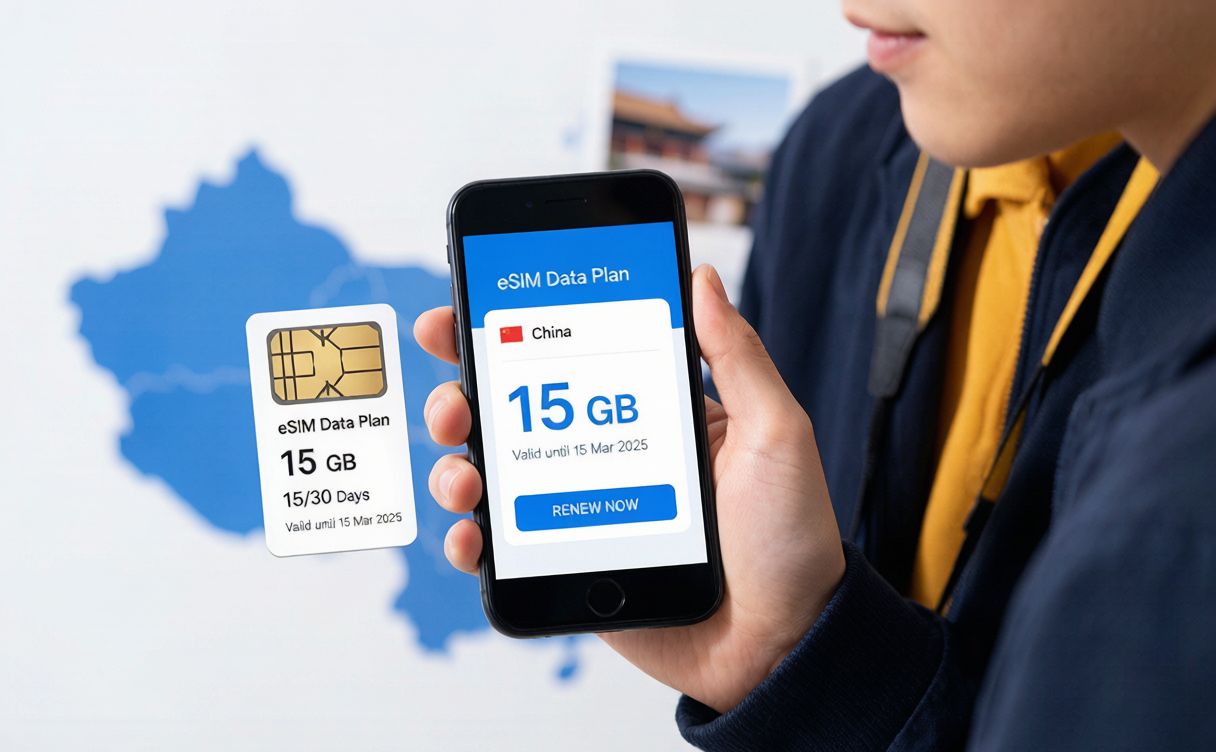
The practical eSIM route is a third-party travel eSIM provider that partners with a local network and sells you a QR-code profile online before you fly. You buy, scan, and activate on arrival — no kiosk, no passport scan at a counter. For travelers with eSIM-capable phones (most iPhone 14+ and recent Androids), this is genuinely convenient. I tested one on a 2024 trip and had data the moment I cleared customs — a small revelation after years of airport lines.
The downsides: travel eSIMs can be pricier per GB than a physical tourist SIM, coverage depends on the partner network, and some cheaper profiles throttle speed or restrict tethering. For a deeper look, our China eSIM and SIM card guide breaks down specific providers and activation steps. To compare the broader market, Airalo’s eSIM marketplace is a useful reference for plans and pricing.
Rule of thumb: pick a physical SIM for the cheapest, fastest, most reliable data if you don’t mind a 15-minute airport stop; choose an eSIM if your phone supports it and you value skipping the counter while keeping your home SIM live for calls.
Registration & Real-Name Rules (Important!)
China enforces real-name registration for all SIM cards. Every SIM — physical or travel eSIM — must be tied to a verified identity. For tourists that means your passport. At a carrier store or airport kiosk, they’ll scan your passport and register the number to you on the spot. This is non-negotiable; no shop that follows the rules will sell you an anonymous SIM.
Two practical notes. First, register the SIM yourself, in person, against your own passport — never accept a “pre-registered” number from a stranger, or you can be locked out and the line suspended. Second, one passport can typically hold a limited number of lines (usually up to five), so you won’t hit a ceiling on a normal trip. Keep the activation receipt; it lists your number and plan, handy if you need support.
APN, Tethering & Getting Online
Good news: on a tourist SIM from a carrier store, data usually “just works” — APN settings are pushed automatically. If you see signal but no internet, ask the clerk to confirm the APN, or check your phone’s network settings. For Unicom it’s often 3gnet, for Mobile cmnet, for Telecom ctnet, but you rarely set this manually.
Tethering (hotspot) is allowed on tourist plans and works fine. Some ultra-cheap resold SIMs block it, another reason to avoid bargain kiosks. Also remember: a local SIM gives you data, not access to every Western site. Google, WhatsApp, and Instagram are restricted behind the Great Firewall, so pair your SIM with a VPN you install before you arrive. Our guide to using the internet in China covers what works, what doesn’t, and how to stay connected.
Money-Saving Tips From Experience
After many trips, these are the habits that actually save money and headaches:
- Buy at the airport on arrival if it’s your first time — the premium is small and the certainty is worth it.
- Match the carrier to your route. City-heavy? Unicom. Heading west or onto trains a lot? Mobile.
- Don’t overbuy data. 10–15 GB covers two weeks of maps, Didi, and messaging. Use hotel Wi-Fi for video streaming.
- Keep your home SIM in a second slot or eSIM for calls and 2FA texts, and run the China SIM for data. Dual-SIM phones are ideal.
- Lock in a VPN before you fly. You can’t download one once you’re inside the firewall.
A Few Final Words Before You Land
Getting connected in China is far easier than the horror stories suggest — the system is built for it, as long as you register properly and buy from a real source. Carry your passport, pick a carrier that fits your route, and decide physical vs eSIM based on your phone. Our China travel safety tips and the latest on visa-free entry policies pair naturally with sorting out your SIM. Land, activate, and you’re one tap away from the whole country.
IMPORTANT: Buy your SIM or eSIM against your own passport at an official carrier counter or a reputable travel provider — never accept a pre-registered number from a stranger, or it can be suspended and you’ll lose access mid-trip.