

My first dim sum memory is a noisy Sunday morning in Guangzhou, squished onto a plastic chair while a cart lady rattled past shouting the names of steaming baskets. I had no idea what I was pointing at. Twenty minutes later I’d eaten shrimp dumplings so delicate they nearly dissolved, and a pork bun so fluffy it felt like a cloud. If you’ve ever wanted a real Cantonese food guide dim sum experience but felt lost at the table, this is the article for you. I’ve spent years eating my way across southern China, and below I’ll walk you through exactly what to order, how to order it, and where to begin — whether you’re staring at a trolley or a QR code.
What Cantonese Cuisine Is
Cantonese cooking comes from Guangdong province in southern China, and it’s the style most foreigners already recognize as “Chinese food” from their local takeout. But the real thing is lighter and fresher than the sweet-and-sour version abroad. The guiding idea is respect for the ingredient: quick stir-fries, gentle steaming, and broths that taste of the thing they came from rather than a wall of sauce.
Seasoning stays in the background. You’ll taste ginger, scallion, a little oyster sauce, and that’s often it. What shines through is the shrimp, the greens, the roast meat. For travelers this is good news — Cantonese food is approachable, rarely numbingly spicy, and almost always built to share. It’s also one of eight major regional traditions in China, and if you want the fuller picture, our Chinese food guide to the eight regional cuisines breaks down how Guangdong’s kitchen differs from Sichuan, Hunan, and the rest.
Dim Sum 101: The Dishes to Know
Here’s the part everyone asks about. “Dim sum” translates roughly to “touch the heart,” and it refers to the small plates — dumplings, buns, rolls, and sweets — served with tea, usually mid-morning. The phrase you’ll hear is yum cha, or “drink tea.” Think of it as brunch with a thousand small options. This part of our Cantonese food guide dim sum tour is the easiest to love.
Start with the classics below and you’ll never look lost again.
Har Gow and Siu Mai
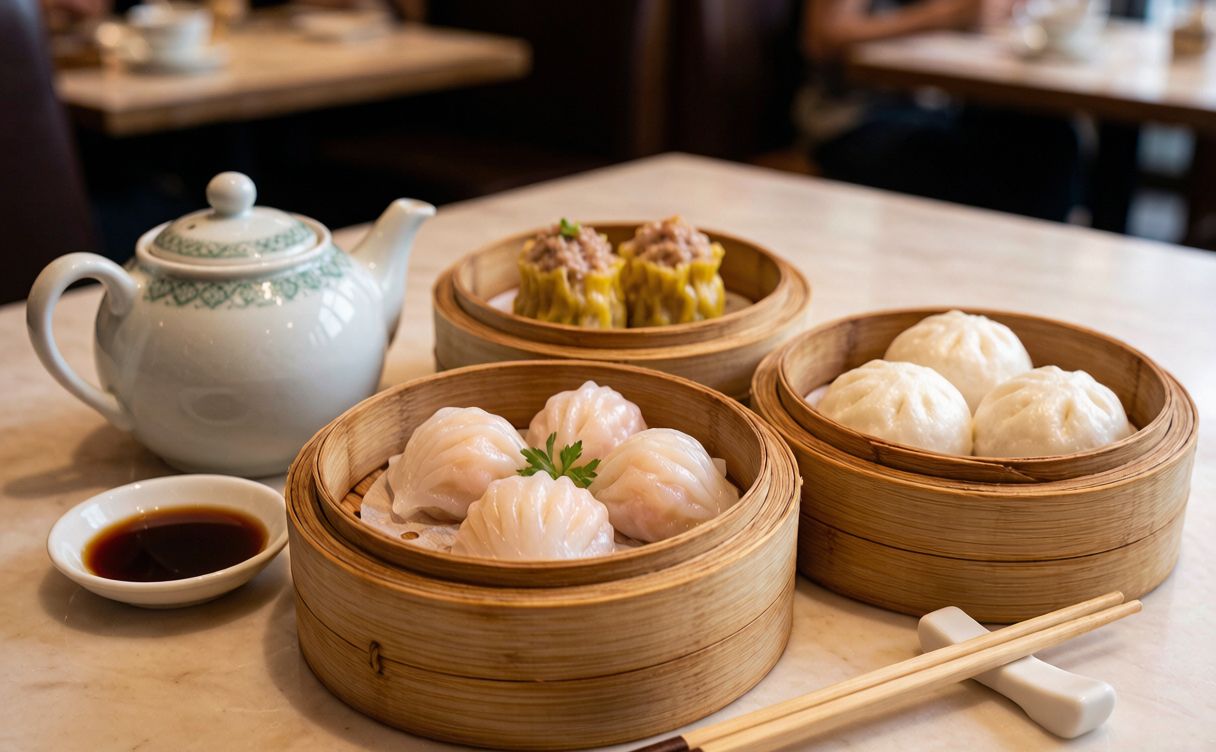
These two are the gatekeepers. Har gow are shrimp dumplings wrapped in a thin, faintly translucent pleated skin — a good kitchen shows off its skill here, because the wrapper should be tender but never fall apart. Siu mai are the open-topped baskets of pork and shrimp, often crowned with a dot of crab roe or a pea. Order one basket each as a warm-up; they’re the benchmark every dim sum lover judges a restaurant by.
Char Siu Bao and Cheung Fun
Char siu bao are barbecue pork buns, and the steamed version gives you a soft white pillow hiding sweet, sticky roast pork. Some places also offer them baked with a glossy golden top — try both if you can. Cheung fun (rice noodle rolls) are silky ribbons of fresh rice starch, usually filled with shrimp, beef, or char siu, then doused in a sweet soy sauce. They slide down faster than you’d expect, so pace yourself.
Egg Tarts and Beyond
Save room, because the sweet stuff is half the fun. Egg tarts (dan tat) have a flaky shell and a wobbling custard center, with a faint Portuguese echo from Macau’s history. Beyond those, look for lo mai gai (sticky rice with chicken steamed in a lotus leaf), lo bak go (fried turnip cake), and jin deui (crunchy sesame balls with red bean paste). None of these require bravery — they’re the friendly end of the menu.
How to Order: Push Carts vs Order Sheets
The ritual trips up a lot of first-timers, so here’s the honest version. The old-school way is the push cart: ladies wheel stacked baskets through the room, you point at what you want, and they stamp a card on your table. When you’re done, you hand over the card and pay. It’s chaotic, loud, and wonderful — but it’s getting rarer.
Most modern spots, especially in big cities, now use a paper order sheet or a QR code on the table. You tick boxes or tap a menu on your phone, and the kitchen sends dishes as they’re ready. Either system works for a visitor; the only real risk is over-ordering because everything looks good. Go light on the first round, see what lands, then add. Tea is usually included or a few yuan — just lift the lid of the pot and leave it tilted if you want a refill.
Must-Try Beyond Dim Sum
Dim sum is a morning thing, but Cantonese cooking doesn’t stop at brunch. At dinner, the stars are the roasts: roast goose with crackling skin, char siu (honey-glazed pork), and siu yuk (crispy pork belly). White cut chicken sounds plain but depends entirely on a perfect bird and ginger-scallion dip. For comfort, order claypot rice — meat and vegetables scorched onto the bottom of a hot pot — or a bowl of wonton noodles in a clean shrimp broth.
One note: the “sweet and sour pork” you know from home is a Western remix. The Cantonese original uses a lighter vinegar tang and is worth trying once, just to compare.
Another dish worth seeking out is braised tofu in a clay pot with mushrooms, or gai lan (Chinese broccoli) blanched and dressed with oyster sauce — even the plainest vegetables taste clean and bright here. If you’re feeling adventurous, Guangzhou’s late-night stalls serve lui sui (gently braised pig parts) that locals swear by, though I’d start with the tofu. The through-line is balance: a rich roast beside a plain green, a sweet tart after something savory.
Where to Eat: Guangzhou vs Hong Kong
If you can only pick one city, know what each offers. Guangzhou is the birthplace and still the most down-to-earth. Prices are lower, portions generous, and you can still find genuine push-cart houses in the older districts. It’s where I send friends who want the unfiltered version. Our Guangzhou travel guide maps the neighborhoods worth basing yourself in for food.
Hong Kong, by contrast, has turned dim sum into something closer to fine dining, with timed seatings at famous restaurants and pristine har gow that cost more but dazzle. The yum cha habit is woven into daily life there, and the Hong Kong Tourism Board keeps a solid list of recommended teahouses if you want names before you fly. Either city works; the Victoria Harbour guide to Hong Kong is a good companion for planning the rest of your stay.
Etiquette and Tips
Nobody expects a foreigner to be perfect at the table, but a few habits go a long way. When someone pours you tea, tap two fingers lightly on the table — it’s a quiet thank-you with roots in a folk tale. Don’t stand your chopsticks upright in a bowl of rice; that mimics incense at funerals and reads as bad luck. Do tear shared plates into smaller portions for the table rather than eating from a big dish alone.
A few practical things: go early, ideally before 11 a.m., because the best baskets sell out and the waits grow. Noise is normal — dim sum rooms are loud by design. Most places are cash-friendly but increasingly app-based, so carry some notes just in case. And if you don’t know a dish’s name, point at a neighbor’s table or a photo on the wall; servers are used to it and rarely judge.
One more thing about timing: in Hong Kong, celebrated dim sum houses often open at dawn, and the early crowd is half retirees reading newspapers over pots of pu’er tea. Joining them is part of the charm — you’ll get the freshest baskets and the calmest room before the 1 p.m. rush hits.
Vegetarian and Allergy Notes
This is where dim sum gets tricky, because pork and shrimp show up everywhere. Even “vegetable” spring rolls may share a fryer with meat, and the wrappers on har gow and siu mai contain gluten. If you’re vegetarian, safer bets include steamed vegetable buns, plain congee (rice porridge, ask for no meat topping), tofu dishes, and some sweet buns — but always confirm, because char siu flavor sneaks into fillings you’d never expect.
For shellfish or gluten allergies, tell the staff clearly and point to the menu item. Many kitchens will steer you to rice rolls or egg tarts (egg, not shellfish, but check the filling) and away from the risky stuff. Worst case, a plate of greens with garlic and a bowl of plain noodles will keep you fed and happy while your friends explore the weirder baskets.
The Bottom Line
Every reader of a Cantonese food guide dim sum worries about that first order, but the truth is simpler than it looks. Dim sum is really just small plates, hot tea, and a willingness to point at whatever smells good. Learn six dishes, pick a city, and let the carts (or the QR code) do the rest. The worst outcome is a basket you didn’t love — and even that one teaches you what to skip next time.
Written by Karl — last updated July 2026. Karl has spent three years helping foreign visitors plan low-stress trips across China.