

By Karl Huang – field notes from Changsha. Last verified November 2026.
Quick answer: Changsha stinky tofu (chou doufu) is firm soybean tofu soaked in a dark fermented brine, then deep-fried until the outside blisters into a black, crackling shell while the inside stays pale, soft and steaming. The vendor pokes a hole in each piece and floods it with chili, garlic and soy dressing. It smells like a barnyard and tastes like a rich, salty, savory crouton with a custardy center. In Changsha a typical portion of about six pieces runs 6-18 RMB depending on the stall (12-25 RMB at branded chains); confirm on site. Start with less chili than you think you want, eat it standing up while it is still hot, and do not assume it is vegan.
- What to expect: jet-black outside, white inside, shatteringly crisp, spicy-salty dressing, eaten hot.
- Where it comes from: Changsha, Hunan; the black color comes from a fermented vegetable and black-bean brine, not from spoilage.
- Price and payment: roughly 6-18 RMB a portion at stalls, more at chains; WeChat Pay and Alipay dominate, foreign cards often fail – confirm on site.
- Dietary flags: always soy; usually sesame; sometimes shrimp or fish in the brine and liquor in the soak. Vegetarians and anyone avoiding alcohol should ask before ordering.
- The one mistake to avoid: biting a whole cube on the first try. The trapped dressing is scalding.
Your nose will lie to you: what this actually tastes like
I have watched first-timers do the same thing on Huangxing Road: they get within two metres, wrinkle their noses and walk away. The smell is real. Changsha’s version is the most aggressive of the family – sharp, sulfuric, faintly like old cheese in a warm room. But the aroma sits mostly in the raw brine and oil, and much of it cooks off. What reaches your mouth is far milder than what reached your nose.
The first bite is textural before it is flavored. The shell is thin, dark and glassy, with blisters that crackle under your teeth. Then the interior: pale, steaming, almost custard-soft, soaked with dressing. Temperature matters more than most guides admit. A cube eaten two minutes from the oil is a different food from one left fifteen minutes in a paper tray – the shell goes leathery, the filling dense. Locals eat fast, standing at the counter, for exactly this reason.
Expect salt, fermented depth, garlic and chili heat up front, with faint sweetness from pickled radish. If strong blue cheese makes sense to you, you are close.
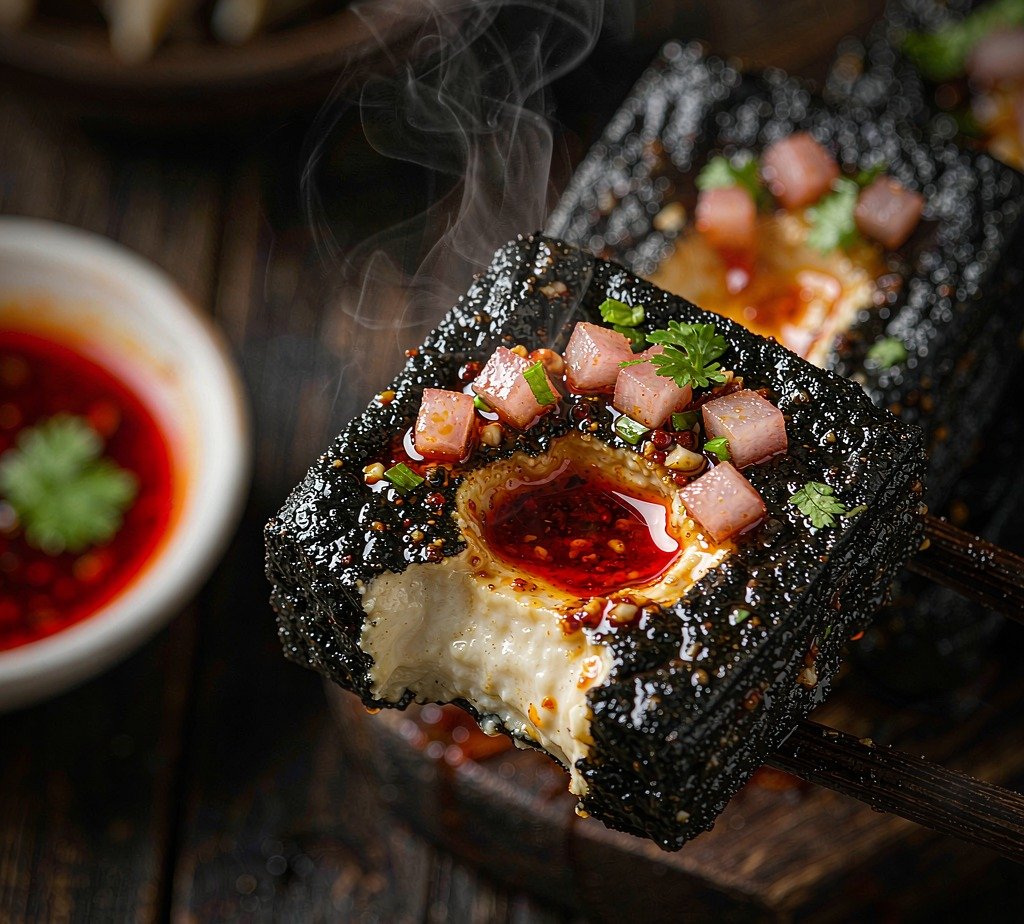
Why it is black outside and white inside – and why that is not rot
The answer is chemistry, not magic. Firm tofu is soaked in a brine matured from Liuyang black fermented beans (douchi), winter bamboo shoots, dried shiitake and mustard greens, with salt, soda ash and a little liquor. Some traditional accounts mention food-grade ferrous sulfate, or qing fan, which reacts with vegetable tannins to fix the black color. Additive rules tightened around ferrous sulfate in soy products after 2011, so practices vary; confirm on site.
During the soak, microbes break down soy proteins – proteolysis, the same reaction family behind aged cheese. Analyses of Changsha brine identify phenols, indoles and organic acids; indole and hydrogen sulfide account for the smell. The inside stays pale because color compounds sit mostly at the surface and set during frying. Frying at roughly 180-200 C for about five minutes drives off the most volatile aromatics while crisping the skin.
So: fermentation, not spoilage. Spoilage is uncontrolled growth of harmful bacteria; this brine is a managed culture. That said, use your eyes. A stall with tray after tray of pale, slime-coated cubes, or an odor that is harsh rather than deep and funky, is one to skip. Part of eating street food in China safely is reading the stall, not just the menu. I have put a fuller framework in how to eat street food in China safely.
Black Changsha, golden Nanjing, Taiwanese: a side-by-side comparison
People say “stinky tofu” as though it were one dish. It is a family, and the regional styles differ enough that I would not call them substitutes.
| Style | Appearance and texture | Usual dressing | Spice level | Best for |
|---|---|---|---|---|
| Changsha (Hunan) | Jet-black crisp shell, pale custardy center, roughly 5 cm square and 1 cm thick | Chili oil, garlic water, soy, sesame oil, pickled radish, scallion, cilantro poured into a poked hole | Medium to hot by default | First-timers who want the iconic black version |
| Nanjing (Jiangsu) | Golden-brown, often double-fried, lighter and shatteringly crisp | Sweet bean sauce, chili sauce, sesame seeds | Mild | People who find the black version intimidating |
| Taiwanese night-market style | Golden fried cubes, thin shell, molten interior; also steamed or braised | Pickled cabbage, garlic sauce, thick soy paste; sometimes squid or meat sauce | Mild to medium | Anyone who wants a gentler entry point |
| Shaoxing (Zhejiang) | Paler brined tofu, golden after frying, softer | Light soy, chili, sometimes braised in broth | Mild | Travelers continuing east through Zhejiang |
For the broader regional context, the Hunan cuisine guide explains where this sits among the province’s chili-forward dishes, and my Changsha food guide covers the other things worth queueing for in the same neighborhoods.
The stall run: prices, payment and the exact ordering sequence
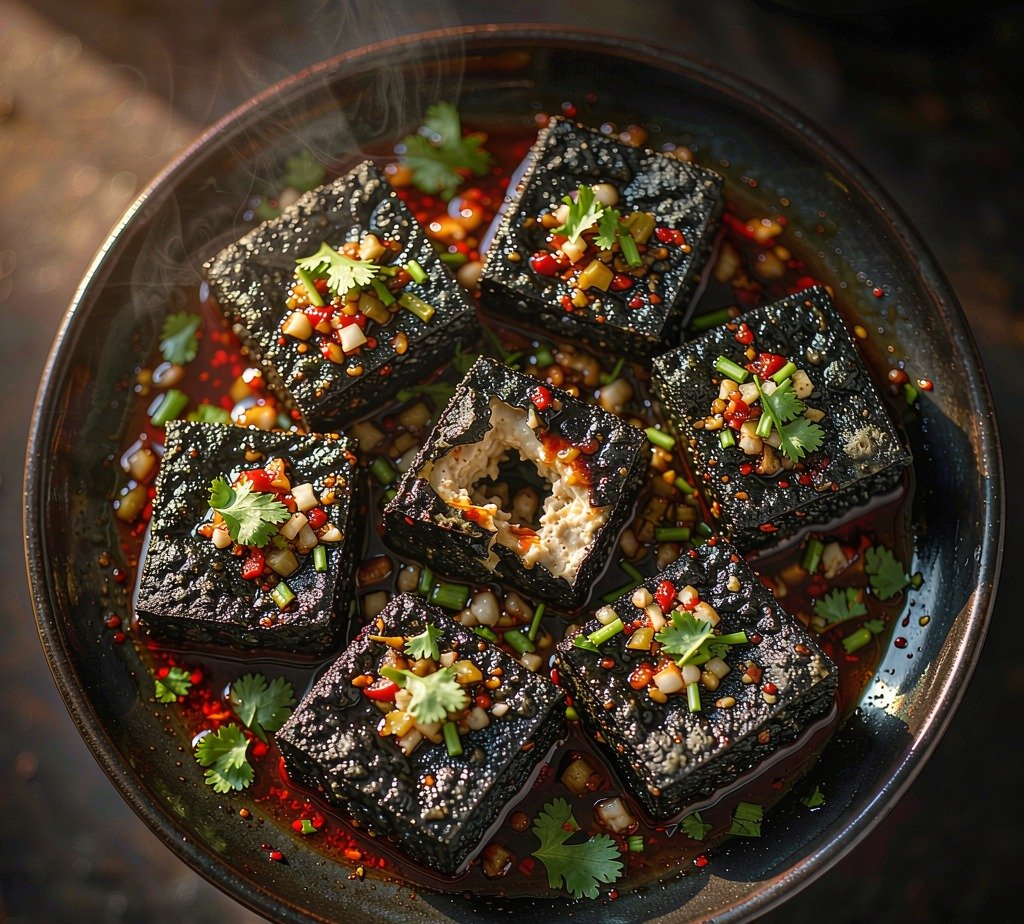
Here is the sequence at a typical Changsha stall. Walk up, point at the black cubes in the tray, hold up fingers for how many portions. The vendor lifts them into the oil with long chopsticks, fries them, pokes a hole in the top of each and ladles in red dressing. Pickled radish, scallion and cilantro go on last. The exchange takes three to five minutes when the queue is short.
Price: a portion of roughly six pieces is typically 6-10 RMB at a neighborhood Changsha stall and 10-18 RMB at night markets or tourist-facing stands; branded shops charge 12-25 RMB. Prices drift by district and year, so treat these as typical bands and confirm on site. Public reporting suggested the city was selling well over two million pieces a day back in 2014 – a measure of how ordinary this snack is locally.
Payment: WeChat Pay and Alipay are the norm. Many stalls take cash; international card acceptance is rare. Sort your wallet before you queue. Ask “ke yi shua ka ma” to check card acceptance.
Queue and timing: the line builds after dusk, peaking 19:00-22:00 and worse on weekends. A quiet stall at 16:30 can have a twenty-person wait by 20:00. For the crispest shell and shortest queue, go early or on a weekday.
What is in the box: portions, toppings and the allergen ledger
One portion is usually five to eight pieces, each about 5 cm square and 1 cm thick – a snack for one, or a shared tasting portion if you are also eating crayfish and rice noodles. The toppings are not decoration: pickled radish brings acid to cut the oil, cilantro freshness, and garlic water much of the savory work.
Now the ledger, because this matters more than most travel write-ups admit:
- Soy: guaranteed, it is tofu.
- Sesame: sesame oil is standard in the dressing; confirmed at most stalls.
- Crustaceans or fish: some brine traditions include dried shrimp or fish to deepen umami. A black cube is therefore not automatically vegetarian or vegan. Ask before you order if this affects you.
- Alcohol: cooking liquor may be used in the brine. If you avoid alcohol entirely, ask; the vendor may not think to mention it.
- Dairy and meat: the tofu itself contains neither, but toppings and shared oil are a cross-contact risk at busy stalls. Confirm on site.
- Gluten: the soy-and-vegetable base is gluten-free, but bottled sauces vary. Ask if you are strict.
- Spice adjustment: ask for “shao la” (less chili) or “bu la” (no chili). The chili is in the poured dressing, so it is genuinely adjustable at most stalls – unlike a stew that has been cooking for hours. The pickled radish and garlic stay.
- Calories: it is deep-fried and soaked in oil-and-chili dressing; a portion is a indulgent snack rather than a diet food. One portion shared is a sensible approach.
Sitting, standing or walking: the physical setup at a stall
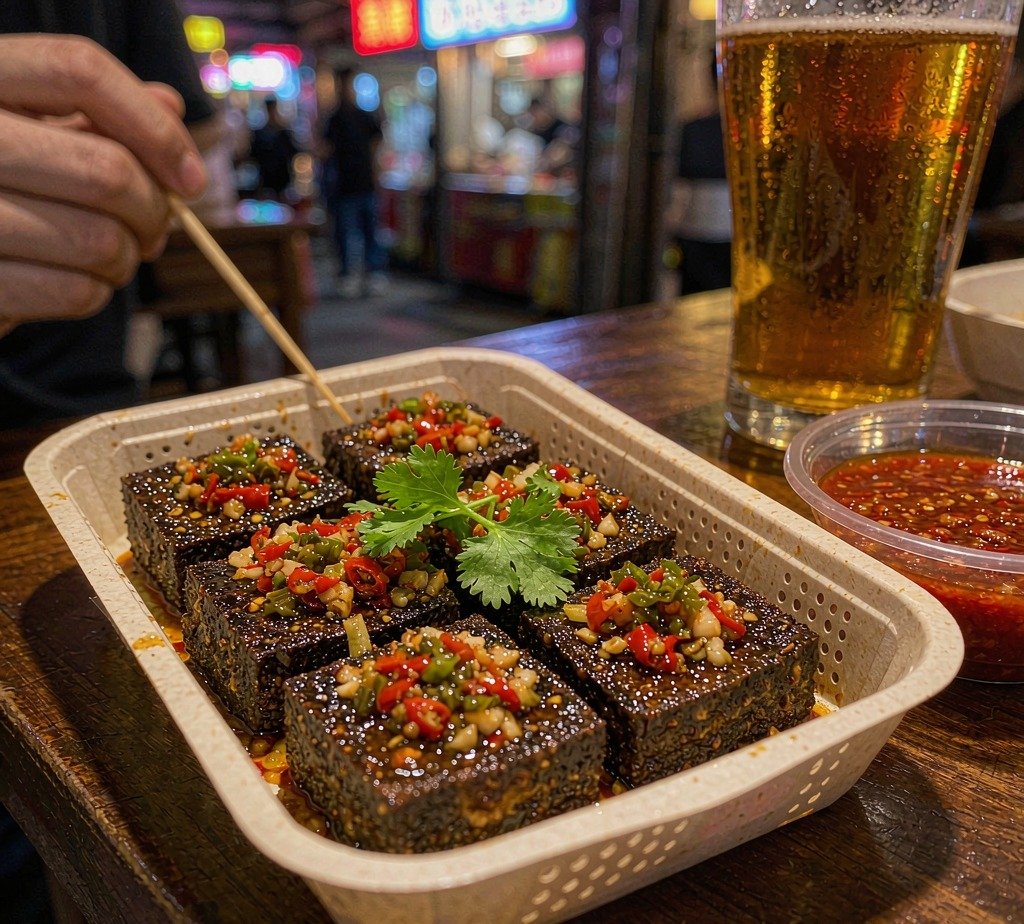
This is the stuff guides leave out. At most night-market stalls there is no seating: you eat standing at the counter or walk off with a paper tray and skewer. Some stalls have plastic stools; Huogongdian, the Fire Palace food complex in central Changsha, has tables and a sit-down section. Everything is open-air with no air conditioning, and summer fryer heat plus body heat is uncomfortable. Go in loose clothes.
Smoking is common in night markets; if it bothers you, Huogongdian’s sit-down hall is a better bet. Restrooms are usually public market facilities: often squat-style, sometimes free, sometimes a yuan or two, and toilet paper is not guaranteed – carry a tissue pack. Wet wipes and napkins generally come with the tray, but a busy stall may skip them; ask for “zhi jin.” Chopsticks come with the order; takeout is the default.
Getting there: Huangxing Road and Taiping Street sit near Wuyi Square and Huangxing Square metro stations, so you can step off the train into the snack cluster within minutes. Yangfan Night Market is served by Line 3 at Wanjiali Square and has a denser concentration of stalls. Street parking is scarce; the metro is the sane choice. Exit numbers change, so confirm on site.
How to make it at home – the honest version
Be upfront: a home kitchen cannot easily reproduce the black shell, which comes from a long-matured commercial brine. You can make very good fried fermented tofu with the same dressing logic. For the black version, use vacuum-packed black stinky tofu from a Chinese grocer. The recipe below assumes plain firm tofu and a short soak.
Ingredients for two
- 300 g firm or extra-firm tofu, cut into 5 cm cubes and patted dry
- 2 tbsp fermented black beans (douchi), rinsed and roughly chopped
- 1 dried shiitake mushroom and a small handful of dried bamboo shoots, soaked and chopped
- 1 cup water, 1 tsp salt, 1/2 tsp soda ash (optional; skip if unavailable)
- 500 ml neutral oil for frying
- 2 tbsp chili oil, 1 tbsp light soy sauce, 1 tsp sesame oil, 2 garlic cloves minced with 1 tbsp water
- 2 tbsp finely diced pickled radish, scallion and cilantro to finish
Steps
- Step 1 – build the soak. Simmer the douchi, shiitake and bamboo shoots in the cup of water for ten minutes, add the salt and soda ash, cool to room temperature, then strain.
- Step 2 – soak. Submerge the tofu cubes in the cooled liquid for at least four hours and up to overnight in the fridge. Longer means deeper flavor and smell, not necessarily better.
- Step 3 – dry. Lift the cubes out and pat them very dry on paper towels. Wet tofu splatters and never crisps.
- Step 4 – heat the oil. Bring the oil to 180-200 C. A chopstick dipped in should bubble immediately.
- Step 5 – fry. Fry four or five cubes at a time for about five minutes, turning once, until the exterior is blistered and firm. Do not crowd the pot.
- Step 6 – drain. Lift onto a rack, not a flat plate, so the bottoms stay crisp. Salt lightly while hot.
- Step 7 – fill. Mix chili oil, soy, sesame oil and garlic water. Poke a hole in each cube with a chopstick and spoon the dressing in.
- Step 8 – finish and eat immediately. Scatter pickled radish, scallion and cilantro over the top. Serve within minutes with cold tea or beer.
When to go, and how locals actually eat it
Best window: 17:30-19:00 on a weekday, before the after-work crowd. For photographs without elbows in frame, go earlier – some stalls open late afternoon. Avoid cold winter days if you dislike standing outside; warm weather is better, though the smell is stronger.
The classic mistake is treating this as a dare and ordering the hottest version. The second is judging it by smell from twenty feet away. The third is biting a whole cube at once: the trapped dressing is scalding and will squirt. Locals blow on the cube, take one or two bites, hold the tray under their chin and share while walking. They pair it with cold beer or milk tea, then something sweet – sugar-oil baba is standard. For a wider crawl, a guided Changsha food tour handles the ordering and queueing.
Where to stay, and how to fit this into a trip
The best stalls cluster around Wuyi Square, Huangxing Road and Taiping Street, so base yourself within walking distance and walk back after dinner rather than crossing the city full. I compared the options in where to stay in Changsha near the food streets – the decision I would make first. If your trip is really about Zhangjiajie, slot the night market into your first or last evening rather than between trains.
Frequently asked questions
What does Changsha stinky tofu taste like compared with the smell?
Far milder than it smells. The aroma comes from volatile compounds in the brine and frying oil; much of it evaporates in the fryer. The taste is salty, deeply savory, garlicky and chili-hot, with a soft, almost custardy interior inside a crisp black shell.
Is stinky tofu safe to eat, and is it actually rotten?
It is fermented, not rotted: a controlled microbial process rather than uncontrolled spoilage. Choose a busy stall with clean oil and cubes that smell deep and funky rather than harsh and putrid. If the oil looks dark and neglected, walk away.
Is stinky tofu vegetarian or vegan?
Not guaranteed. The tofu is plant-based, but some brines include dried shrimp or fish, the dressing contains sesame oil, and shared oil can introduce meat contact. Tell the vendor your restriction and confirm on site.
How much does stinky tofu cost in China, and can I pay by card?
A typical portion of five to eight pieces is about 6-18 RMB at Changsha stalls and 12-25 RMB at branded shops. WeChat Pay and Alipay are the normal payment methods; some stalls take cash, but international cards are rarely accepted. Check before queueing.
How do I order stinky tofu in Changsha, and can I make it less spicy?
Point at the tray, indicate how many portions, pay, and wait while the vendor fries, pokes and fills the cubes. Say “shao la” for less chili or “bu la” for none. The heat is in the poured dressing, so the adjustment is easy at most stalls.
Can I make stinky tofu at home, and how long does it take?
Yes, with a caveat: the signature black shell needs a matured commercial brine. A home version using firm tofu, a short douchi-and-vegetable soak and the standard chili-garlic dressing takes about four hours of soaking plus twenty minutes of cooking. Vacuum-packed black stinky tofu from a Chinese grocer is the reliable shortcut.
The vendor will hand you the tray without ceremony, probably without looking up, and the first bite will do the arguing. That is the charm of it: a snack that has converted generations of skeptics on street corners, one crackling black cube at a time. Order one portion, share it, and give yourself a second bite before you decide.