

Rising from the southern edge of Guilin’s historic core, Elephant Trunk Hill (Xiangbishan) is the single most recognizable silhouette in all of Guangxi. Shaped over millions of years by the slow erosion of limestone, the hill looks exactly like a giant elephant bending down to drink from the Li River, its trunk dipping into the water to form a perfectly round arch known as the Water Moon Cave. For first-time visitors to Guilin, this is the postcard image that defines the city, and for returning travelers it remains the touchstone of the region’s famous karst scenery. If you take only one photograph in Guilin, this is the shot you want.
The story of Elephant Trunk Hill begins deep in geological time. Around 300 million years ago, the area that is now Guilin lay beneath a warm, shallow sea. Layer upon layer of marine organisms and mineral sediment compressed into the limestone that underlies the entire region. When the sea retreated and the land rose, groundwater and seasonal rains began their patient sculpture. Limestone is soft enough to dissolve where it meets slightly acidic water, yet strong enough to hold dramatic shapes once carved. The result across Guangxi is a landscape of solitary peaks, hidden caves, and rounded hills that have inspired Chinese painters and poets for more than a thousand years. Elephant Trunk Hill is the most beloved example, a natural arch so symmetrical it seems almost designed.

Today, the site is managed as a compact urban park, which makes it unusually easy to combine with the rest of a Guilin city walk itinerary. The entrance sits just a few minutes by car or a pleasant riverside stroll from the city center, and the grounds include not only the hill itself but also the Ming-dynasty Puxian Pagoda perched near the summit, the Moon-Viewing Pavilion, and the soft sandy cove where the “trunk” meets the water. Because the attraction is small, most travelers spend between one and two hours here, leaving plenty of time to explore nearby landmarks the same day.
Planning your visit begins with the practical details. The current Elephant Trunk Hill Guilin ticket price is modest compared with larger scenic areas, and tickets can usually be purchased at the gate or reserved online through major Chinese travel platforms. Opening hours run from early morning to early evening, with the last entry typically an hour before closing. Arriving shortly after the gates open has two advantages: the light is soft for photography, and the narrow paths around the Water Moon Cave are far less crowded. Children, students, and seniors often qualify for reduced admission, so it is worth carrying identification. During major Chinese holidays the park can reach capacity, and timed entry may be enforced, so building flexibility into your schedule is wise.
For photography lovers, finding the best photo spot for Elephant Trunk Hill is part of the fun. The most celebrated angle is from the south bank of the Li River, looking north across the water so that the elephant’s trunk and body frame the reflection perfectly. At sunrise the eastern light gilds the limestone; at sunset the hills behind turn violet and the river goes mirror-still. On clear nights the full moon appears to nestle inside the natural arch — the “Water Moon” that gave the cave its name. A growing number of visitors also shoot from the pedestrian bridge just upstream, which compresses the composition and adds the city skyline as a backdrop. Tripods are permitted outside peak hours, and a polarizing filter helps cut glare on the water.
What makes Elephant Trunk Hill special is how it connects to the wider Li River experience. One of the most rewarding ways to see the landmark is from the water itself. The classic Elephant Trunk Hill to Li River cruise connection works in two directions: you can board a short downtown sightseeing boat that loops past the hill and returns, or you can begin a longer downstream journey toward Yangshuo and watch the elephant shrink into the distance as the metropolis gives way to open countryside. Either option turns a static landmark into a moving tableau, and the cruise piers are only a short walk from the park entrance. For travelers with limited time, the short loop cruise delivers the iconic view with minimal logistics.
Ready to stand beneath the elephant’s trunk yourself? Plan your perfect Guangxi escape with our Guangxi 7-day itinerary and let us help you weave Elephant Trunk Hill into a seamless route.
Once you have explored the hill, the surrounding district rewards further wandering. Among the things to do near Elephant Trunk Hill, the most popular is a relaxed riverside walk toward the illuminated Guilin Sun and Moon Pagodas, two striking towers set on and beside a lake that glow after dark. Families often pair the morning at Elephant Trunk Hill with an afternoon at Seven Star Park, where camels-shaped rocks and a small zoo keep younger travelers entertained. Food stalls near the park entrance serve Guilin rice noodles, a local breakfast staple, and the nearby pedestrian streets are good for picking up osmanthus tea and carved stone souvenirs. Because everything sits within the city, you can move between sights by foot, rented bike, or a short taxi ride rather than committing to a full-day tour.
A well-paced Guilin city walk itinerary might start at Elephant Trunk Hill at opening, continue along the Li River embankment to the Sun and Moon Pagodas, pause for noodles and coffee in the old town, then finish at a viewpoint such as Folded Brocade Hill for a panorama of the peaks. This loop covers the essence of Guilin without the fatigue of long transfers, and it leaves the following day free for the countryside around Yangshuo. If you prefer to base yourself closer to the dramatic rural scenery, our Yangshuo travel guide explains how to split your stay between the city and the riverside county, and our best hotels in Yangshuo roundup highlights riverside lodgings with balcony views of the karst.
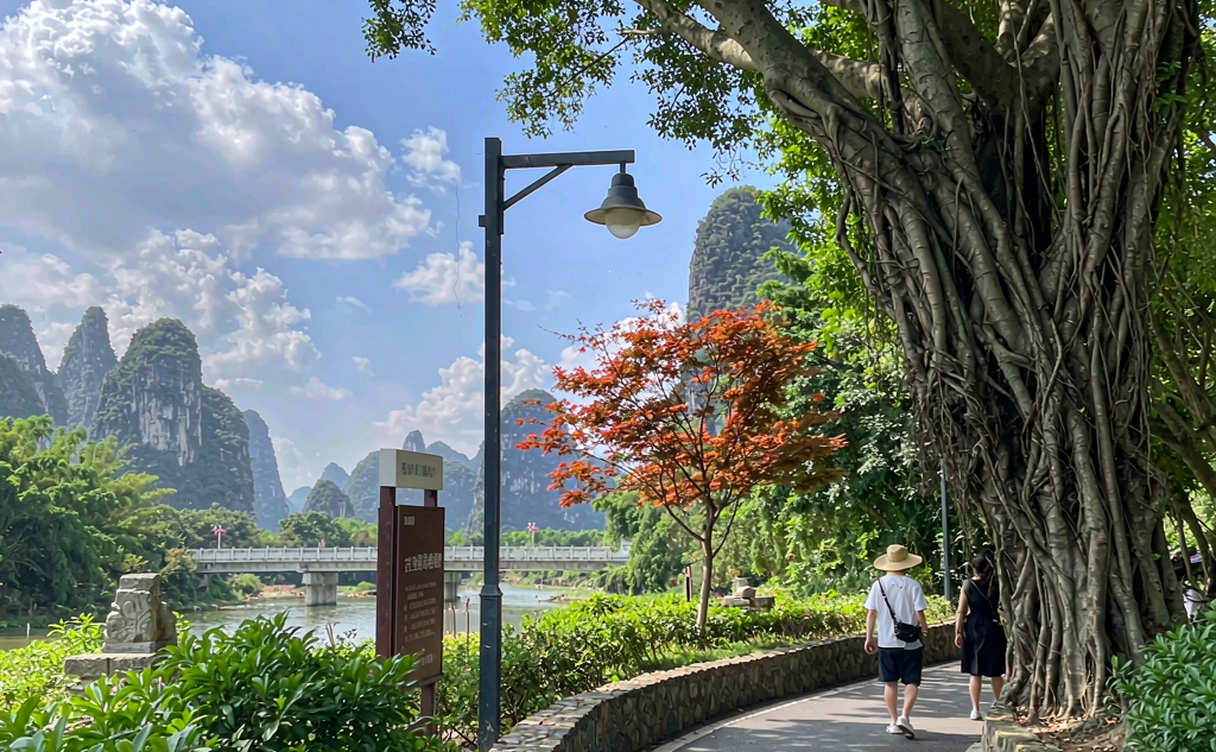
To appreciate why this single hill matters so much, it helps to see it within the broader Guilin karst landmarks guide context. Guilin and the wider Guilin–Yangshuo karst belt are part of a spectacular south China landscape that UNESCO has recognized for its outstanding universal value, and you can read the official scientific description of this terrain on the UNESCO World Heritage karst page. What sets the region apart is not one peak but the density and variety of forms: pinnacles, towers, cones, and arches all appear within a short drive of the city. Elephant Trunk Hill is the most approachable of these, the one you can reach in slippers and a camera phone, yet it teaches the same lesson as the remote peaks — that water and stone, given enough time, create art.
Seasonal timing shapes the experience. Spring brings mist that softens the hills into ink-painting scenes; summer is lush and green but humid, with sudden showers that clear to brilliant light; autumn, especially October, offers the most comfortable temperatures and the clearest skies, which is why it is peak travel season; winter is cool and quiet, ideal for travelers who prefer empty paths and low hotel rates. Regardless of season, mornings after rain tend to produce the best reflections on the Li River, so checking the weather and planning an early start pays off.
Practical tips for a smooth visit: wear comfortable shoes with grip, since the steps near the summit can be damp; bring water and a sun hat in warmer months; keep some small cash or a mobile payment app ready for snacks and boat tickets; and respect the ropes and signage around the cave, where the current can be stronger than it looks. Guilin’s airport and high-speed rail station connect easily to the park by taxi or rideshare, and most downtown hotels can arrange a driver for a half-day karst circuit.
Want the countryside views to match the city icons? Discover where to stay for sunrise over the peaks with our best hotels in Yangshuo and turn your Guilin trip into a complete Guangxi adventure.
Beyond Guilin itself, the karst landscape stretches into minority-rich corners of the province worth a detour. Our Sanjiang Guangxi travel guide covers the Dong wind-and-rain bridges and terraced villages that lie a few hours north, a rewarding contrast to the urban elegance of Elephant Trunk Hill. Combining the city icon with the rural hinterland gives a fuller picture of what makes Guangxi one of China’s most photogenic regions.
Elephant Trunk Hill endures as Guilin’s symbol because it is both effortless to reach and impossible to forget. Whether you arrive by riverside walk at dawn, by sightseeing boat at golden hour, or by evening stroll under lantern light, the elephant drinking from the Li River captures the romance that has drawn travelers here for centuries. Build it into the start of your journey, pair it with the city’s other landmarks, and let the slower rhythms of the river set the tone for everything that follows.
Start planning today — browse our Yangshuo travel guide and Guangxi 7-day itinerary to build the perfect trip around Elephant Trunk Hill and beyond.