

Most travelers to Shanxi head straight for Datong, Pingyao and the Ming walls, and treat Taiyuan as a railway station on the way. That is a shame, because 40 kilometers north-west of the city sits one of the quietest cave sites in the country: the Tianlong Mountain grottoes. Twenty-five caves are cut into a red cliff on a forested ridge, carved across four centuries, the finest of them by Tang dynasty sculptors. This Tianlong Mountain grottoes guide covers the lay of the caves, the long and the short way up, the ticket and shuttle basics, and how the site compares with Yungang Grottoes further north.
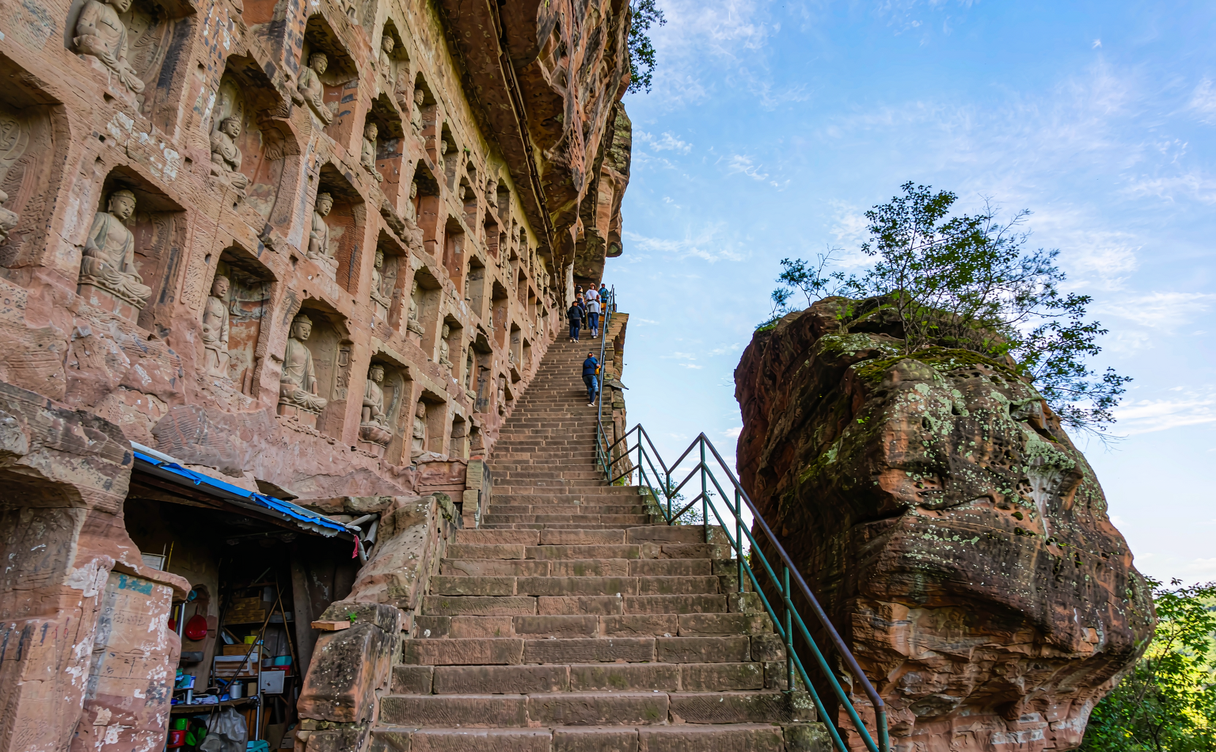
Four centuries carved into one ridge
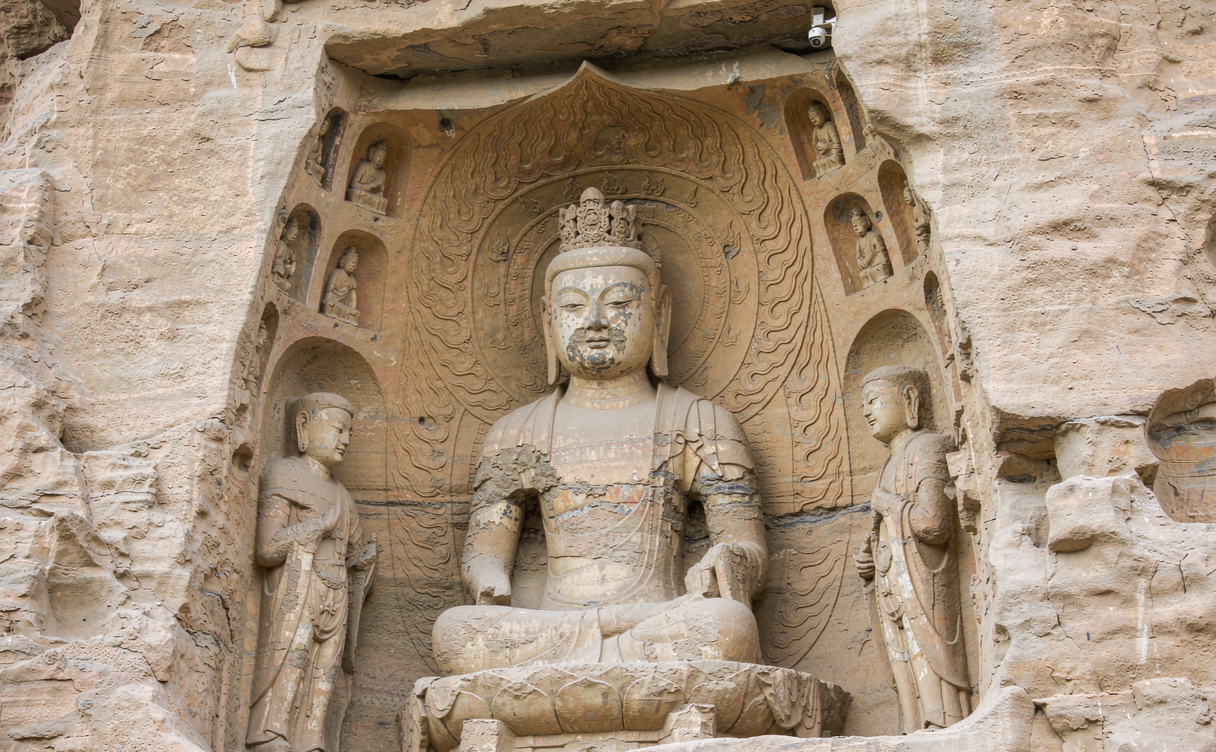
The carving here runs from the sixth century to the tenth, and you can read the dynasties in stone as you climb. Work began under the Eastern Wei (534–550), when the first small shrines were opened into the cliff for patrons from the Taiyuan basin. The Northern Qi (550–577) widened the scheme, cutting the broad terraces and the taller cave mouths. The Sui (581–618) added compact niches with tightly coiled bodies, and the Tang (618–907) produced the sculpture the place is famous for: slender bodhisattvas, full-lipped seated Buddhas, and a calmness that art historians still use as a benchmark.
Tianlong Mountain was never a state project on Yungang’s scale. It was a mountain temple for a city — a cool retreat above the dust of the plain, and, more than a monument, a pilgrimage route, with shrines stacked up the slope.
Cave 8 and the headless Buddha
Of all twenty-five caves, Cave 8 is the one people come for. Its north wall holds a colossal Buddha head carved in very high relief, the so-called Tianlong Mountain headless Buddha, a masterpiece of Tang modelling: broad nose, heavy lids, lips held in a half smile, hair in tight curls. The niche behind it is open to the sky, and the missing head left such a clean shape in the stone that visitors have photographed the empty walls as much as the carvings beside them.
The story of that head is worth understanding before you stand in front of it. In the early twentieth century, as the cliff was being photographed and catalogued by visiting scholars and art dealers, a number of figures were cut free and sold on. The majority of the small headless bodhisattva pieces from Tianlong went to Japanese museums and private collections, and the trade gave its name to what the art world now calls the Tianlongshan style. One of these heads was formally returned to China in 2021 and has since been shown at home; the rest can be traced through museum catalogues, and the Met Museum’s online collection records are a reasonable place to begin if you want to see how far the dispersion spread.
On the mountain, nothing was faked. A carefully made copy stands in the original position, cut in a lighter stone so that it reads as a copy, and the signage explains the gap without drama: niche, stair, broken edge and new head in the same frame, a hundred metres above the traffic below.
If the grottoes are only one stop on your route, build the week around them. Most visitors pair the cliff with Jinci Temple in Taiyuan, about 45 minutes south, or continue north for the temple complexes of Wutai Mountain; the distances and travel times are set out in our Taiyuan travel guide.
What the twenty-five caves hold
The whole complex is modest in size and generous in quality. Twenty-five caves hold roughly 500 statues and about 5,000 square metres of carved surface, from tiny niches no bigger than a doorway to the colossal seated figure in Cave 21. Many carry donor inscriptions recording a name and a date — this is how the chronology was rebuilt — and a few mix Buddhist and Daoist imagery on the same cliff.
Two things reward a slow walk. The caves sit at different heights along the slope, so you meet the sculpture at eye level rather than looking up at it, which is the opposite of the Yungang experience and far more intimate. The Tang niches on the upper terraces carry flowing drapery and a slight, elegant sway. Binoculars help for the upper rows.
How to get to Tianlong Mountain from Taiyuan
If you are working out how to get to Tianlong Mountain from Taiyuan, both options below end at the same visitor centre at the foot of the hill.
By car. Rent a car in Taiyuan or take a taxi and drive north-west out of the city; it is around 40 kilometers, roughly 40 minutes on a normal day. The last stretch is the mountain road itself — a winding ascent with dozens of bends that gains several hundred metres in a dozen kilometers, so take it slowly and stop at the first viewpoint if you are prone to motion sickness.
By public transport. Regular tourist buses and shuttle services run from Taiyuan towards the Tianlong Mountain scenic area, and rideshare apps will drop you at the visitor centre. From there the scenic-area shuttle takes the last few kilometers up the access road to the cable car station and the trailhead; it is included with entry, so there is no reason to walk the road. Confirm the boarding point and timetable when you arrive, since seasonal routes change.
The route up: cable car and walk
Two ways reach the same niches, and most travelers pick one and envy the other.
The cable car. It runs in a large enclosed cabin rather than an open gondola, which makes it reassuring in wind and winter. From the lower station it climbs for about twenty minutes, above the treeline and straight onto a broad ridge path; from the upper station a ten-minute walk brings you to the terraces where the caves open. Queue early if you want a cabin on a weekend morning.
The walk. The route we recommend you try at least once. From the shuttle terminus a paved road switchbacks up through pine and birch, then joins the old stone stairway — more than a thousand worn steps, with handrails on the worst drops. It is about 40 minutes from the road to the first caves and roughly an hour and a half to the summit temple. This is the best stretch of the visit: the niches open one after another on both sides of the stair, unlit, cool and shadowed, with the valley opening out below.
If you need the Tianlong Mountain cable car and walk route in one line: take the shuttle up, walk down. The descent is easier on the knees than the ascent, and you see the same caves in afternoon light.
Tickets and time. Entry covers the mountain and the shuttle up and down; the cable car costs extra, and prices shift between the summer and winter seasons, so buy at the gate or through the official channel rather than trusting a figure you read online. The Tianlong Mountain headless Buddha ticket and the shuttle both come from the same office at the visitor centre. Allow two to three hours inside the grottoes.
Short on time on this trip? Keep the grottoes for a slower day, ride the shuttle both ways, and check the current opening hours, the last shuttle departure and the seasonal road status in our Taiyuan travel guide before you set off.
Tianlong Mountain versus Yungang grottoes
The comparison people raise most often comes down to scale and intimacy. Yungang Grottoes, on the outskirts of Datong, was carved from about 460 for the Northern Wei court: bigger, louder, more monumental, with the colossal seated Buddha of Cave 20 visible straight from the road, and a UNESCO World Heritage site with a proper visitor spine. Tianlong Mountain versus Yungang grottoes therefore splits along taste as much as history — Yungang overwhelms you with size, Tianlong rewards attention with detail.
Practically, Yungang is easier to reach, flatter to walk and doable in two hours, while Tianlong needs a half day because you are climbing. Most itineraries do both: Yungang in the north on the way to Datong, Tianlong as the quiet afternoon in the capital. Our Datong Yungang Grottoes guide covers the northern site in full.
Best time to visit Tianlong Mountain
The best time to visit Tianlong Mountain is late spring and early autumn — May and June, then September and October — when the ridge is green, the stair is dry and the light lasts into the evening. Summers are cool up here, but haze in the Taiyuan basin flattens the view by afternoon, so mornings are the better bet; after autumn rain the red cliff shows its colour and the forest turns gold. Winters are short on daylight, the stair can ice over and the shuttle may run a reduced timetable between December and March, so confirm before driving up. Skip the May Day and October National Day holidays if you dislike crowds: the stair is narrow and the queue at the cable car is real.
Photography and visitor etiquette
Photography is straightforward, since the niches are open to the sky and you can frame forest, cliff and carving together from the walkways. Skip flash on the stone, leave the drone at home unless you have written permission — this is an active mountain temple, not a scenic overlook — and leave the tripod, which is awkward on the steps and unwelcome in the narrow passages.
Etiquette matters more than rules here. Dress modestly, keep your voice down in the shrine terraces, do not run a hand along the carved edges or the empty socket, and stay on the marked path, because the drop beside the stair is unfenced. Water is sold at the visitor centre and at the tea stop near the upper terraces, but carry more than you think you need for the climb.
Put this visit into your itinerary properly: decide between the cable car and the full stair climb, see how the grottoes pair with Pingyao and Datong on one Shanxi loop, and subscribe so seasonal shuttle timetables and road news reach you before you travel.
Walk down the last flight of steps, turn once, and the whole cliff is in front of you again: twenty-five niches, the copy in Cave 8, and a stair worn smooth by everyone who climbed it for the same reason. Give it a morning and three hours, and it will be the quietest memory of your trip through Shanxi.