

I first heard about the place from a taxi driver in Yulin who kept saying “long zhou” and drawing wave shapes on a fogged-up window. Two winters later I finally stood on the edge of a crimson canyon and understood why people call it China’s answer to the Arizona slot canyons. This Wave Valley Shaanxi guide is built from that trip and a second visit in early autumn, with the practical details I wish I had before going.
Where Wave Valley Actually Is
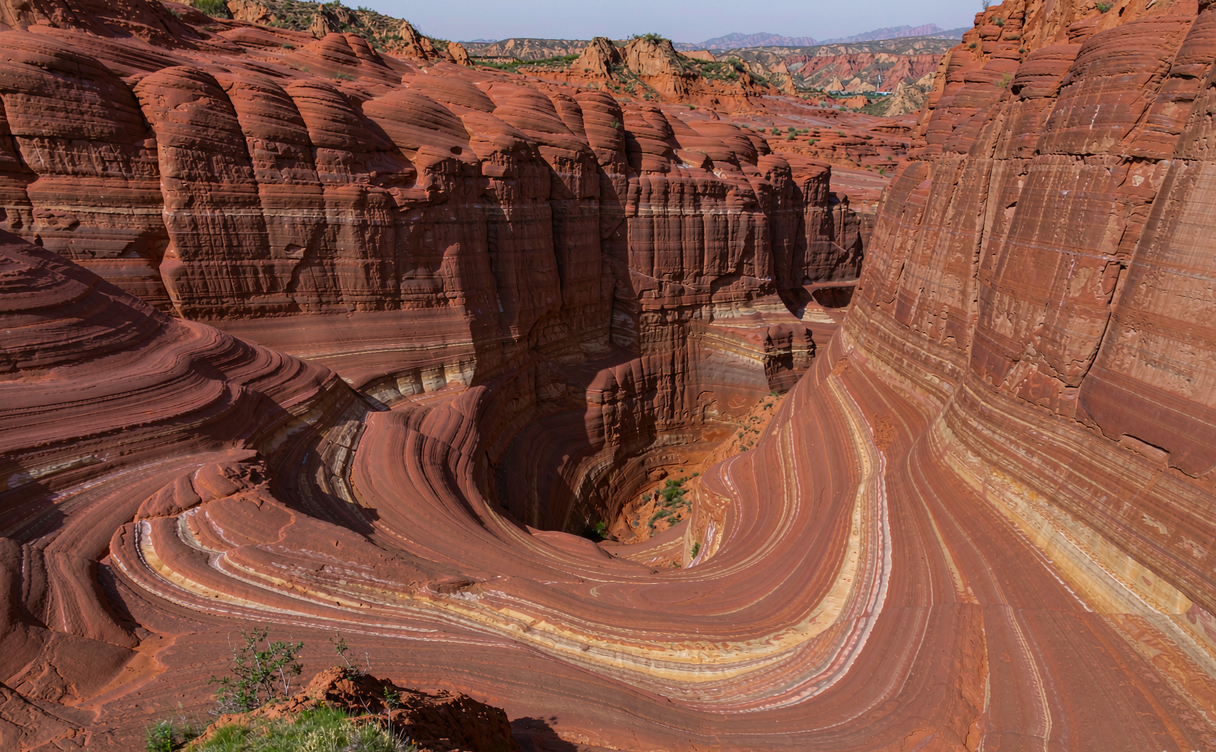
Let me clear up the most common mistake first: this is in Shaanxi province (written 陕西, with two ‘a’s), not neighboring Shanxi (山西, one ‘a’). The site sits inside Jingbian County, about 25 km southeast of the county town, in the Loess Plateau’s northwestern corner. Locals call it Longzhou Danxia (龙洲丹霞) or Longzhou Wave Valley. The rock is not true Danxia in the strict geological sense — it is a red quartz sandstone eroded by wind and flash floods into flowing ribbons. If you want the textbook definition, the Danxia landform background on Wikipedia explains the family of red-bed landscapes this belongs to.
The Wave Valley Jingbian area is split into a few named sections: the Flame Rift (火焰峡), the Water Rift (水上丹霞), the Earth Heart Rift (地心谷), and the open ridge walks. You will not see all of them in one relaxed morning, so pick by light and stamina.
How to Get There
Most foreign travelers reach the valley from one of three cities. Here is the real picture.
From Xi’an: A Wave Valley to Xi’an trip is the classic loop. Take a high-speed train from Xi’an North to Yulin (about 3.5–4.5 hours, second class around ¥180–240), then a bus or private car to Jingbian (1.5 hours). Alternatively, trains run Xi’an to Jingbian directly in about 5–6 hours. Driving the whole way is roughly 480 km and 6–7 hours on good expressways; I do not recommend it for a first-timer who wants to arrive rested.
From Yan’an: Yan’an sits roughly halfway. A train or bus to Jingbian takes 2–3 hours and costs ¥40–70. Yan’an itself is worth a half day if revolutionary history interests you.
From Yulin: This is the closest hub. Yulin coach station has frequent buses to Jingbian (1–1.5 hours, ¥25–35). From Jingbian bus station, charter a car or take the local tourist shuttle to the scenic gate (30–40 minutes, ¥60–100 per car split among riders).
Once you reach the entrance, you cannot walk the last stretch in your own vehicle. A shuttle bus is mandatory and included in the combined ticket.
Tickets, Shuttle and Opening Hours
When I visited, the gate ticket plus shuttle was ¥90 (about CNY 90) in peak season and ¥70 in the low season. Children under 1.2 m and seniors over 65 with valid ID usually enter free or at half price — carry your passport. The site opens around 07:30 and closes entry at 17:00, with the last shuttle leaving the inner stops by 17:30. Arrive before 09:00 in summer to beat the tour buses that roll in from Yulin and Ordos.
Card payment works at the gate, but the shuttle queue moves faster if you have Alipay or WeChat Pay set up. If you came from Xi’an, pairing this stop with the Xi’an Terracotta Warriors visit guide makes a logical north-Shaanxi route.
Best Light and Weather
The single most useful tip in any how to visit Wave Valley plan is about light. The red sandstone glows only when the sun rakes across it at a low angle.
- Best months: April–June and September–October. Summer is brutally hot and crowded; winter is cold but empty and strangely beautiful under thin snow.
- Best hours: 08:00–10:30 and 16:00–18:30. Midday washes the color flat and bakes you on the open ridges.
- After rain: A day or two after a downpour the rock darkens to a deep maroon and the contrast with the sky is dramatic. I caught this by luck in September and the photos needed almost no editing. Check the forecast for Jingbian and aim for the clear day right after rain.
- Avoid: Windy spring days when Loess dust coats the lenses and your throat.
This timing question is the heart of the best time Wave Valley decision, and it matters more than which section you pick.
Photo Spots and Drone Rules
The Flame Rift gives the famous smooth ribbon walls — shoot with a wide lens low to the ground to stretch the curves. The narrow crack called “Line of Sky” (一线天) is best at noon when a blade of light hits the floor, counter to the rest of the site. The Water Rift reflects the red walls in a shallow pond; calm windless mornings give the mirror effect.
On the Wave Valley vs Danxia comparison travelers often ask: unlike the towering red peaks of Huangshan and other mountain guides, here the drama is horizontal and intimate, walked at eye level.
Drones: recreational drones are restricted inside the reserve. I was told by a ranger that the no-fly rule protects both the rock and visiting birds, and that permits are not issued to casual tourists. Leave the drone in your hotel. For ground cameras, a polarizer cuts glare on wet rock.
A Sample One-Day Itinerary
- 07:30 — Arrive at the gate, buy the shuttle combo, board the first bus.
- 08:00–10:00 — Flame Rift and the open ridge walk in soft morning light.
- 10:00–11:30 — Earth Heart Rift, the coolest and most enclosed section.
- 12:00 — Lunch at the exit food row (see below).
- 13:30–15:00 — Water Rift for reflections, then Line of Sky.
- 15:30 — Shuttle back, drive or bus toward Yulin or Jingbian town.
If you have a second day, the Dazu rock carvings near Chongqing show a completely different way humans have treated stone, useful contrast for a travel journal.
Where to Eat and Sleep
At the scenic exit there is a row of noodle and barbecue stalls. A bowl of Shaanxi biangbiang noodles runs ¥18–28, grilled lamb skewers ¥3–5 each. Inside the reserve there is no restaurant, so eat before you enter or after you leave.
For sleep, Jingbian town has decent mid-range hotels at ¥150–300 per night (e.g., standard chain properties). Yulin, 1.5 hours away, has better international-standard hotels at ¥300–600 and a livelier night market. I stayed in Jingbian to catch the sunrise and it saved me the pre-dawn drive.

What to Pack and Watch For
The site is exposed and has little shade, so a short packing list saves the day. Wear shoes with real tread; the ribbon rock is polished slick where water runs, and I watched a fellow visitor slide into a puddle because of smooth-soled loafers. Carry at least 1.5 L of water per person in summer, a brimmed hat, and high-SPF sunscreen — the plateau sun is stronger than it feels. A light rain shell is wise from June to September even if the morning looks clear. Bring some cash (¥100 is plenty) because the stall vendors at the exit sometimes cannot process foreign cards, and keep a power bank since photo sessions drain phones fast. A local SIM or a downloaded offline map of Jingbian County helps when rural signal drops; I lost data the moment I left the highway and was glad I had cached the route.
Practical FAQ
Do I need a guide? Not for the marked paths. The shuttle drivers point out the main stops. A guide helps only if you want off-trail geology talk, which is not permitted anyway.
Is it wheelchair accessible? The ridges have steps and uneven rock; the Water Rift has boardwalks but the Flame Rift does not. Plan for limited access.
How long does a visit take? Three to four hours at a relaxed pace covers the main sections.
What should I wear? Sturdy closed shoes with grip — the rock is slick when wet. A hat and 1.5 L of water in summer.
Can I swim in the Water Rift pond? No. It is shallow, protected, and swimming is forbidden.