

Mong Kok Hong Kong is the densest, loudest, most alive slice of Hong Kong, China you can stand in, and it is exactly the neighborhood I send people to when they say they want the real city rather than the postcard skyline. Packed into a handful of blocks are the busiest sidewalks on earth, neon that never quite switches off, and a street-food culture that runs from dawn egg waffles to midnight curry fish balls. I have lost count of the nights I have arrived for “one bowl” and left at 2am with a bag of roasted chestnuts.
How to get to Mong Kok
Figuring out how to get to Mong Kok is almost too easy, because the MTR puts you right in the thick of it. The Mong Kok station sits on both the Tsuen Wan line (red) and the Kwun Tong line (green), and either platform feeds you straight into the district through exits D, E, or F. A single ride from Central costs about HK$11, and the trains run until just after midnight. If you are coming from the airport, the Airport Express to Kowloon plus a short taxi is fastest, but the cheapest route is the bus A21, which deposits you on Nathan Road a five-minute walk from the action for roughly HK$34. Ride-hailing apps work too, though traffic on Nathan Road can make the last mile slower than walking.
Mong Kok street food
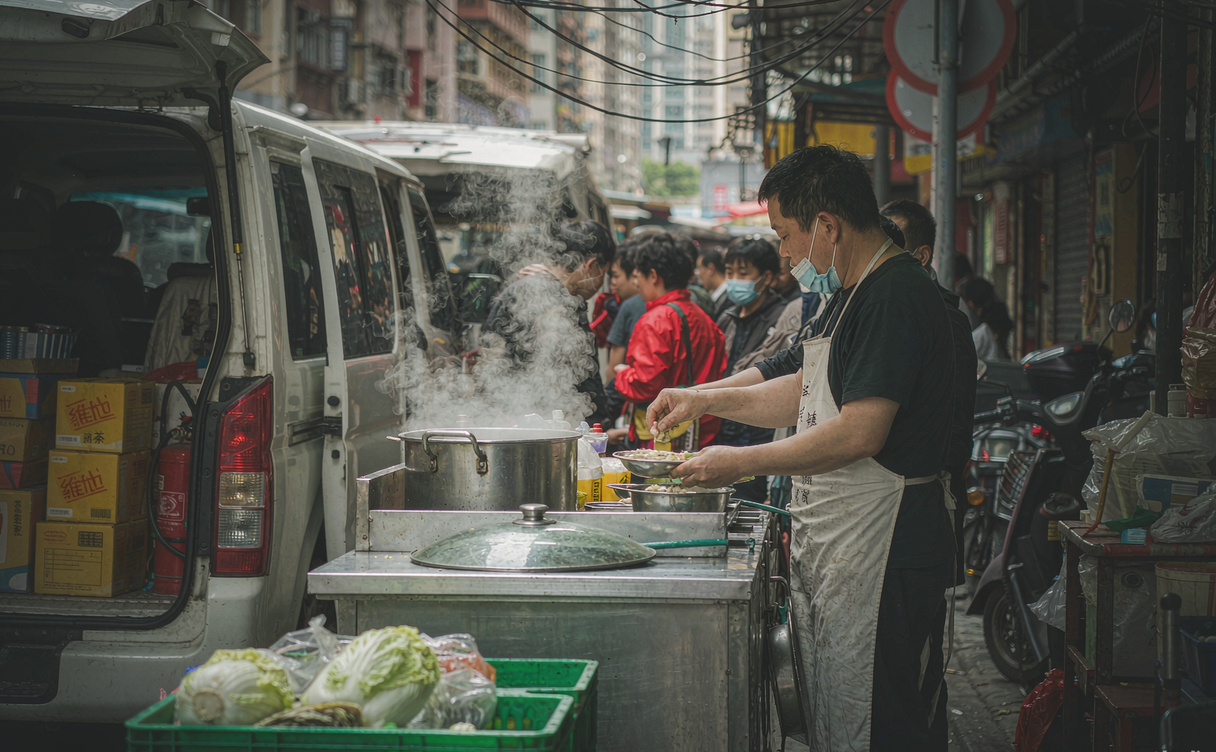
The heart of Mong Kok street food is the stretch around Fa Yuen Street and the junctions off Nathan Road, where pushcarts and hole-in-the-wall shops have fed crowds for decades. The classic order is a paper cup of curry fish balls (HK$10–15) eaten standing up, followed by a fresh egg waffle (gai daan jai) at about HK$18, its bubble grid crisp on the outside and custardy within. For something heartier, the clay-pot rice shops along Argyle Street simmer individual pots of rice with pork, sausage, and preserved vegetable through the winter, running HK$45–70 a pot. At night the mobile carts reappear near the Ladies Market with roasted squid and sugar-dusted mini doughnuts. Prices have crept up, but a full graze-and-walk dinner still lands under HK$100.
Things to do in Mong Kok
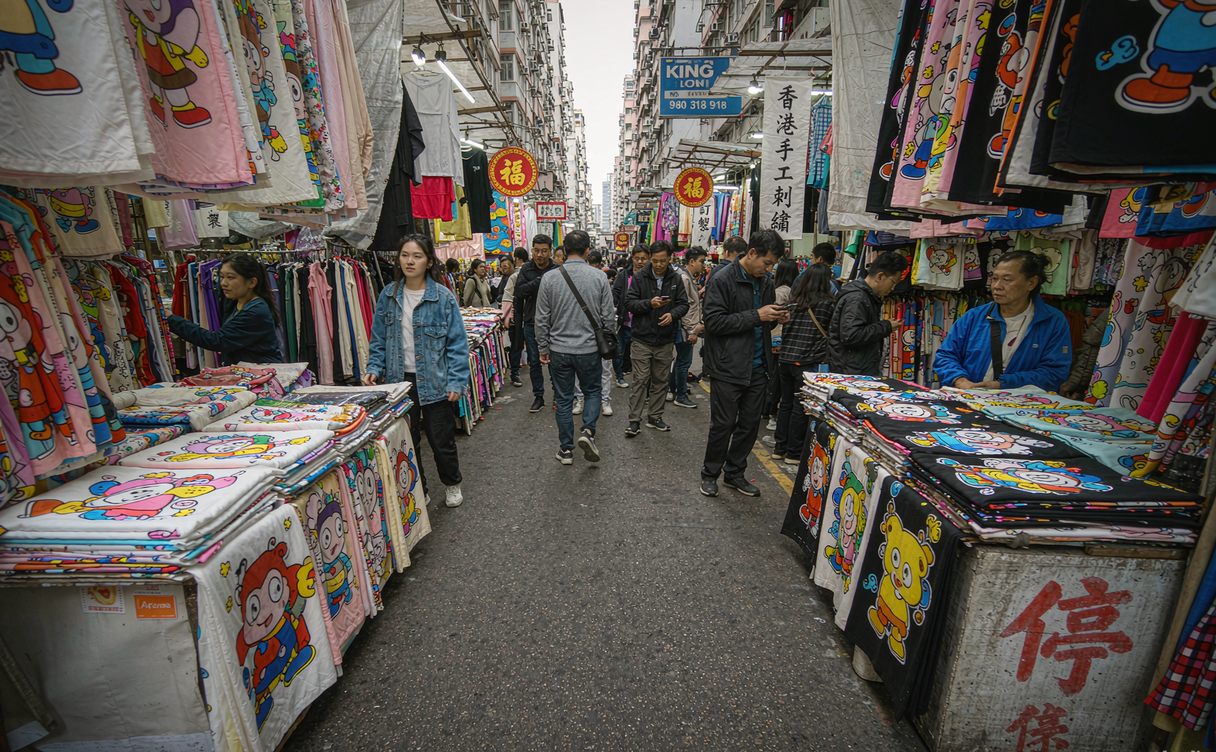
Beyond eating, the things to do in Mong Kok are gloriously specific to the district. The Ladies Market on Tung Choi Street is the obvious stop — a half-kilometer of stalls selling everything from phone cases to silk pajamas, best browsed after 7pm when the sellers are in full flow and the bargaining is good-natured. A block away, Sneaker Street (Fa Yuen Street) is the city’s sneaker headquarters, with limited editions in the windows and real pairs if you know the shops. The Goldfish Market turns a normal street into a wall of aquariums after dark, and the adjacent Bird Garden on Yuen Po Street keeps the old Cantonese hobby of songbird keeping alive, with elderly men walking their caged birds in the morning. For tech, the Mong Kok Computer Centre and the surrounding arcades are where locals buy phones and cameras without the island’s markup.
Hong Kong night markets
Mong Kok is the backbone of the Hong Kong night markets scene, and the rhythm is what makes it special. The stalls open as the offices empty and peak around 9–11pm, when the whole neighborhood becomes an open-air mall under flickering signs. Temple Street, a short walk or one MTR stop south in Yau Ma Tei, extends the night-market feeling with fortune tellers and opera singers on some evenings, but I usually stay in Mong Kok because the energy is denser and the food cheaper. If you want the night-market experience without the crush, arrive by 6:30pm on a weekday; by Friday night the main lanes are shoulder-to-shoulder.
Best time to visit Hong Kong
The best time to visit Hong Kong is October through early December and again in March and April, when the humidity eases and the streets are comfortable for hours of walking. I would skip July and August, when the heat and the occasional typhoon make crowded sidewalks genuinely rough, and avoid the Lunar New Year week if you dislike closures — many stalls shut for a few days. Mong Kok is a year-round destination, but the spring and autumn evenings are when the street food tastes best and the neon looks sharpest against a clear sky.
A Mong Kok-based Hong Kong itinerary
A smart Hong Kong itinerary uses Mong Kok as the Kowloon anchor and balances it with the quieter sights. Spend one evening here for food and markets, then give a day to the Ngong Ping Big Buddha on Lantau for the cable car and the monastery. Families often split a day between Hong Kong Disneyland and Ocean Park, both reachable by MTR, but I would not trade a Mong Kok night for either. If you are continuing to Macau, China or across the border to Shenzhen, both are easy next steps from Kowloon, and each offers a completely different face of the region.
Practical notes before you go
Bring small cash — many carts still do not take cards, though the Octopus card and mobile pay now cover most stalls and every MTR ride. Watch your bag in the crush; pickpockets work the Ladies Market on busy nights. The district is walkable but dense, so wear comfortable shoes and do not try to drive. The Mong Kok neighborhood is consistently ranked among the most densely populated places on the planet, which is exactly why it feels so electric after dark. Toilets are scarce on the street, so use the ones in the MTR station or a mall like Langham Place.
Final thoughts
Mong Kok is not a place you observe from a distance; you step into it and let it carry you. The reward is sensory — the sizzle of a waffle iron, the press of the crowd, the sudden smell of roasted chestnuts, the way a neon sign reflects on a wet sidewalk after rain. For a first taste of Hong Kong, China, there is no better classroom than these few blocks, and no better way to end a day than with a cup of fish balls in hand and the city humming around you.