

Most visitors to Yunnan rush the Dali–Lijiang corridor, but the Hequing travel guide you actually want is the one that tells you to stop halfway. Heqing County sits in the northwest of Yunnan, inside Dali Bai Autonomous Prefecture, where the farmland begins to climb toward the Lijiang plateau. We’ve sent travelers there who arrived planning two hours and left two days later — the pace is the point. This is a place of Bai courtyards, lazy wetlands, and the soft clink of silver being hammered in village workshops, and it remains one of the best-kept low-cost bases in northern Yunnan.
Why Heqing, and where it actually is
Hequing (鹤庆) is roughly 40 km south of Lijiang city and about 120 km north of Dali Old Town. It rarely appears on first-time itineraries, which is exactly why it works. The county town is compact, walkable, and refreshingly free of the ticketed “ancient towns” that dominate the region. In our experience, the best way to use Heqing is as a relaxed, inexpensive base while you day-trip to the headline sights of northern Yunnan, then retreat to quiet lanes and a cheap bowl of noodles at night.
How to get to Heqing
The single most useful fact in any how to get to Heqing plan is the railway. The Dali–Lijiang line has a station at Heqing, and EMU trains run several times a day. From Kunming you’ll usually change once at Dali; total time is about 3.5–4.5 hours and a second-class seat runs ¥120–¥180. From Lijiang it’s a lazy 30–45 minutes for ¥14–¥23, and from Dali about 50–70 minutes for ¥40–¥60. Trains are punctual and the station is only 4 km from the county center, so a ¥10–¥15 taxi gets you to your guesthouse.
If you prefer the road, long-distance buses leave Lijiang bus station roughly every 40 minutes (¥25, 1.5 hours) and Dali’s north station has frequent services (¥45, 2.5 hours). Driving yourself is easy on the G5611 expressway, and many travelers rent a car in Lijiang specifically to explore Heqing and the surrounding villages at their own speed. Ride-hailing apps work in the county seat but not in the villages, so arrange a return pickup with your driver in advance.
Best time to visit Heqing
For a best time to visit Heqing answer that won’t steer you wrong: late March through May, and then September through early November. Spring brings mild temperatures (15–24°C days), plum and peach blossoms across the terraces, and clear light for photography. Autumn is our favorite — the rice is gold, the air is dry, and the wetland fills with migratory birds. Winter (December–February) is sunny but cold at night (down to -3°C); it’s the quietest, cheapest season and good for birdwatchers. We’d avoid the mid-summer weeks of July and August when afternoon thunderstorms are frequent, though the landscape is at its greenest then and hotel prices dip.
Things to do in Heqing
The headline attraction, and the one that justifies the trip, is things to do in Heqing centered on Xinhua Village (新华村), about 7 km from the county seat. This is China’s best-known silver-crafting village: an estimated 80% of households are involved in making, finishing, or selling silver and copperware, and the craft has been passed down for more than a thousand years. You can walk the lanes watching artisans chase patterns onto teapots, build filigree onto bracelets, and pour molten silver into moulds. There’s no entry fee to wander. Pieces are sold by weight plus craftsmanship; a handmade bracelet starts around ¥150 and serious teapots run into the thousands. Bargaining is expected but gentle — and buying directly from a workshop means you skip the markups of Lijiang’s tourist shops.
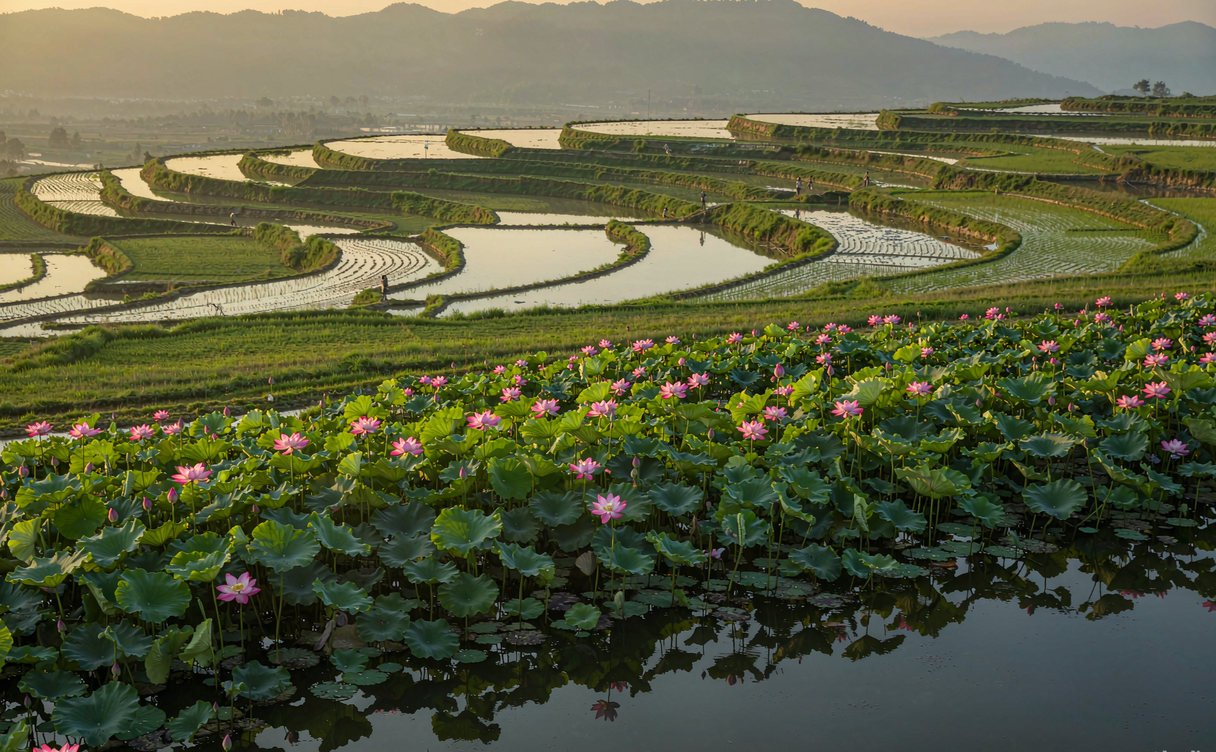
From Xinhua, the Caohai Wetland (草海湿地) is a 2 km hop. A raised boardwalk loops through reed beds and open water where egrets, herons, and wintering ducks gather; with luck you’ll spot the elegant black-necked crane in deep winter. Entry is ¥10, and the magic hour is just after sunrise when the mist sits low on the water. Bring binoculars and wear shoes that can handle damp boardwalk planks.
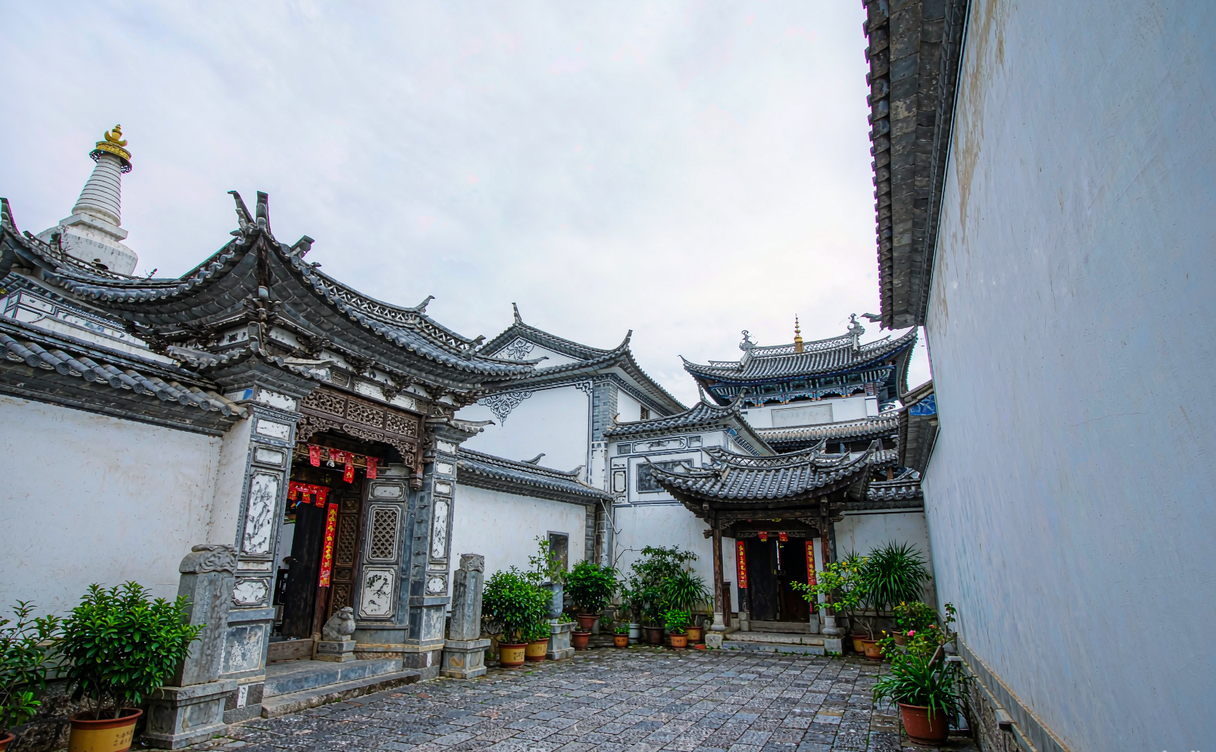
Back in Heqing town, the morning market is the real cultural show: Bai women in indigo aprons sell mountain herbs, cured ham, and stacks of rushan (乳扇, a grilled cheese sheet). The old quarter still has a handful of intact Bai courtyards with painted gable ends — free to peek at respectfully. South of town, Huanglongtan (黄龙潭) is a cold spring pool ringed by willows, a calm spot for an hour with a thermos of tea and a book.
Culture and local life
What keeps travelers in Heqing is not a single monument but the rhythm of Bai daily life. The Bai people here practice a mix of Buddhism and 本主 (benzhu) village-god worship, and you’ll pass small roadside shrines on nearly every lane. If you time a visit to the fourth lunar month you may catch a local opera performance in the open courtyard of a temple, with hand-painted masks and a squealing two-string fiddle. In our experience these unannounced village events are worth more than any ticketed show in Lijiang. The pace is slow enough that strangers are greeted, invited to sit, and occasionally fed — a rarity in China’s more polished tourist towns.
A practical Heqing itinerary
A relaxed Hequing itinerary looks like this. Day 1: arrive by train from Lijiang, check in, walk the town and evening market. Day 2: morning at Caohai Wetland, late morning to Xinhua Village for silver, afternoon tea by Huanglongtan. Day 3: bus or train onward to Dali (for the Yunnan Three Pagodas) or back to Lijiang. If you have a fourth day, the nearby Nuodeng Village makes a fine slow excursion into Yunnan’s ham-curing heartland, about two hours south by bus.
Getting around the county
Inside Heqing town you can walk almost everything in 20 minutes. For the villages, rent an e-bike in the county seat for ¥30–¥50 a day — it’s the most pleasant way to reach Xinhua and Huanglongtan, and you’ll pass rice fields the whole way. Taxis within town are ¥8–¥15; a round-trip charter to Xinhua and the wetland with waiting time runs about ¥80–¥120. Buses to the villages leave from the east-side station but run infrequently, so the e-bike or charter is the smarter choice.
Food, stay, and money
Hequing eats like the rest of Bai Yunnan but cheaper. Must-tries: rushan grilled with rose sugar, cured ham fried with green beans, preserved plum (雕梅) eaten as a snack, and the local “heqing bait” rice cake. A solid bowl of rice-noodle soup is ¥8–¥12; a shared Bai feast for two runs ¥80–¥120. Guesthouses in town start at ¥120 a night for a clean double, ¥200–¥300 if you want a courtyard room with character. ATMs are limited outside the county seat, so carry cash for the villages and the silver stalls that often prefer it.
Altitude here is around 2,200 m — high enough that you shouldn’t sprint up any hills on day one, but low enough that most people feel nothing. Our separate Yunnan first-timer guide covers the basics of acclimating and getting around the province, and pairs well with a Heqing stopover.
Hequing itself is a county rather than a UNESCO site, but the wider Dali–Lijiang cultural landscape is well documented; background on the county’s geography and administration is available on Wikipedia’s Heqing County page.
Planning your wider Yunnan loop
If Hequing Yunnan is your first taste of the province, you’ll quickly want the bigger mountains. The Ailao Mountain piece is a good companion for travelers who like forests over crowds.