

Cross the Qinling tunnel south of Xi’an and Shaanxi changes completely. The loess plateau gives way to a green river basin of paddy fields, bamboo and tea, ringed by mountains — a landscape that looks and eats like Sichuan but is still Shaanxi. For three weeks in March the whole basin turns yellow with rapeseed flowers. The rest of the year it offers cliff-bolted plank roads, a Han dynasty capital and the last stronghold of the crested ibis. This Hanzhong travel guide covers all of it.
Why Visit Hanzhong
Hanzhong is a city of three million in the Han River basin, wedged between the Qinling range to the north and the Daba mountains to the south. This was Liu Bang’s power base before he founded the Han dynasty — the dynasty, the river and the written characters all carry the name that starts here.
The appeal is threefold. The rapeseed bloom in March and early April is one of the great seasonal spectacles in China and still overwhelmingly domestic. The plank roads cut into gorge walls are the physical remains of the supply routes that made the Three Kingdoms campaigns possible. And the surrounding counties hold golden monkeys, takin and the crested ibis, a bird that in 1981 was down to seven known individuals in the world, all of them here.
Best Time to Visit Hanzhong
Mid-March to mid-April — the best window. Rapeseed opens across Nanzheng, Yangxian, Chenggu and Mianxian, 10–22°C, and the basin is yellow to the mountain foot. Also the busiest period: book rooms a month out.
May and June. Green, warm at 18–29°C, and much quieter. Good for the plank roads and the ibis reserve, with the Xixiang tea terraces at their best.
July to September. Hot and wet at 24–34°C. Rivers run high and the gorges are dramatic, but landslides occasionally close mountain roads.
October to November. Clear and mild at 10–22°C, with autumn colour in the Qinling — the second-best time to come.
December to February. Cold at −2 to 10°C, damp, snow on the passes, and reduced services in the mountain scenic areas.
How to Get to Hanzhong from Xi’an
The Xi’an–Chengdu high-speed railway, opened in 2017, tunnels straight through the Qinling and turned a full-day journey into an easy morning. Hanzhong Station (汉中站) takes both high-speed and conventional services and sits in the city, a ¥15 taxi from most hotels.
| From | Mode | Typical duration | Approx. cost |
|—|—|—|—|
| Xi’an North → Hanzhong | High-speed rail | 1 hr 10 min – 1 hr 45 min | ¥110–145 (US$15–20) |
| Chengdu East → Hanzhong | High-speed rail | 1 hr 50 min – 2 hr 20 min | ¥170–195 (US$24–27) |
| Chongqing North → Hanzhong | High-speed rail | around 3 hr 30 min | ¥260 (US$36) |
| Hanzhong → Shimen Plank Road | Bus or taxi | 30–40 min | ¥60 taxi (US$8.50) |
| Hanzhong → Wuhou Temple, Mianxian | Coach | around 1 hr | ¥20 (US$3) |
| Hanzhong → Yangxian ibis reserve | Coach or car | around 1 hr | ¥25 coach (US$3.50) |
Buy on the official 12306 app with your passport number, which you also scan at the barrier. City buses cost ¥1–2 and Didi covers the centre for under ¥20.
Top Things to Do in Hanzhong
The rapeseed flower sea (油菜花海)
From roughly 10 March to 10 April, about a million mu of rapeseed flowers across the basin, and the county governments run a loose festival around it with viewing platforms and shuttle routes. The best concentrations are Nanzheng’s Wushan-Xinji area, Yangxian’s terraced slopes and Chenggu, where the flowers run up to the mountain wall.
Go early: haze builds by 10:00 and coach parties arrive at 11:00. Yangxian’s terraces are the most photogenic because the fields step uphill rather than lying flat. Most viewpoints are free; a few charge ¥20–40. This is the headline entry in any list of spring destinations in China.
Shimen Plank Road Scenic Area (石门栈道)
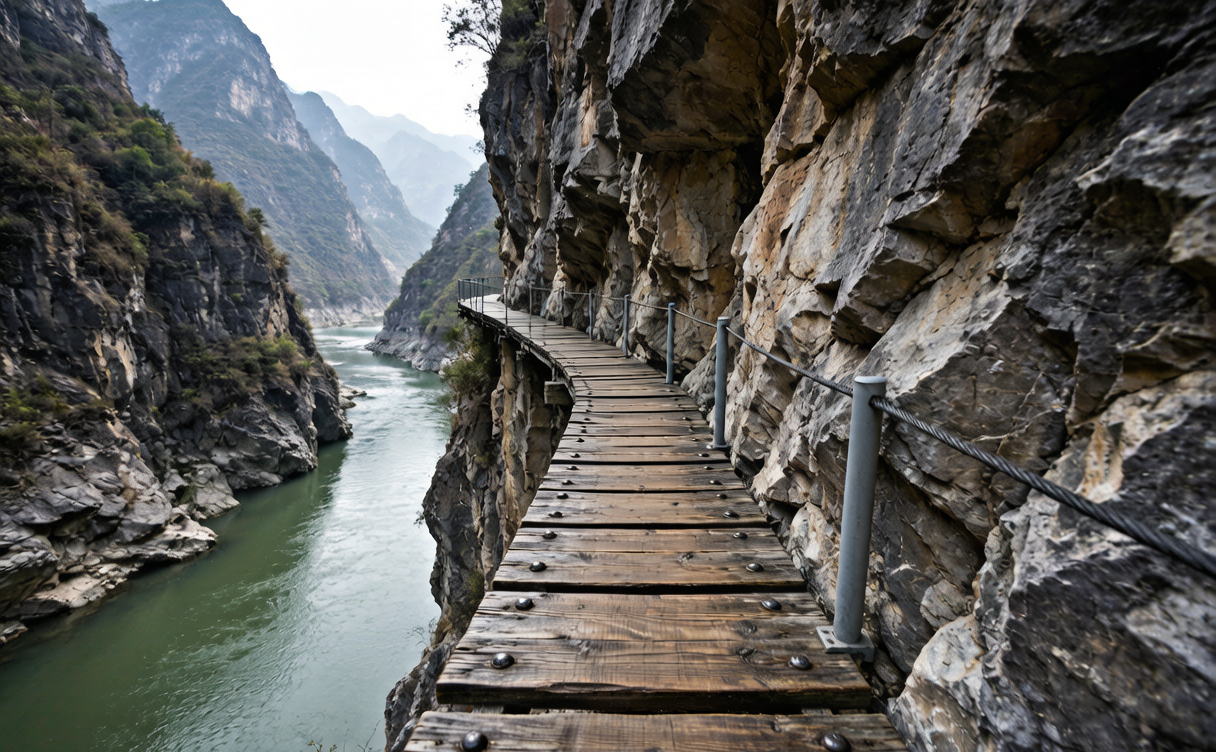
Fifteen kilometres north of the city, where the Bao river cuts out of the Qinling, the ancient Bao-Xie plank road was drilled and bolted into the gorge wall to carry armies and grain between the Wei and Han valleys. The Shimen tunnel itself — one of the world’s earliest road tunnels — was flooded when the reservoir was built, but its stone inscriptions were cut out and moved to the Hanzhong Museum, and a long section of plank roadway has been rebuilt above the water.
Walking it is the point: a timber gallery pinned to a vertical cliff several storeys above green water. Around ¥60–70, allow two hours. The best short walk in the region for anyone comfortable with heights.
Gu Han Tai and the Hanzhong Museum (古汉台·汉中博物馆)
This raised earthen terrace in the city centre was reputedly Liu Bang’s residence when he was made King of Han. It now houses the city museum, whose real treasure is the Shimen Thirteen Steles — cliff inscriptions in early clerical and semi-cursive script, prized by calligraphers for two millennia and rescued from the reservoir. Cheap, central, closed Mondays. Nearby, Bai Jiang Tan (拜将坛) marks where the general Han Xin was appointed.
Wuhou Temple and Zhuge Liang’s tomb (武侯祠·武侯墓)
An hour west in Mianxian, Wuhou Temple is the oldest shrine to Zhuge Liang, strategist of the Shu Han state, founded soon after his death in 234 AD. His tomb lies a short drive south in a cypress grove at the foot of Dingjun Mountain. For anyone who has read the Three Kingdoms, this is the most atmospheric site in the province. Around ¥50 each.
Yangxian crested ibis reserve (洋县朱鹮)
The crested ibis was believed extinct until seven birds were found in the hills above Yangxian in 1981. Protection has brought the wild population back into the thousands, and the reserve near Huayang runs an observation area where you can reliably watch them feeding in the paddies. The same forest corridor holds takin and golden monkeys, and the old town at Huayang (华阳古镇) makes a good base for anyone building a China hiking and trekking itinerary.
Where to Stay in Hanzhong
Budget — ¥100–190 (US$14–27). Chain hotels around Hanzhong Station. Functional and clean; no English.
Mid-range — ¥250–450 (US$35–65). Business hotels around Beida Street — the best base, walkable to Gu Han Tai and the night market.
Splurge — ¥550–1,000 (US$78–140). Four-star properties in the new district, plus rural guesthouses in Huayang and around the Yangxian terraces, far more atmospheric in flower season.
In March, book three weeks ahead and confirm the property registers foreign passports; chains always do.
What to Eat in Hanzhong
Hanzhong eats like Sichuan with Shaanxi wheat behind it: rice-based, chilli-heavy, sour.
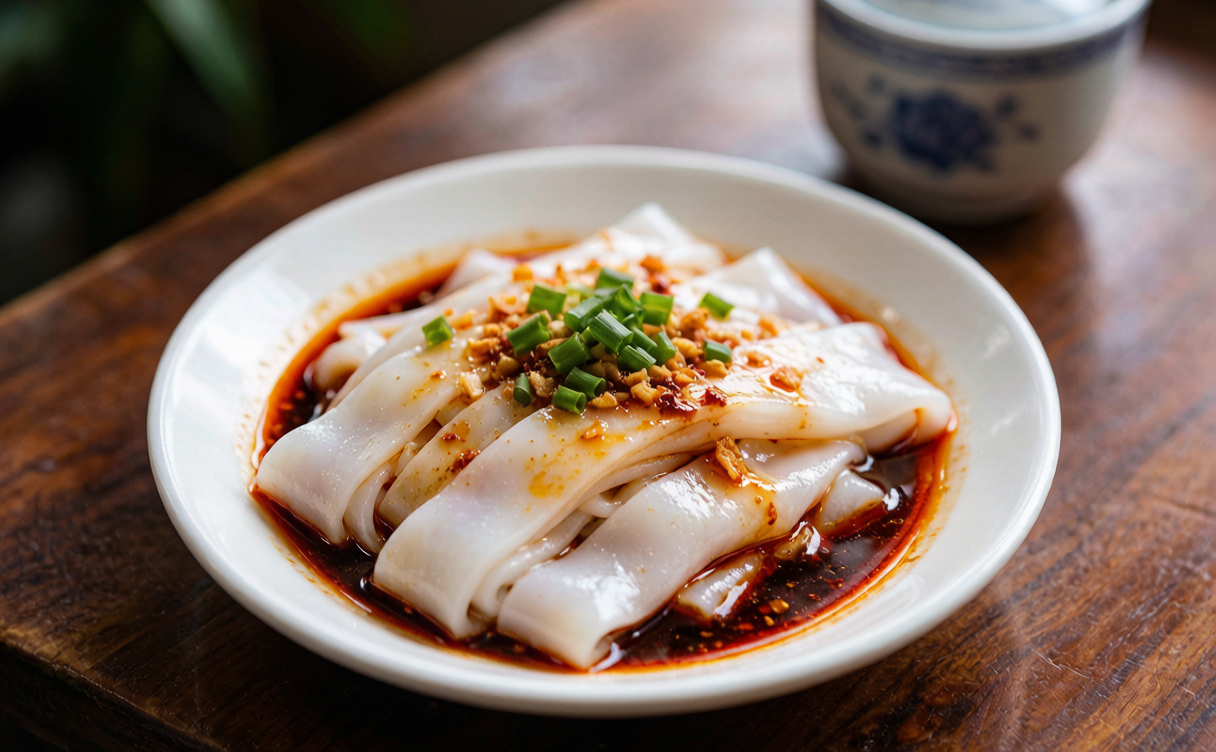
- Hanzhong mianpi (汉中面皮). The city’s signature: rice batter steamed into sheets, cut into wide ribbons, dressed with chilli oil, vinegar and garlic water. A breakfast dish, ¥8–12.
- Cai doufu (菜豆腐). Mianpi’s traditional partner — tofu curd set with rice water and cooked with greens, mild and clean against the chilli.
- Walnut mo (核桃馍). A small crisp walnut bread from Ningqiang County, the standard souvenir.
- Jiangshui noodles (浆水面). Noodles in a lightly fermented, faintly sour vegetable broth — the summer bowl.
- Lueyang black-boned chicken (略阳乌鸡). Stewed with herbs and dates, a mountain-county speciality.
- Xixiang green tea (西乡炒青). Grown on terraces south of the city; buy loose leaf in April.
Sample Hanzhong Itinerary for Foreign Tourists: Two Days
Day 1 — city and gorge
- 08:00 mianpi and cai doufu near Beida Street
- 09:30 Gu Han Tai and the Hanzhong Museum steles
- 11:30 Bai Jiang Tan, lunch in the old centre
- 14:00 taxi to Shimen Plank Road; walk the cliff gallery
- 18:30 Tianhan Wetland Park, dinner in town
Day 2 — pick one
- Three Kingdoms: Mianxian for Wuhou Temple and Zhuge Liang’s tomb below Dingjun Mountain
- Nature: early car to Yangxian for the ibis reserve, on to Huayang if you have a spare night
- March only: a full day in the rapeseed fields at Nanzheng and Chenggu
- 19:00 evening train to Chengdu or back to Xi’an
Practical Tips
- The bloom moves. Flowering runs about ten days earlier in the low basin than on the Yangxian terraces. Check local reports, not fixed dates.
- Hire a car for the counties. Mianxian, Yangxian and Huayang are each an hour or more apart. A driver costs ¥500–700 a day and pays for itself.
- Bring rain gear. Southern Shaanxi is far wetter than Xi’an in every season.
- Payment. Alipay and WeChat Pay accept foreign Visa and Mastercard and cover buses, taxis and tickets. Carry ¥200 in notes for village stalls.
- Passport as ID. Needed at museum desks, train barriers and hotel check-in.
- Silk Road link. Zhang Qian, the envoy who opened the western routes, is buried in Chenggu County here; his tomb is a component site of the UNESCO Silk Roads World Heritage listing and takes half an hour to visit.
- Language. Almost no English. Save addresses in Chinese and keep an offline translator running.
FAQ
Is Hanzhong worth visiting?
Yes, particularly in flower season or for Three Kingdoms history. It is also the natural place to break the Xi’an–Chengdu run, and it shows a green, watery Shaanxi that nothing in Xi’an prepares you for. It fits well into any off the beaten path route through China.
How many days do I need?
Two covers the city, the plank road and one county excursion. Three is better in March, when the flower fields deserve a full day.
When exactly do the rapeseed flowers bloom?
Usually from around 10 March in the low basin, peaking in the third week, and lasting into early April on higher terraces. Warm winters pull it forward by a week.
Can I see wild giant pandas near Hanzhong?
Wild pandas live in the Foping and Changqing reserves here, but sightings are rare and access is restricted. Realistically you come for the crested ibis, golden monkeys and takin.
Is Hanzhong a good stop between Xi’an and Chengdu?
Almost purpose-built for it. Trains run frequently both ways, the station is central, and one night here splits a four-hour journey into two easy legs. Pair it with our Xi’an travel guide for the northern half of the route.
Written by Karl, China Travel Places — updated August 2026.