

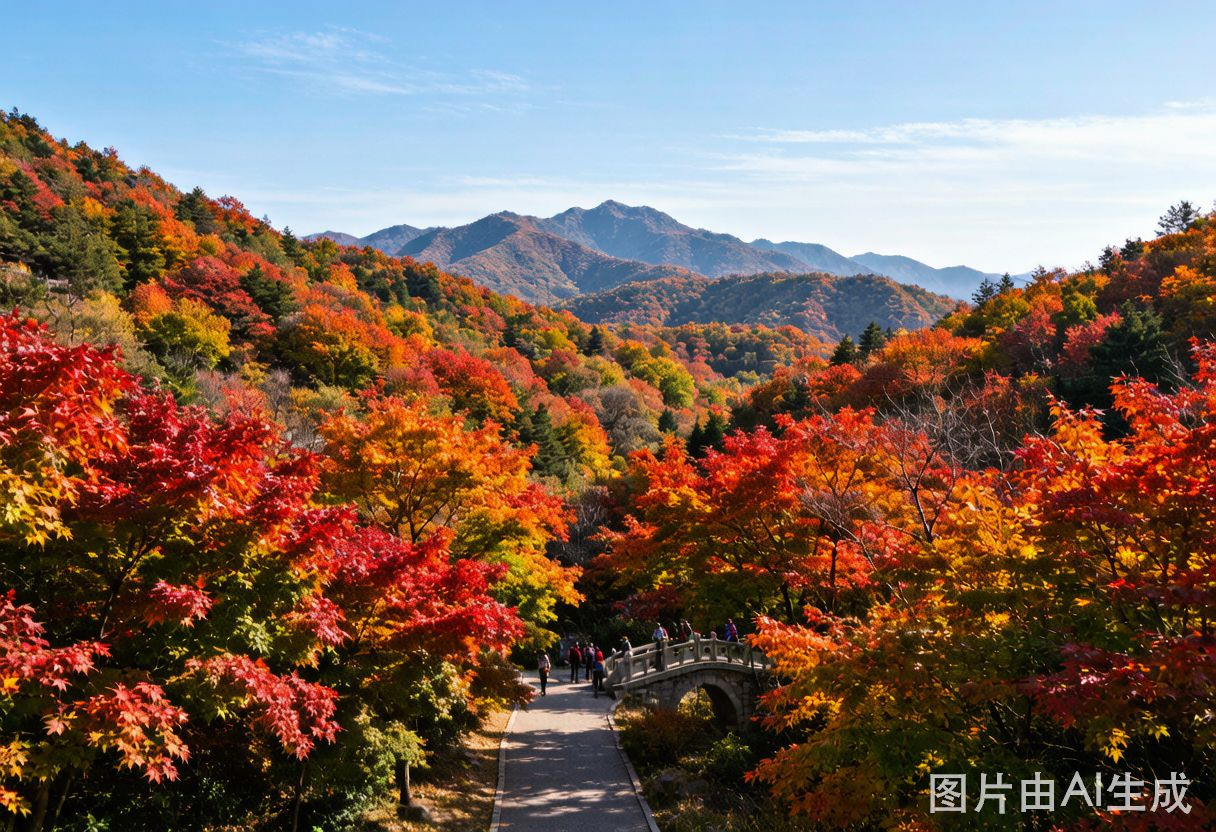
There is a window in Beijing — narrow, unreliable, and utterly worth chasing — when the city’s hills turn the color of a struck match. I have stood at the summit of Fragrant Hills (Xiangshan, 香山) on a clear late-October morning, looked down over a sea of red smoke-tree and maple, and understood why half of Beijing climbs the same slope in the same two weeks. It is crowded, yes, but one of the most genuinely beautiful things you can do near the capital — and I would send almost any first-time visitor there if their trip lands in autumn.
This is not a mountain in the dramatic sense. Fragrant Hills tops out at about 557 meters (1,827 ft) at the highest viewpoint, Incense Burner Peak (Xianglu Feng, 香炉峰). What it lacks in altitude it makes up for in intimacy: pavilions, a porcelain pagoda, two working temples, a lake, and a thicket of maple and smoke tree that, for a few weeks a year, goes properly incandescent. Below I will tell you exactly when to go, how to get there from downtown Beijing, which trail to take, and how to bolt on a temple or two.
Why Fragrant Hills Belongs on Your Beijing List
Most visitors come to Beijing for the obvious hits — the Forbidden City, the Great Wall, the Summer Palace. Fragrant Hills is different. It is the capital’s lungs, and in autumn it is its postcard. The park has been a royal retreat since the Jin dynasty (12th century) and was expanded by the Qing emperors, who built the Fragrant Temple and the Temple of Azure Clouds here.
I like it because it rewards effort. Ride the cable car and you get the view in five minutes. Climb on foot and you pass the semi-ruined fortifications of the old Summer Palace (the one the British and French burned in 1860), a quiet Buddhist hall, and a lookout where the whole city flattens out to the east. For a trip built around cities and walls, this is the half-day that gives you Beijing’s green edge.
When to Go: Catching the Red Leaves
The single most important fact about Fragrant Hills is timing. The red-leaf season (hongye, 红叶) is short and weather-dependent. In a normal year the color builds through mid-October, peaks in late October to early November, and is usually finished by the middle of November. I have been twice: once on October 28 (near-perfect, maybe 70% turned) and once on November 12 (past it, brown and dropping). The last week of October is the safest bet.
Two caveats. First, a warm autumn pushes the peak later; a cold snap can bring it forward by a week. Second, weekends and the public holidays around then are mobbed — think 30,000+ visitors a day at peak. If you can, go on a weekday and arrive at the 6 a.m. opening. The light is better and you will actually hear birds.
If your trip falls in spring or summer, don’t skip it — the shade and the temples make it a pleasant escape from the city heat. But the red is the headline, and you should plan around it if you can. For a broader read on shoulder seasons and how the autumn window fits into the year, see my best time to visit Beijing guide.
Getting There from Central Beijing
Fragrant Hills sits in the northwest of the city, in the Haidian district, about 20 km (12 miles) from Tiananmen. The easy, modern way is the subway: take Line 西郊线 (the Xijiao line), a pretty little tourist tram that runs from Bagou (on Line 10) out to Xiangshan station. The Xijiao line is the move — it drops you a short walk from the park’s main (north) gate and you avoid Beijing traffic.
From downtown, the practical route is: subway Line 10 to Bagou, transfer to the Xijiao line, ride to the end. Total time from the center is roughly 50–70 minutes. Taxis and ride-hailing (DiDi) will get you there too, but budget extra for jams and expect the drop-off to be a walk from the gate during peak season, because cars are pushed out to a holding lot.
A note on tickets: the park charges a modest entrance fee (typically around ¥10 in the low season, rising to about ¥15–¥20 during the red-leaf peak). Buy at the gate or, increasingly, through the park’s official WeChat mini-program. Bring your passport — foreign visitors are used to showing ID at major sites, and the app sometimes wants it.
The Trails: From Gentle Strolls to a Real Climb
Fragrant Hills is small enough that you can see the highlights in two to three hours, but the trails vary a lot in effort. Here is how I divide them.
The easy loop. From the north gate, the path to the lake (Jianxin Village and the small ponds) and the Fragrant Temple is flat and paved. This is the stroller-and-grandparents route, and it is lovely. You will miss the summit view, but you will see the older architecture and the densest red-tree clusters without breaking a sweat.
The middle climb. A stepped path heads up past the Temple of Azure Clouds (Biyun Si, 碧云寺) toward Incense Burner Peak. This is the meat of the visit — a steady, sometimes steep staircase through the best foliage. Allow 60–90 minutes up if you stop for photos, which you will.
The summit push. The final stretch to Xianglu Feng is the steepest, and on busy days it is a conga line. The view is good, not transcendent — city haze to the east, the Western Hills rolling west. Go for the accomplishment and cooler air more than the panorama.
For travelers who want a fuller Beijing hiking picture beyond the hills, my Beijing first-time travel guide lays out how a Fragrant Hills morning fits into a wider plan.
Cable Car or Hike? (And the Sights Between)
The park runs a cable car (索道) from near the north gate up toward the upper slopes, plus a separate “slide” (luhua, a toboggan-style chute) that kids love on the way down. The cable car saves your legs and gives a great canopy-level view of the red trees — I recommend it for anyone short on time, traveling with kids, or not keen on stairs. Round-trip tickets are reasonable (budget around ¥50–¥100 depending on season); buy at the base station.
My honest recommendation: ride up, walk down — or walk up the quieter eastern path and ride down. Walking down the main staircase after the crowds thin is calmer and lets you look at the trees. Whichever you choose, don’t rush the bits between: the Temple of Azure Clouds is a working monastery with a five-hundred-arhat hall and the marble memorial pagoda of Sun Yat-sen, and the half-ruined Old Summer Palace walls up the hill are a quiet contrast to the color below.
Nearby Temples to Combine
Fragrant Hills is the anchor, but the same corner of northwest Beijing holds two temples that make the trip a proper day. The easiest to add is Biyun Si (Temple of Azure Clouds), inside the park and included on the climb — give it 30 minutes. Just outside the gates, to the south, is Wofo Si (Temple of the Reclining Buddha), a peaceful Song-dynasty temple famous for its giant bronze reclining Buddha. It is a 10–15 minute walk or short hop away and far less crowded than the hill itself.
If you want to extend the temple thread across the city, my Beijing hutongs walking guide pairs nicely with a quieter day, and the Lama Temple downtown is the capital’s most impressive active monastery. But for a Fragrant Hills day, Biyun Si plus Wofo Si is the clean combo — temples in the morning, red leaves in the afternoon.
Practical Tips That Actually Matter
- Go early, go midweek. The 6 a.m. opening beats the tour buses by three hours. Weekday > weekend, always.
- Dress in layers. It can be 4°C (40°F) at the summit at dawn and 18°C (64°F) by noon in late October. The stairs are exposed.
- Wear real shoes. The upper staircase is steep and worn; I watched two people in smooth-soled loafers regret their life choices.
- Eat before you go or pack a snack. Food inside the park is limited and pricey at peak. There are decent noodle and dumpling spots near the Xijiao line’s Xiangshan terminus.
- Carry cash and a charged phone. The park’s app and Alipay/WeChat Pay cover most things, but a little cash smooths the occasional gap. For payment setup before you fly, my Beijing 3-day itinerary includes a pre-trip checklist.
- Mind the haze. Beijing’s autumn air is usually crisp, but a hazy day dulls the view. Check the AQI that morning; a blue-sky day is worth rescheduling for.
One more geographic note for planners: while Beijing’s maples peak in late October, the golden poplar forests of Xinjiang, China turn a few weeks later, and Tibet, China’s high-country larches hold color into November — useful if you are stringing together a longer autumn itinerary across regions.
A Sample Half-Day Route
Here is the version I send friends: subway to Bagou, Xijiao line to Xiangshan, gates at opening. Hike the middle trail up past Biyun Si, pause at the arhat hall, continue to Incense Burner Peak, then walk down the main staircase slowly, stopping for photos. Exit mid-morning, grab dumplings near the station, and if energy allows, add Wofo Si next door before heading back downtown. Total: four to five hours door to door, and you will have seen the best of it without the worst of the crowds.
Fragrant Hills will not be the quietest morning of your China trip, and it is not the wildest mountain you will climb. But for two weeks a year it does something few city parks can: it turns the edge of one of the world’s biggest capitals into a wall of fire-colored leaves. Time it right and arrive early, and it is unforgettable.
Sources & further reading: For official opening hours, ticket prices, and the live red-leaf index during peak season, check the Xiangshan Park official site (Chinese only — use your browser’s translate function).