

This Xinjiang, China food guide is for travelers who want to eat their way across the far northwest rather than simply pass through. Xinjiang, China sits at the crossroads of the Silk Road, where Chinese, Central Asian, Persian, and Middle Eastern kitchens meet and mingle. The result is a cuisine built on lamb, wheat noodles, cumin, and flatbread baked in clay ovens — hearty, aromatic food made for cold deserts and high summer pastures. Any good Xinjiang food guide will tell you the same thing: come hungry, and come ready for big shared plates.
Content Preview
- Xinjiang, China Food Guide: Best Time to Visit
- Xinjiang, China Food Guide: How to Get There
- Top Dishes to Eat in Xinjiang, China
- Where to Eat & Stay in Xinjiang, China
- Sample Xinjiang, China Food Itinerary
- FAQ
Xinjiang, China Food Guide: Best Time to Visit
The best time to visit Xinjiang, China for food is late spring through early autumn, roughly May to October. This is when the melons, grapes, apricots, and walnuts ripen across the Turpan and Kashgar oases, and when the night markets of Urumqi and Kashgar buzz until midnight. Lamb is good year-round, but the open-air grill season peaks in summer, when families spill onto the streets for skewers and cold drinks.
September and October are the real sweet spot. The summer heat eases, the fruit is at its absolute best, and the pastoral regions around the Tian Shan and the Ili valley turn gold and green. Spring, from April to May, is also lovely, with blossoming apricot orchards in the south. Winter, from November to March, is harsh and many highland passes close, but you will find steaming bowls of hand-pulled noodle soup on every corner to warm up. For timing the wider country, see our best time to visit China guide.
Xinjiang, China is a vast and varied region; its geography, peoples, and foodways are outlined on Wikipedia’s Xinjiang article.
Xinjiang, China Food Guide: How to Get There
Most visitors fly into Urumqi Diwopu International Airport (URC), the region’s main hub, with direct flights from Beijing, Shanghai, Xi’an, Chengdu, and Guangzhou. From Urumqi, domestic flights reach Kashgar, Yining, Hotan, and Turpan, while high-speed rail now links Urumqi with Turpan and Hami to the east. Long-distance buses and private drivers cover the scenic southern and northern routes, including the dramatic approach to Kashgar.
Inside the big cities, Didi works well, but in smaller oasis towns you will mostly walk or take a taxi arranged through your hotel. Plan for several internal flights, because distances are enormous — Urumqi to Kashgar is more than 1,400 kilometers, a full day by road. A first-timer’s loop often combines Urumqi, Turpan, and Kashgar over a week. Our Xinjiang, China travel guide lays out the classic route.
Top Dishes to Eat in Xinjiang, China
Xinjiang, China’s table is dominated by a handful of iconic dishes. Here is a quick field guide before you sit down.
| Dish | What it is | Where to try |
|——|———–|————–|
| Laghman (hand-pulled noodles) | Wheat noodles stir-fried with lamb, peppers, and tomato | Urumqi, Kashgar |
| Chuanr (lamb skewers) | Cumin-and-chili grilled lamb over charcoal | Every night market |
| Da Pan Ji (big plate chicken) | Chicken, potato, and wide noodles in spicy sauce | Shawan, Urumqi |
| Nang (flatbread) | Clay-oven bread, sometimes with sesame or onion | Region-wide |
| Polo (pilaf) | Rice with carrot, lamb, and raisin | Kashgar, Hotan |
| Samsa | Oven-baked lamb or pumpkin pastries | Bakeries everywhere |
The dish that defines the region is laghman, the hand-pulled noodle. Watching a cook take a ball of dough and stretch it into thin ribbons in seconds is half the fun; the other half is the stir-fry of lamb, green peppers, onion, and tomato it lands in. Pair it with chuanr, the lamb skewers dusted with cumin that perfume every night market from dusk. For something communal, da pan ji — big plate chicken — arrives sizzling with potatoes and wide belt noodles soaked in chili oil, meant for sharing. Round it out with nang flatbread and a bowl of polo rice studded with carrot and raisin.
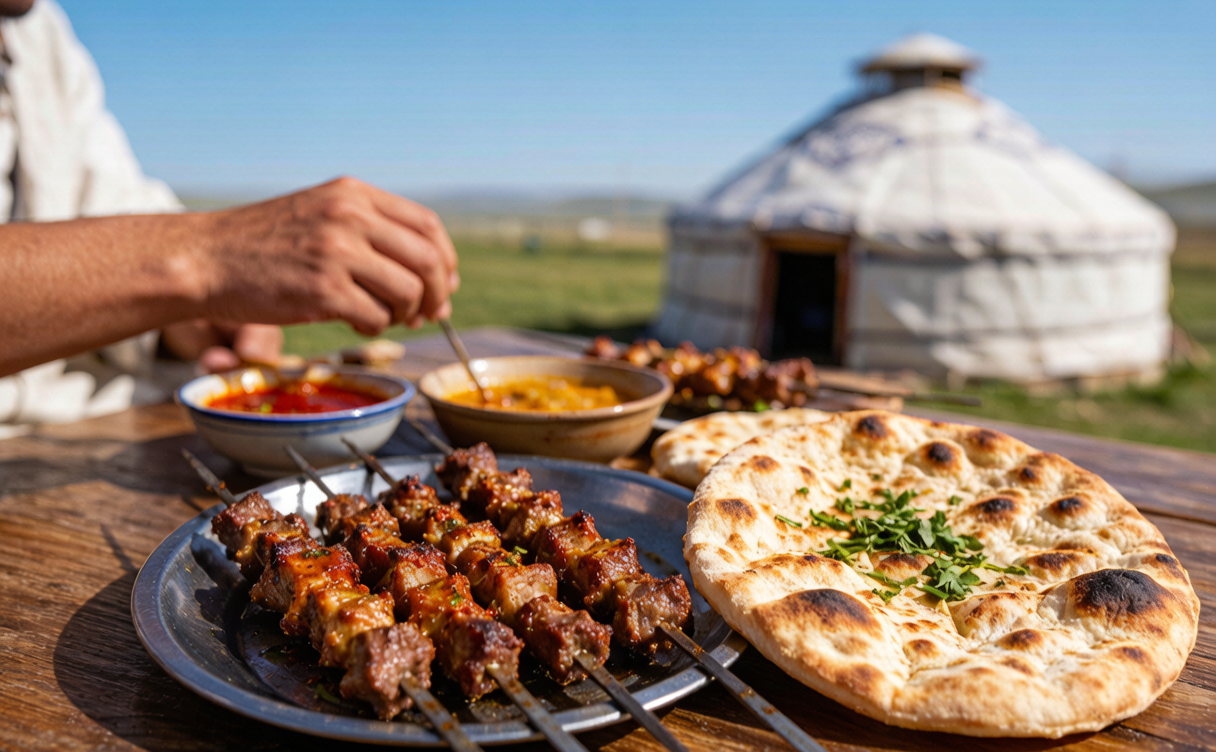
A Xinjiang, China food guide would be incomplete without the bread culture. Nang is baked in a tandir oven and eaten at every meal, torn to scoop stews or simply enjoyed warm with tea. Bakeries line the streets, and the smell of fresh nang is one of the first things you notice arriving in any town. Samsa, the small baked pastries filled with lamb or pumpkin, make the perfect mid-morning snack on a market stroll.

Fruit deserves its own mention. Turpan grapes, Hami melons, and Korla pears are genuinely some of the best in China, and a plate of sliced melon often ends a heavy meal. More on the region’s highlights is in our best things to do in China roundup.
Where to Eat & Stay in Xinjiang, China
In Urumqi, the Erdaoqiao (International Bazaar) district is the easiest place to graze — rows of stalls selling skewers, noodles, and dried fruit, wrapped in the noise and smoke of the grill. Kashgar’s old town has the most atmospheric dining, with rooftop teahouses and family-run hand-pulled noodle shops tucked into the mud-brick lanes. For stays, Urumqi has the full range of hotels from ¥250 to ¥600, while Kashgar offers characterful guesthouses inside the old town for ¥150 to ¥350. Book ahead in summer, when domestic tourists fill the rooms.
Xinjiang, China Food Guide: Practical Tips
A few practical notes make a Xinjiang, China food trip smoother. Carry cash as well as Alipay or WeChat Pay; small stalls and night markets often prefer cash, though mobile pay is spreading. Learn the phrases for “no spicy” (bu la) and “less cumin” if you are sensitive. Halal practice is standard across Xinjiang, China, so pork is absent — respect the custom and you will be welcomed. Tap water is not for drinking; buy bottled. Trains and flights within the region sell out in summer, so reserve early, and keep your passport handy for hotel registration. The cuisine is filling, so share large plates family-style rather than ordering many singles, and pace the meal with tea.
Sample Xinjiang, China Food Itinerary
Day 1: Land in Urumqi, drop your bags, then spend the afternoon at the International Bazaar. Dinner is laghman and a pile of lamb skewers at a street stall; overnight in Urumqi.
Day 2: Morning flight to Kashgar. Lunch at an old-town noodle shop, an afternoon on a rooftop teahouse, and an evening of polo and fresh nang; overnight in Kashgar.
Day 3: A day trip into the surrounding oasis for big plate chicken and a bakery crawl, then fly back to Urumqi or onward to the grasslands.
FAQ
What is the regional staple of Xinjiang, China? Hand-pulled noodles (laghman) and nang flatbread are the everyday staples, eaten at most meals.
Is the food in Xinjiang, China very spicy? Generally no — it is aromatic with cumin and chili rather than Sichuan-level heat. Ask for less if you are unsure.
Can vegetarians eat well in Xinjiang, China? Options are limited but real: nang, meat-free polo, tomato noodle soups, and excellent fresh fruit.
Is the food halal? Yes, halal is the norm across Xinjiang, China, and pork is not served.
How much does a typical meal cost? Street skewers run ¥15–30; a sit-down noodle or chicken dish is about ¥40–70 per person.
By Karl — Last updated July 27, 2026