

I still remember the first time I stepped onto the coarse sand at Tianya Haijiao and looked up at two giant grey boulders rising out of the South China Sea. The wind was warm, the waves were loud, and the carved characters on the rocks seemed to say something bigger than just a beach. If you are planning a trip to Hainan, this is one of those spots that surprises people who expected only resorts and cocktails. Tianya Haijiao is part love story, part geography lesson, and part open-air calligraphy museum.
Most foreign visitors have never heard the name before they land in Sanya. I hadn’t either. But once you understand what the place means to Chinese travelers, the crowds make sense. “Tianya” means “the edge of the sky” and “Haijiao” means “the corner of the sea.” Together they form the phrase that has meant “the end of the world” for more than a thousand years. For centuries, being sent to the far southern edge of the empire was a kind of exile. Today the same phrase is printed on postcards as a promise of romance.
What caught me off guard was how layered the meaning is. To an ancient official banished from the capital, Tianya Haijiao was a place of sorrow, the literal farthest point from home. To a modern honeymooner, it is a place of devotion, the farthest point you would gladly travel for love. Standing at the waterline, I could feel both readings at once. The sea does not care which story you bring, and that indifference is oddly comforting.
I would not call Tianya Haijiao a hidden gem. It is one of the most famous sights on Hainan and it earns the attention. But it is also easy to dismiss as a tourist trap if you only glance at the parking lot. Give it two hours and a curious mind, and the Tianya rocks turn into something closer to a cultural landmark than a photo stop.
Getting There from Sanya
Tianya Haijiao sits about 23 kilometers southwest of central Sanya, on the western side of the Sanya Bay coastline. I took a taxi from the Dadonghai area and it took roughly 35 minutes, depending on traffic, for a fare around 60 to 80 yuan. If you are on a tighter budget, public bus 25 and bus 26 both stop near the entrance, and the ride from downtown costs only a few yuan. Just be ready for a slower, bumpier trip.
The park has a clear main gate, a ticketing plaza, and a long seaside walk that connects the major boulders. I arrived around 9 a.m. and was glad I did, because tour buses started filling the parking lot by late morning. If you stay near Sanya beach travel guide areas like Yalong Bay or Dadonghai, a half-day trip here is easy to fit in.
What to See
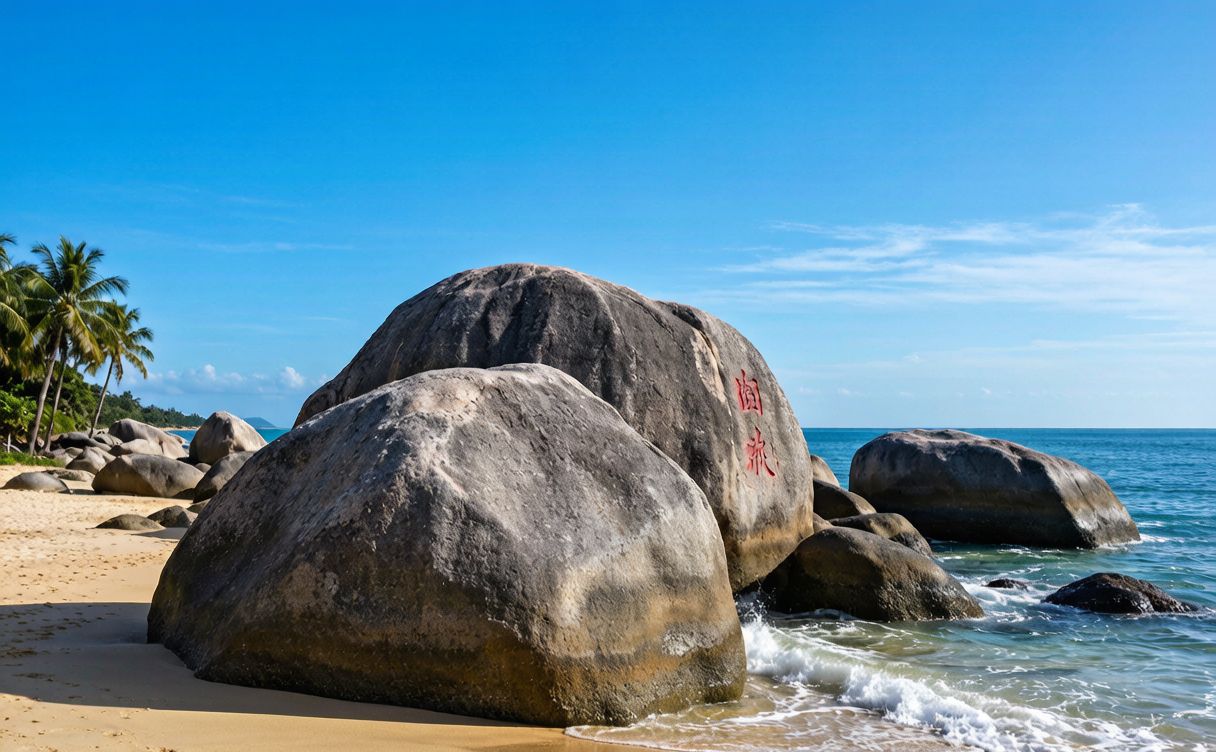
The whole site is built around a flat stretch of beach backed by weathered granite boulders. Unlike the high-rise hotels of Sanya Bay, this coastline feels raw and a little wild. The main path runs west along the shore, and every few hundred meters you meet another stone with a story. I walked slowly, because the best views are not the rocks themselves but the way the rocks frame the horizon.
Beyond the named boulders, there is a long public beach where locals fly kites and wade in the shallows. I watched a grandmother teaching a child to skip stones while a wedding couple posed for photos nearby. That mix of everyday life and tourist spectacle is exactly what makes Tianya Haijiao feel real rather than staged. There is also a small garden area, a coastal boardwalk, and a few cafes near the exit if you need shade and a cold drink.
The Inscribed Boulders
This is the heart of the visit. The two most famous Tianya rocks stand close together near the waterline. One is carved with “Tianya” (天涯) and the other with “Haijiao” (海角). Standing between them, with the sea behind, is the classic photo every visitor takes. I queued for about ten minutes to get a clean shot, and I do not regret it.
A third stone nearby reads “Nantian Yizhu” (南天一柱), meaning “a pillar holding up the southern sky.” It is smaller but somehow more dramatic, a single upright rock that looks like it was dropped there by a giant. Further along, you will find boulders inscribed by scholars and officials from the Song and Qing dynasties. As someone who usually skips museums, I found these open-air carvings more moving than I expected. The Tianya rocks are not just scenery; they are a record of how people once thought about distance, exile, and home.
One detail I loved: the characters were not painted on. They were chiseled deep into the granite by hand, then weathered by salt wind for generations. Some are crisp, others are half-faded, and that unevenness tells its own story about time. I ran my fingers along a Qing-era inscription and tried to imagine the official who ordered it, probably missing the capital as much as I was missing my own kitchen back home. Small moments like that are why I keep coming back to China’s older sites instead of only its cities.
If you enjoy this kind of carved-stone heritage, it sits in the same family of Chinese landmarks as the famous Suzhou tiger hill and the cliffside art of the Chongqing Dazu rock carvings. Different regions, different styles, but the same human urge to leave a mark where the land feels permanent.
The symbolism explains why couples love this place. In modern Chinese pop culture, declaring “I will go with you to Tianya Haijiao” is like saying “I will follow you to the ends of the earth.” On my visit I saw at least a dozen engagement shoots. If you are traveling with a partner, the romantic angle is hard to miss. If you are solo, like I was, the geology and history are more than enough.
Tips
Buy your ticket online in advance if you can. The standard entry is around 68 to 95 yuan depending on season, and online platforms sometimes shave a few yuan off the gate price. Bring sunscreen, a hat, and water. There is little natural shade on the open beach, and the Hainan sun is no joke by midday.
Wear shoes you do not mind getting sandy. The path is partly paved but the beach sections are loose gravel and shell. I wore sandals and was fine. Avoid the loudest midday window if you want photos without strangers in every frame; early morning or late afternoon gives softer light and smaller crowds.
Watch out for the “free” photography touts near the entrance. A few people offered to take my picture and then asked for payment. Polite refusal works. Also, the on-site restaurants are convenient but pricey, so I ate a late breakfast before coming and grabbed a coconut from a street vendor outside the gate instead.
Best Time
Sanya is warm all year, but the most comfortable months are November through April, when the humidity drops and the temperatures sit in the high 20s Celsius. I visited in March and the weather was perfect for a long walk. The summer months, May through September, are hotter and bring the occasional typhoon, though the park usually reopens quickly after storms.
Try to time your arrival for the morning or the last two hours before closing. The light is better for photos and the tour groups thin out. Weekdays beat weekends almost every time. If you are building a wider Hainan itinerary, pair this stop with a relaxed beach afternoon, and you will see both the wild and the tame sides of Sanya’s coast.
Good to know: For official opening hours, ticket prices, and seasonal notices, check the Sanya Tourism Board site before you go: Visit Sanya (official tourism board). I always confirm the day before, because holiday schedules in China can shift quickly.
Want more ideas for your China trip? Here are a few hand-picked reads from our team.