

When I tell fellow travelers that Nanjing has a free, 500-year-old imperial lake sitting right next to its main train station, most people look surprised. Xuanwu Lake (also spelled Xuanwuhu, or simply “Nanjing lake” on older maps) is one of those places that locals treat as a casual weekend backyard and visitors treat as a hidden gem. I spent three full days walking its causeways, and I still haven’t seen every corner.
This guide is the one I wish I’d had before my first visit. I’ll walk you through how to get there, what’s actually worth seeing, the five islets that make up the park, and the practical tips that saved me time and money.
Getting There
Xuanwu Lake’s biggest advantage is location. The park’s south gate (Xuanwu Men, 玄武门) sits about 1.5 km north of Nanjing’s city center, and the lake’s eastern shore is a five-minute walk from Nanjing Railway Station. When I arrived by high-speed train from Shanghai, I dropped my bag at a hotel near the station and was standing on the lakeshore within twenty minutes.
By metro, take Line 1 to Xuanwumen Station (Exit 3 or 4) for the south gate, or Line 1/3 to Nanjing Railway Station for the north shore. Both are clearly signed in English and Chinese. Buses 1, 33, and 35 also stop near the gates, but I found the metro far simpler with luggage.
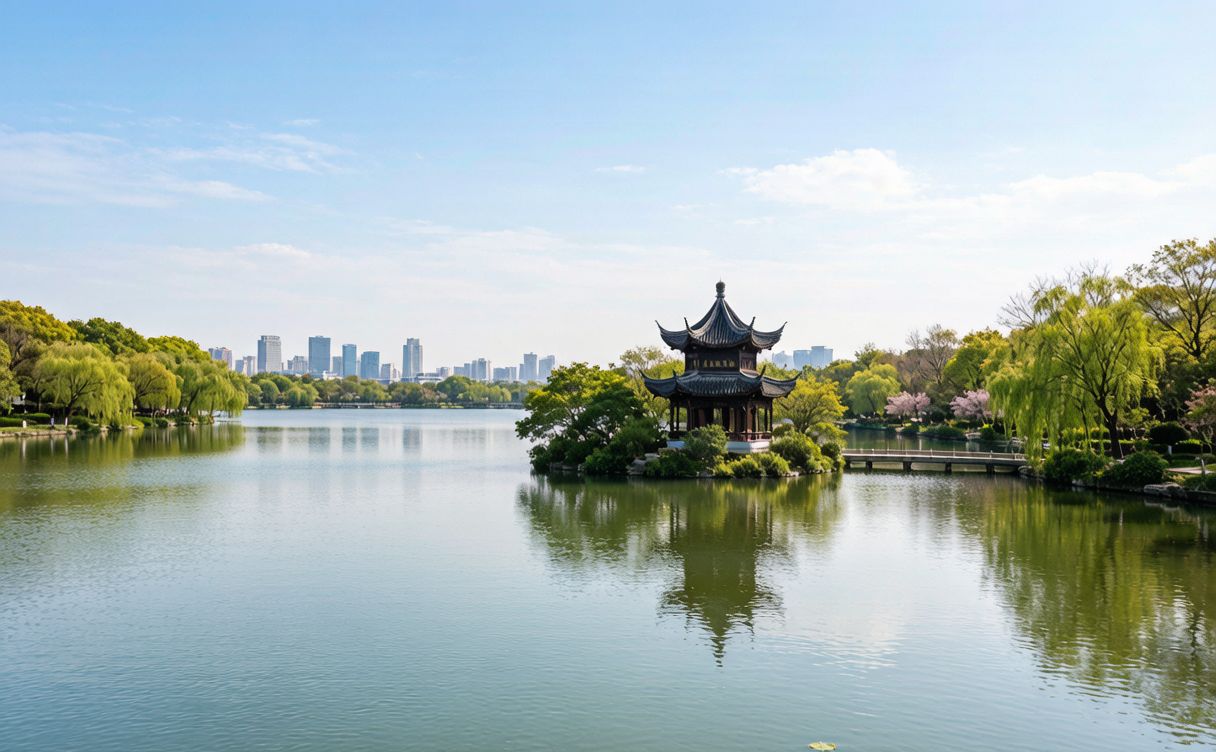
The park has multiple entrances and is open from roughly 6:00 a.m. to 9:00 p.m. Best of all, entry to the lakeside park itself is free. You only pay for boat rentals, the small zoo, and a couple of pavilion attractions inside.
What to See
The first thing that struck me was the scale. Xuanwu Lake covers about 3.7 square kilometers, with water making up most of that. A ring road and a series of causeways connect everything, so you can circle the whole lake on foot in two to three hours at a relaxed pace.
My favorite quiet spot was the Ming City Wall section that runs along the lake’s southern edge. You can climb part of the wall and look down on both the water and the modern skyline beyond. At sunset, the contrast between 600-year-old brick and glass towers is genuinely photogenic.
Boating is the signature activity. I rented a pedal boat for 60 RMB per hour and spent an hour drifting near the islets — far cheaper and more peaceful than the motorized tours. Electric sightseeing carts also loop the perimeter if you’d rather save your legs.
The Xuanwu Lake Zoo sits on the eastern shore and is a modest, older-style zoo. I’d skip it unless you’re traveling with kids; the real draw is the open water and gardens.
One detail I appreciated as a photography-minded visitor: the lake changes mood throughout the day. Mornings bring fog that softens the far islets into watercolor shapes. Midday is bright and energetic, full of families and paddle boats. Evening turns the water gold as the city lights flicker on behind the wall. I ended up visiting at three different hours just to catch all three atmospheres, and each felt like a different park.
If you enjoy gardens, look for the restored Fangqiao tea pavilions near Liang Island. I stopped for a 15 RMB cup of local green tea and watched elderly locals play cards under the pavilion roof — a slice of everyday Nanjing that no museum can replicate.
The Five Islets
Xuanwu Lake is divided into five connected islets, each with its own character. Understanding them helps you plan a route instead of wandering aimlessly, which is exactly what I did on day one.
- Ling Island (菱洲) — the easternmost islet, known for open lawns and the zoo. Good for families.
- Huan Island (环洲) — shaped like a ring, famous for weeping willows and thePu Qing monument. It’s the most planted and shaded.
- Ying Island (樱洲) — the cherry blossom island. In spring this is the busiest and prettiest corner of the lake.
- Liang Island (梁洲) — the historical heart, home to the Nanjing Museum of Paleontology gardens and the oldest architecture. I spent the most time here.
- Cui Island (翠洲) — the quietest, with bamboo groves and a small botanical feel.
I recommend starting at Liang Island for the history, crossing to Ying Island if you’re visiting in March or April, then looping back along Huan Island’s willow path. That half-day loop hits the highlights without backtracking.
Don’t expect the islets to feel wild or remote. This is a cultivated imperial landscape, not a nature reserve, and that’s part of its charm. Every causeway is paved, every viewpoint has a bench, and signage is decent in English. For travelers who want a low-effort, high-reward taste of Chinese garden design without leaving a major city, the five-islet layout delivers exactly that.
Tips
A few things I learned the hard way that will make your visit smoother:
- Go early. By 9 a.m. on weekends the causeways fill with joggers, photographers, and tour groups. I arrived at 7 a.m. one morning and had the misty water almost to myself.
- Bring water and snacks. There are vendors, but prices rise near the main gates. The park is huge, and shade is limited on the open causeways in summer.
- Boats stop at dusk. If you want to paddle, go before 5 p.m. — rentals close earlier than the park gates.
- Free doesn’t mean empty of cost. Budget 60–120 RMB per person if you plan to boat and enter a paid pavilion.
- Wear comfortable shoes. The full loop is 9+ km if you walk every causeway. I logged 18,000 steps on my circle day.
Best Time
Spring is the headline season. From late March to mid-April, Ying Island’s cherry blossoms turn the lake pink, and the weather is mild enough for all-day walking. I visited in early April and the blossom crowds were real but manageable before 8 a.m.
Autumn (October–November) is my personal favorite. The sweet osmanthus trees along the causeways scent the whole park, and the clear skies make the city-wall views crisp. Summer is hot and humid, though the lake breeze helps; winter is cold but beautifully empty, with occasional frost on the willows.
Good to Know
Xuanwu Lake has been a royal park since at least the Six Dynasties period (around 1,500 years ago) and later served the Ming dynasty. Today it’s managed as a public park by the city. For official opening hours, seasonal events, and any ticketing changes, check the Nanjing municipal tourism portal, which publishes updates in both Chinese and English.
If you’re building a China itinerary around iconic scenery, don’t miss our list of China bucket-list attractions — Xuanwu Lake pairs perfectly with a stop in nearby Suzhou or Hangzhou.
Xuanwu Lake surprised me more than almost any paid attraction in Nanjing. It’s free, central, and endlessly walkable — the kind of place you return to each morning of your stay. If your China trip includes Nanjing, put it at the top of your list and give it a full half-day. You won’t regret the early start.