

There’s a moment, somewhere around minus twenty, when your breath hangs in the air like smoke and the whole world goes blue and white. That’s the Harbin Ice Festival. Every January and February, this northeastern city turns the Songhua River’s frozen surface and a sprawling park on its banks into the largest ice and snow sculpture show on earth. I’ve stood inside a six-story ice castle lit from within by colored LEDs, walked a snow corridor carved into the shape of a Russian cathedral, and watched teenagers sled down a slide built entirely from packed snow. If you can handle the cold, Harbin is the most surreal winter trip in China — and the most photogenic.
At a glance
- Best time to visit: Mid-January to mid-February, when the sculptures are freshest and the Ice and Snow World is fully open.
- How many days: 3 to 4 days covers the main sites without rushing.
- How to dress: Layers, and then more layers. Down jacket (-25°C rated), thermal base layer, insulated waterproof boots, thick gloves, hat that covers ears, and a face mask for windy days.
- Getting there: Fly direct from Beijing, Shanghai, or Seoul; or take an overnight high-speed train from Beijing (about 7–8 hours).
- Don’t miss: Ice and Snow World at night, Sun Island snow sculptures by day, and Saint Sophia Cathedral for the city’s Russian side.
What the Harbin Ice Festival actually is
The event is officially the Harbin International Ice and Snow Sculpture Festival, and unlike a single fenced exhibition, it spreads across several sites. The two headliners are Ice and Snow World (built from blocks cut out of the Songhua River) and the Sun Island Snow Sculpture Art Expo (carved from compacted snow). Add the smaller Zhaolin Park ice lantern fair and the city’s Russian-architecture backdrop, and you’ve got a winter festival that feels closer to a frozen art biennale than a carnival.
The festival usually opens on January 5 and runs through late February, though the biggest, brightest displays are at their peak from mid-January. After that, warmer days start to round off the sharp edges of the sculptures, so plan early in the window if you want crisp detail.
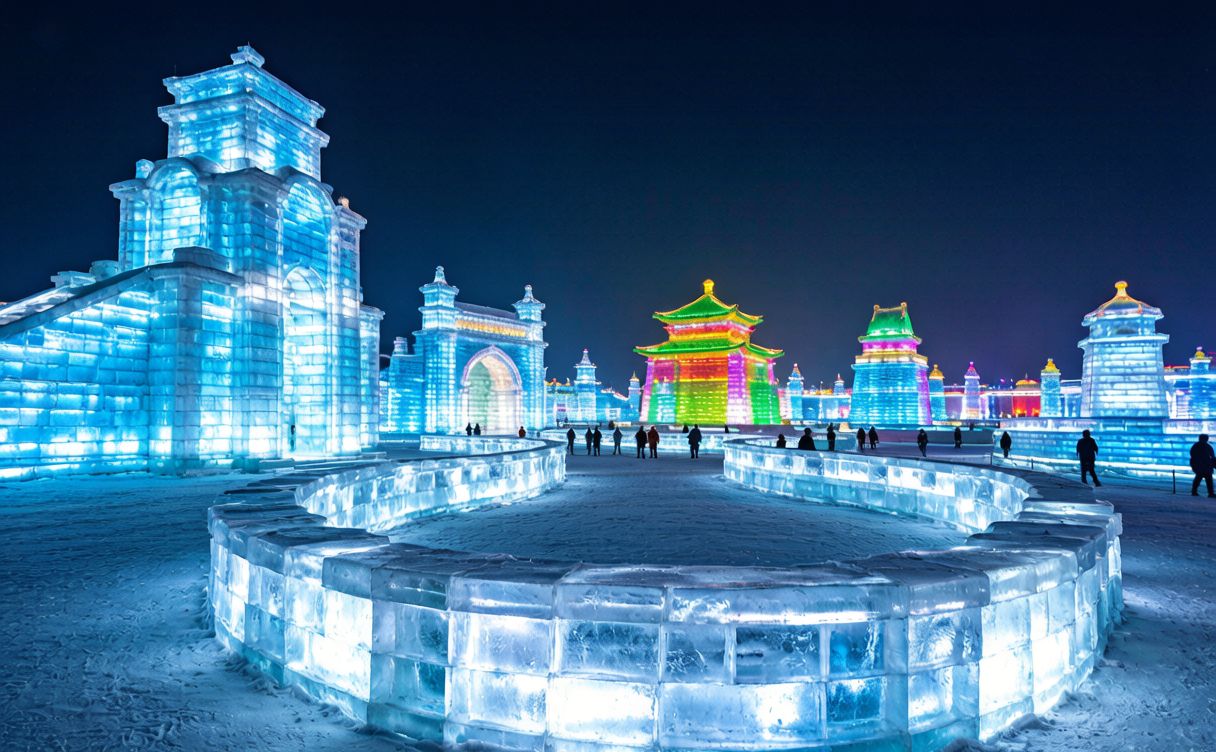
Ice and Snow World: the main event
This is the one people travel for. Workers cut enormous blocks of transparent ice from the river, and teams of carvers build full-size palaces, pagodas, and slides you can actually ride. At night the ice glows from inside, lit in reds, greens, and blues, and the scale is hard to grasp until you’re standing under a tower that dwarfs you.
A few practical notes from experience:
- Go after dark. The ice is clear and gray during the day; the lights are what make it magical. Arrive around 4 p.m. to watch the transition, or simply come at night.
- Buy tickets online in advance. The park caps daily entries during peak weeks. Booking ahead also saves you from freezing in a ticket line.
- Ride the slides early. The popular ice slides build long queues by mid-evening. Hit them first.
- Mind the cold on metal. Gloves off for photos means fingers go numb fast. Keep a thin liner glove under your mittens.
Sun Island and the snow sculptures
Across the river on Sun Island, the focus shifts from ice to snow. The Snow Sculpture Art Expo is where you’ll see the giant figures — dragons, mythical creatures, and intricate architectural replicas all carved from packed snow. Because snow is softer and whiter than ice, these read as detailed white reliefs rather than glowing structures. Go in the morning for flat, even light and smaller crowds, then warm up inside the island’s indoor exhibits.
The island also has a small Siberian tiger park nearby and makes a calm counterpoint to the sensory overload of Ice and Snow World. If you only have one full day, do Sun Island by day and Ice and Snow World by night — they’re on opposite banks but a short taxi ride apart.
Saint Sophia Cathedral and Harbin’s Russian soul
Harbin’s Russian layer runs deeper than the festival. Built by Russian expatriates in the early 1900s, Saint Sophia Cathedral is a red-brick Byzantine structure with green domes that dominates a central square. It’s now a museum, but the exterior alone is worth the walk, especially at dusk when floodlights turn it gold. The surrounding Daoli district still has tree-lined streets and faded European facades from the city’s days as a stop on the Trans-Siberian railway.
For more of that atmosphere, stroll Stalin Park along the Songhua River. In winter the river freezes solid and locals set up ice fishing huts, horse-drawn sleds, and makeshift skating rinks. It’s free, it’s local, and it’s the best place to watch ordinary Harbiners enjoy the cold they’re born into.
Eating in Harbin: guobaorou and more
Harbin food leans hearty and a little sweet-sour, shaped by both northern Chinese and Russian influences. The dish to seek out is guobaorou (锅包肉) — thin slices of pork in a crisp batter, flash-fried and tossed in a tangy sweet-and-sour sauce. Done right, it’s loud, crunchy, and addictive. You’ll find it in nearly every local restaurant; ask for the “old style” (old-fashioned) version if you want the original vinegar-forward flavor rather than the tomato-sauce variant.
Other worth-trying items: hongchang (Harbin red sausage, a Russian legacy), madie’er ice cream (eaten outdoors at minus twenty, naturally), and dongbei cabbao (Northeast dumplings). Warm yourself with erguotou liquor or sweet hot soy milk between courses. For a broader map of regional cooking, our guide to China’s eight great cuisines explains where Harbin’s Northeast style fits in.
How to get to Harbin
Most international visitors fly into Beijing first, then connect. From Beijing you have two solid options:
- Flight: About 2 hours, multiple departures daily. Fastest and easiest if you’re short on time.
- Overnight train: A sleeper train from Beijing to Harbin takes roughly 11–13 hours; the newer high-speed services cut that to about 7–8 hours. Booking Chinese train tickets as a foreigner has its quirks, so read our step-by-step guide to booking China train tickets on 12306 before you try.
If you’re building Harbin into a longer trip, it pairs well with Beijing’s imperial sites — see our first-time Beijing travel guide for context on the city you’ll likely transit through.
Staying warm: clothing that actually works
Harbin’s cold is a different beast from a European ski resort. Temperatures regularly sit between minus 15 and minus 25 Celsius, and the wind off the Songhua River bites. The trick is layering with a real plan:
- Base layer: Merino wool or synthetic thermal top and bottom. Cotton holds sweat and will make you colder.
- Mid layer: A fleece or light down for insulation.
- Outer layer: A hooded down jacket rated to at least minus 25. Water-resistant is a bonus when you’re sitting on snow.
- Extremities: Insulated, waterproof boots with thick socks; gauntlet-style gloves you can fit a liner under; a hat that covers your ears; and a neck gaiter or mask for your face on windy nights.
- Hand warmers: Cheap disposable packets tucked into gloves and boots make a huge difference during long photo sessions.
Eye protection matters too — snow glare on bright days can sting, so sunglasses aren’t just for the slopes. And keep your phone in an inner pocket; batteries drain fast in the cold, and a dead phone means no maps and no photos of the ice.
Planning your days
A comfortable 3-day rhythm looks like this:
- Day 1: Arrive, settle in, walk Saint Sophia Cathedral and the central Russian-style streets in the afternoon, then a warm dinner of guobaorou.
- Day 2: Morning at Sun Island snow sculptures; afternoon warming up and cafe-hopping; evening at Ice and Snow World.
- Day 3: Stalin Park and the frozen Songhua River, local food crawl, last-minute photos, and an overnight train or flight out.
If you can add a fourth day, use it for the Siberian tiger park or a slower wander through Harbin’s older neighborhoods.
A few safety notes for the cold
The biggest risks in Harbin aren’t crime — they’re the weather and slippery surfaces. Slips on ice are the most common injury, so walk like a penguin on frozen paths: short steps, feet flat, weight forward. Exposed skin can frostbite in minutes at the windiest points, so cover up even if you feel fine. Stay hydrated and don’t underestimate alcohol in the cold — a little warms you briefly, but too much impairs the judgment that keeps you safe. Our China travel safety tips cover the broader picture, but the cold is Harbin’s own special challenge.
Final thoughts
Harbin rewards the prepared. Show up with the right clothes, accept that your nose will run, and give yourself fully to the strangeness of a city that builds cathedrals out of river ice. The Harbin Ice Festival isn’t a polite museum visit — it’s loud, freezing, dazzling, and unlike anywhere else you’ll stand in China. Go early in the season, charge your batteries (both yours and your phone’s), and let the cold become part of the story.
For the most current dates, ticket prices, and opening hours of the festival sites, check the official Harbin Ice and Snow World information before you fly.
Written by Karl.