

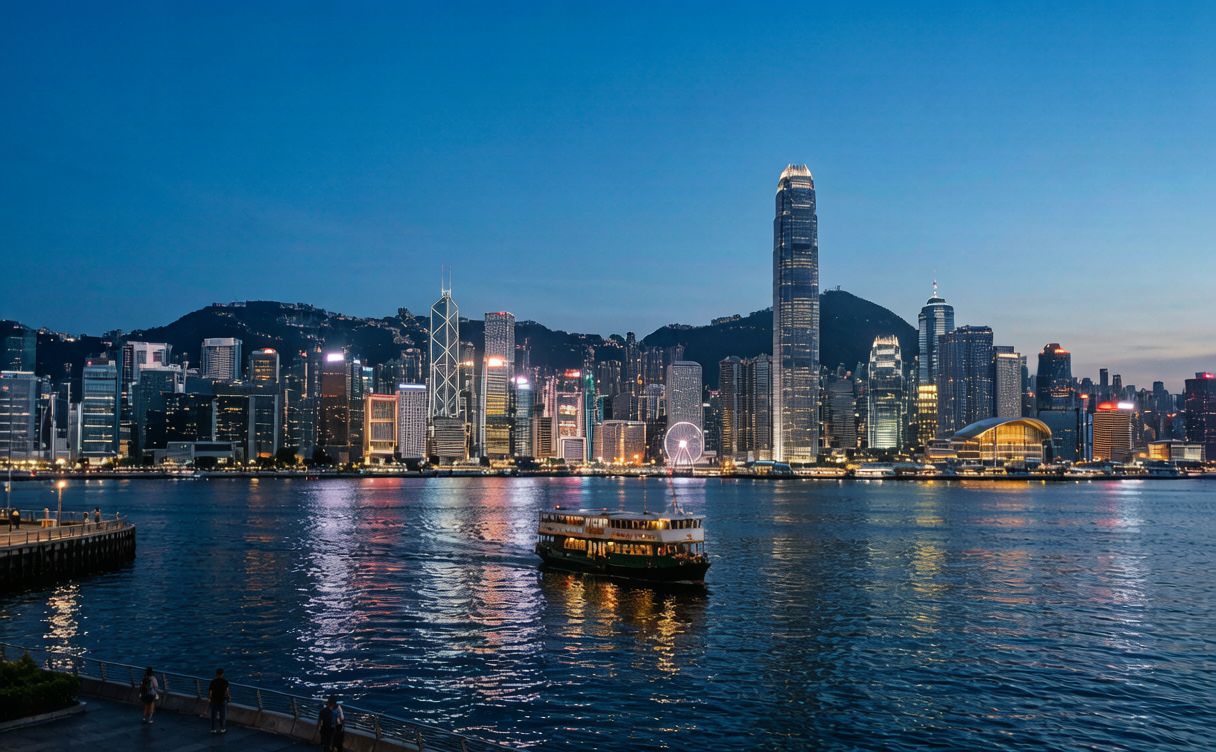
The first time I stood on the Tsim Sha Tsui waterfront after dark, I stopped mid-sentence. Victoria Harbour Hong Kong opened up in front of me like a switched-on city — a wall of towers on Hong Kong Island throwing reflections across the water, a junk boat drifting past with its red sail lit up, and the faint hum of ferries below. I had read about the view for years, but nothing prepares you for how close and alive it feels. This guide walks you through the best vantage points, the nightly Symphony of Lights, the humble Star Ferry that costs less than a snack, and the practical details that make a visit to Hong Kong, China smooth for first-time foreign travelers. By the end you will know where to stand, when to go, and how to move around without stress.
The Harbour As an Icon
Victoria Harbour is the strip of water between Hong Kong Island and the Kowloon Peninsula, and it has shaped the city’s life for more than a century. Ships still move freight through it, but for visitors the draw is the scale of the skyline and the way the water frames it. Hong Kong, China is a Special Administrative Region of China, and the harbour sits at the heart of one of the most visited destinations in the country for overseas travelers.
What makes the harbour special is balance. On the Kowloon side you stand low and look up at the towers. On Hong Kong Island you look back across at the softer, older hills of the mainland. The water in between means you are never just staring at a street — there is always movement, weather, and light to watch.
The harbour also tells the city’s story. Reclamation has pushed the shoreline outward over decades, and the buildings you photograph today stand where ships once docked. That layered history is part of why the view feels earned rather than staged. You are looking at a working port that also happens to be one of the most beautiful urban scenes on earth.
The Skyline & Best Viewpoints
You do not need a ticket to enjoy most of the view. The Tsim Sha Tsui waterfront promenade, near the Avenue of Stars, is free and open around the clock. Arrive about forty minutes before the 8pm light show to claim a railing spot, because the best angles fill up fast on weekends.
For the famous high angle, ride the Peak Tram up to Victoria Peak. The tram leaves from Central and climbs in about ten minutes; a round-trip ticket runs about HKD 88 (around USD 11). From the top, the whole harbour sits below you, and on a clear night the city looks like a circuit board. Buy tickets online to skip the worst of the queue, which can stretch past an hour on weekends. The walking paths around the summit add a quieter, greener frame to the skyline if you want to escape the crowds for a while.
Sky100, on the 100th floor of the International Commerce Centre in West Kowloon, is the other polished option. Entry is about HKD 118 (around USD 15) and the indoor observatory gives you a weather-proof view with big windows and a café. I go there when the humidity is thick and the Peak is buried in cloud — it still delivers. Between these three spots — the free waterfront, the Peak, and Sky100 — you can catch the Hong Kong skyline in every mood, from bright afternoon to full night.
Symphony of Lights
Every night at 8pm, more than forty buildings on both sides of the harbour take part in “A Symphony of Lights,” a synchronized light-and-sound show. It is free, it runs for about ten minutes, and it has been a Hong Kong, China tradition since 2004.
The easiest place to watch is the Tsim Sha Tsui waterfront, but the audio commentary only plays there through the supplied channel or at designated speakers. If you want a quieter experience, book a harbour dinner cruise or watch from a rooftop bar on Hong Kong Island. Either way, arrive early. The best photos come from the moment the first beam hits, not the middle of the show.
A practical note: the show is impressive but brief. Pair it with a slow walk along the promenade before and after, so the evening feels like an event rather than a ten-minute checkbox. On foggy nights the effect weakens, so check the weather and save it for a clear evening if your schedule allows.
The Star Ferry
The Star Ferry is the cheapest great view in the city. For about HKD 3.2 (around USD 0.40) on the upper deck, you cross from Tsim Sha Tsui to Central or Wan Chai and get the skyline from the water level. The boats have run since 1888, and the ride takes roughly eight to twelve minutes.
I treat the Star Ferry as a moving viewpoint rather than just transport. Stand at the front railing, feel the boat rock as it pulls away from the pier, and watch the towers rise. It runs from about 6:30am to 11:30pm, every few minutes at peak. An Octopus card taps you straight on, so you skip the ticket window. If you ride just before the 8pm show, you get the harbour in transition — daylight fading, lights switching on — which is my favourite single moment on the water.
How to Get There
Most foreign visitors fly into Hong Kong International Airport (HKG) on Lantau Island. The Airport Express train is the fast, low-stress choice: it reaches Central in about 24 minutes and costs about HKD 115 (around USD 15) one way, with free shuttle buses to major Kowloon and Hong Kong Island hotels. Buy the ticket at the airport station or load it onto your Octopus card.
From Central or Kowloon, the MTR underground gets you to Tsim Sha Tsui in minutes. Taxis are plentiful but pricey during rain, and many drivers prefer Octopus or cash in HKD. If you are building a wider China trip, compare this stop with our Shanghai Bund night-view guide, where the Huangpu River gives a similar skyline-and-water contrast on the mainland — a useful reference if you plan to see more than one Chinese city.
Day vs Night & Best Time
The harbour changes character completely between day and night. In daylight you see the mountains behind the towers and the working ships in the channel. After dark the architecture takes over and the Symphony of Lights does the rest. Try to see it both ways — a late-afternoon walk followed by the 8pm show is the classic one-day plan.
Hong Kong, China is warm and humid for most of the year. Autumn (October to early December) brings the clearest air and the most comfortable evenings, which is why I send most first-timers then. Summer is hot, with sudden heavy rain; winter is mild but hazier. If you want to pair the harbour with other regions on one trip, our two-week China itinerary maps out a realistic route that fits the city into a broader schedule.
Nearby: Central and Mong Kok
Once you cross on the Star Ferry, Central rewards walkers. The Mid-Levels Escalator, the leafy lanes of SoHo, and the waterfront at Central Pier are all within a short stroll. For a louder, denser slice of the city, take the MTR to Mong Kok on Kowloon. The street markets, neon, and noodle shops there show a different rhythm from the polished harbour front.
If you want to extend past the harbour, our Guangzhou travel guide covers the nearby Guangdong provincial capital, about an hour away by high-speed train — a good add-on if you are already in the Greater Bay Area and want a second city without leaving the region.
Practical Tips for Foreign Visitors
A few things make the trip easier. Get an Octopus card on arrival; it works on the MTR, buses, ferries, convenience stores, and many cafés, so you carry less cash. For data, sort out a local SIM or eSIM before you land — staying connected on arrival saves a lot of fumbling. Mobile payments like Alipay and WeChat Pay are widely accepted in shops and restaurants, and linking them to an international card saves friction at the counter.
Carry some HKD in small notes for markets and tips. Tap water is safe to brush with, but most visitors buy bottled drinks. The MTR is stroller- and luggage-friendly, with step-free exits at major stations. English signage is good throughout the system, which takes the edge off navigation if this is your first time in the region.
Safety
Hong Kong, China is a safe city for tourists, with low violent-crime rates and a visible police presence in busy areas. The main risks are petty theft in crowded markets and heat during summer hikes. Keep your bag zipped on the MTR and drink water through the humid months. Crowds around the harbour promenade are dense during holidays and weekends, so keep a hand on your phone and camera.
The Bottom Line
Victoria Harbour Hong Kong is one of those places that earns its reputation. The free waterfront view, the nightly Symphony of Lights, and a HKD 3 Star Ferry ride together deliver more than many paid attractions. Spend one evening on the Kowloon side, one crossing on the ferry, and one high look from the Peak, and you will understand why this stretch of water defines the city.
For official events, transport updates, and seasonal happenings, the Hong Kong Tourism Board is the most reliable source.
Written by Karl — last updated July 2026. Karl has spent three years helping foreign visitors plan low-stress trips across China.