

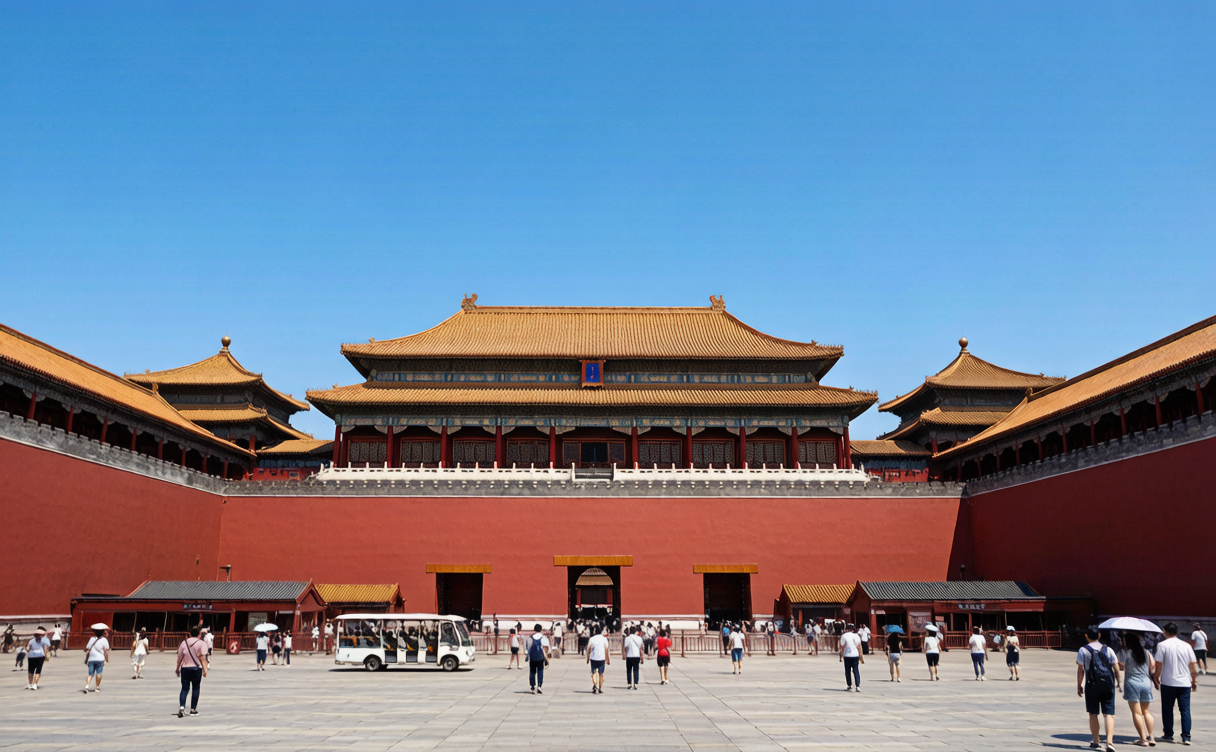
Standing at the foot of the Forbidden City’s Meridian Gate at 8 a.m., I watched a first-time visitor from Chicago freeze. “This is real?” she whispered. A good beijing travel guide for first-timers has to start with that feeling — Beijing doesn’t ease you in. It drops you into 3,000 years of capital history, 22 million people, and some of the best food on the planet, all at once. I’ve guided friends through this city five times since 2019, and the pattern is always the same: day one is overwhelming, day three feels like home.
You’ve probably seen the postcard shots — the Great Wall, the red walls of the imperial palace. This guide goes past the photos: the must-see sights, how to pick a Great Wall section, where to stay, how to ride the subway, the best season, and a ready-to-use 3-day plan. Before you fly, skim our complete China travel guide for first-timers for visas and payments, and if you’re entering on a layover, check the 144-hour visa-free transit rule first.
Key Takeaways
– The Forbidden City, Great Wall, Temple of Heaven, and Summer Palace are the four unmissable imperial sights — all are UNESCO World Heritage Sites.
– For a Great Wall day trip, choose Mutianyu (fewer crowds, great photos) or Badaling (easiest by high-speed train) — skip the over-restored sections if you want atmosphere.
– Stay near a Line 1 or Line 2 subway station (Wangfujing, Qianmen, or Gulou) to reach every major sight in under 40 minutes.
– Beijing’s subway is cheap, English-friendly, and pays via Alipay/WeChat QR — set up payments before you land.
– Spring (April–May) and autumn (September–October) are the best times to visit; avoid National Day (Oct 1–7) and Spring Festival crowds.
Why Beijing Deserves the Top Spot on Your China Trip
Beijing is China’s political and cultural heart, and it shows. Nowhere else packs so many “firsts” into one metro area: the world’s largest palace complex, a section of the Great Wall an hour away, and hutong alleys that predate the United States. If you have limited time in China, this is the city that delivers the most iconic moments per day. It’s also the most foreigner-friendly major city for logistics — signs are bilingual, the subway is immaculate, and staff at top sights often speak basic English.
That said, Beijing is huge and can feel intimidating. The trick is clustering sights by geography and leaning on the subway. Location matters more than price here — a central hotel saves two hours of transit a day.
Top Things to Do in Beijing
The list below is the spine of any good Beijing itinerary, ranked by how much they’ll stick with you after you leave.
1. The Forbidden City — China’s Imperial Heart
The Forbidden City (故宫, Palace Museum) was home to 24 emperors across the Ming and Qing dynasties, built between 1406 and 1420. Today it’s a UNESCO World Heritage Site with more than 980 buildings across 72 hectares — the largest ancient wooden-structure complex on Earth. Walking through the Meridian Gate into the vast courtyards is the single most “I’m really in China” moment you can have.
Two practical traps to avoid. First, it’s closed on Mondays — plan around it. Second, tickets are online-only and capped daily, so book through the official Palace Museum channel (or a trusted platform) days ahead, especially in spring and autumn. Bring your passport; it’s checked against the booking. Budget 3–4 hours, enter from the south (Meridian Gate), and exit north into Jingshan Park for the famous rooftop photo of the palace’s golden roofs.
2. The Great Wall — Which Section Should You Pick?
No trip to Beijing is complete without the Wall, but “the Great Wall” near the capital is really several different sites. Here’s the quick breakdown for first-timers planning a beijing itinerary with a Wall day:
- Mutianyu — My top pick for first-timers. Restored but far less crowded than Badaling, wrapped in forested hills, with a cable car up and a toboggan run down. About 1.5–2 hours from the city.
- Badaling — The most famous and easiest to reach: a high-speed train from Beijing North or Qinghe station gets you there in 30–40 minutes. The trade-off is crowds — packed on weekends and holidays.
- Jinshanling — For hikers. Wild, partly restored, and stunning, about 2.5 hours out. Best for a real trek without tour groups.
Whichever you choose, go early (8 a.m. gates) and on a weekday. The 144-hour visa-free transit rule won’t leave enough days for both Beijing and the Wall if you dawdle, so treat the Wall as a full-day commitment.
3. Temple of Heaven — Where Emperors Prayed for Harvests
The Temple of Heaven (天坛) is where Ming and Qing emperors performed solemn rituals for good harvests. Its blue-tiled Hall of Prayer for Good Harvests is one of the most photographed buildings in China, and the surrounding park is alive with locals practicing tai chi, singing opera, and flying kites. It’s a UNESCO site and more peaceful than the Forbidden City. Go early morning to catch the locals, then walk the circular altar. Half a day is plenty.
4. Summer Palace — Beijing’s Imperial Garden
The Summer Palace (颐和园) is the city’s escape valve: a vast Qing-dynasty garden built around Kunming Lake, with the famous 700-meter Long Corridor and Longevity Hill. Rent a boat in warmer months, or just stroll the lakeside. It pairs well with the Temple of Heaven on a single day if you’re efficient, though I’d give each its own half-day. Another UNESCO World Heritage Site — Beijing is loaded with them.
5. Hutongs — The Soul of Old Beijing
The hutongs are the narrow alleyways that grid the old city, especially north of the Forbidden City. This is where Beijing feels human. The Gulou (Drum Tower) and Houhai lake area is my favorite: beat-up courtyard homes, indie coffee shops, and nightlife by the water. Nanluoguxiang is more commercial but fun for snacks. Explore on foot or by pedicab, and duck into a courtyard home if you’re invited — it’s the real Beijing most tourists miss.
6. Qianmen & Wangfujing — Where to Eat
Food is a Beijing attraction in its own right. Qianmen Street (前门大街), a restored pedestrian thoroughfare south of Tiananmen, mixes old-brand shops with modern eats. Wangfujing is a central shopping street famous for its Snack Street, where you’ll find everything from candied hawthorn to skewers of scorpion (yes, really). For the city’s signature dish, Peking duck, book ahead at Quanjude (the classic, since 1864) or Da Dong (leaner, more refined). Off the tourist trail, try zhajiangmian (fried-sauce noodles), jianbing (breakfast crepes), and douzhi if you’re brave.
For official opening hours, events, and the latest city updates, the Beijing Municipal Culture and Tourism Bureau is the authoritative source.
Where to Stay: Best Beijing Neighborhoods
Pick your base by subway access, not by price. The two lines that matter most are Line 1 (east–west, through Tiananmen and Wangfujing) and Line 2 (the loop around the old city). Good first-timer zones:
- Wangfujing / Chongwenmen — Dead central, walkable to the Forbidden City. Best for first-timers who want zero transit stress.
- Qianmen / Dashilan — Historic, walkable to Tiananmen, charming lanes. Slightly quieter at night.
- Gulou / Nanluoguxiang (Houhai) — Hutong atmosphere, cafes, young crowd. Great for evenings out.
- Sanlitun — Expat hub, nightlife, Taikoo Li shopping. Farther from the old sights but lively.
Avoid airport-adjacent or far southern suburbs unless you’re on a tight budget — the transit tax adds up fast.
Getting Around Beijing
The subway is your best friend. Beijing’s network runs 27+ lines, signage is in English, trains are clean, and rides cost just ¥3–¥9. Buy a Yikatong transit card, use a foreign card at some gates, or — simplest — pay with an Alipay or WeChat Pay transit QR code. If you haven’t set those up yet, our guide to paying with Alipay and WeChat Pay as a foreigner walks you through it in ten minutes.
For maps, use Apple Maps (works in China) or Baidu / Amap with a translation app — Google Maps is unreliable on the mainland. For the Great Wall or trips to nearby cities, the high-speed train guide for foreigners covers booking seats and which station to leave from.
Still deciding how to pay and ride? Set up your payment apps before you fly →
Best Time to Visit Beijing
Beijing has four distinct seasons, and two of them are glorious. Spring (April–May) brings mild days and blooming parks; autumn (September–October) delivers blue skies and comfortable 15–25°C weather — my personal favorite. When you visit Beijing in these windows, the city is at its best. Summer is hot and humid with thunderstorms; winter is bone-dry cold but crisp, cheap, and crowd-free (great for a snow-dusted Wall).
One hard rule: dodge the Golden Weeks. National Day (October 1–7) and Spring Festival (often February) turn every sight into a scrum and sell out trains. I once watched the Forbidden City hit its daily cap by 9 a.m. during National Day — don’t be that traveler. For the full regional picture, see our best time to visit China guide.
Your 3–4 Day Beijing Mini-Plan
Here’s a realistic plan I’ve run with visiting friends. It hits the highlights without exhaustion.
Day 1 — Imperial Core
Tiananmen Square (arrive early for security lines) → Forbidden City (3–4 hrs) → Jingshan Park for the rooftop view → dinner on Qianmen Street.
Day 2 — The Great Wall
Full-day trip to Mutianyu (or Badaling if you’re tight on time). Leave by 7:30 a.m., back by early evening. Rest your legs with a hutong stroll in Gulou after dinner.
Day 3 — Parks, Palaces & Alleys
Morning at the Temple of Heaven, afternoon at the Summer Palace, then an evening in the Houhai hutongs with lakeside drinks.
Day 4 (optional) — Go Deeper or Widen
Option A: Lama Temple and the 798 Art Zone for a modern contrast. Option B: if Beijing is part of a bigger route, fold it into our 2-week China itinerary that adds Xi’an and Shanghai.
This plan leaves buffer for slow mornings and food detours — both essential in Beijing.
Final Tips Before You Go
Beijing rewards preparation. Book the Forbidden City and your Great Wall transport ahead, set up your payment apps, and keep your passport handy (you’ll show it constantly). The city’s scale is daunting on paper but simple on the ground.
If you want the bigger picture — visas, budgets, trains, and how Beijing fits a multi-city route — start with our complete China travel guide for first-timers. Then come back here, lock in your 3-day plan, and go. The red walls, the Wall itself, and a plate of Peking duck are waiting.
Written by Karl, who has guided friends through Beijing’s hutongs, subway lines, and duck restaurants across five visits since 2019 — and still gets goosebumps at the Forbidden City’s Meridian Gate.
Internal Links Used
- complete China travel guide for first-timers → travel-guide/china-travel-guide-for-first-timers
- 144-hour visa-free transit rule → travel-guide/china-visa-free-transit-144-hours
- paying with Alipay and WeChat Pay as a foreigner → travel-guide/alipay-wechat-pay-foreigners-china
- high-speed train guide for foreigners → travel-guide/china-high-speed-train-guide-foreigners
- best time to visit China guide → travel-guide/best-time-to-visit-china
- 2-week China itinerary → travel-guide/china-2-week-itinerary
Meta Title: Beijing Travel Guide for First-Timers: What to See & Do (2026)
Meta Description: Beijing travel guide for first-timers: Forbidden City, Great Wall picks, Temple of Heaven, Summer Palace, hutongs, where to stay, and a 3-day plan.
Primary Keyword: beijing travel guide
Secondary Keywords: things to do in beijing, beijing itinerary, visit beijing
URL Slug: /travel-guide/beijing-first-time-travel-guide/
Word Count: ~1,895