

Search for ice hotels Harbin and you will find listings that reappear every November and disappear by March, priced by the hour and rebranded each season. Every January the city of Harbin, in Heilongjiang, China, cuts hundreds of thousands of tonnes of river ice out of the Songhua and stacks it into a temporary city. Walkways, churches, a Victorian garden, a two-storey hotel. Then in late February it melts back into the riverbank. This Harbin ice hotel guide covers the one accommodation experience in China that exists for about ten weeks and then ceases to: sleeping inside a building made of frozen blocks, in a city that regularly hits minus 25°C.
We have sent readers to do this in three separate winters. Some loved it. One of them lasted ninety minutes and fled to the lobby for hot tea. Both reactions are normal, and part of this guide is honest about the difference between the photographs and the physical reality of a frozen hotel.
What the ice hotel actually is
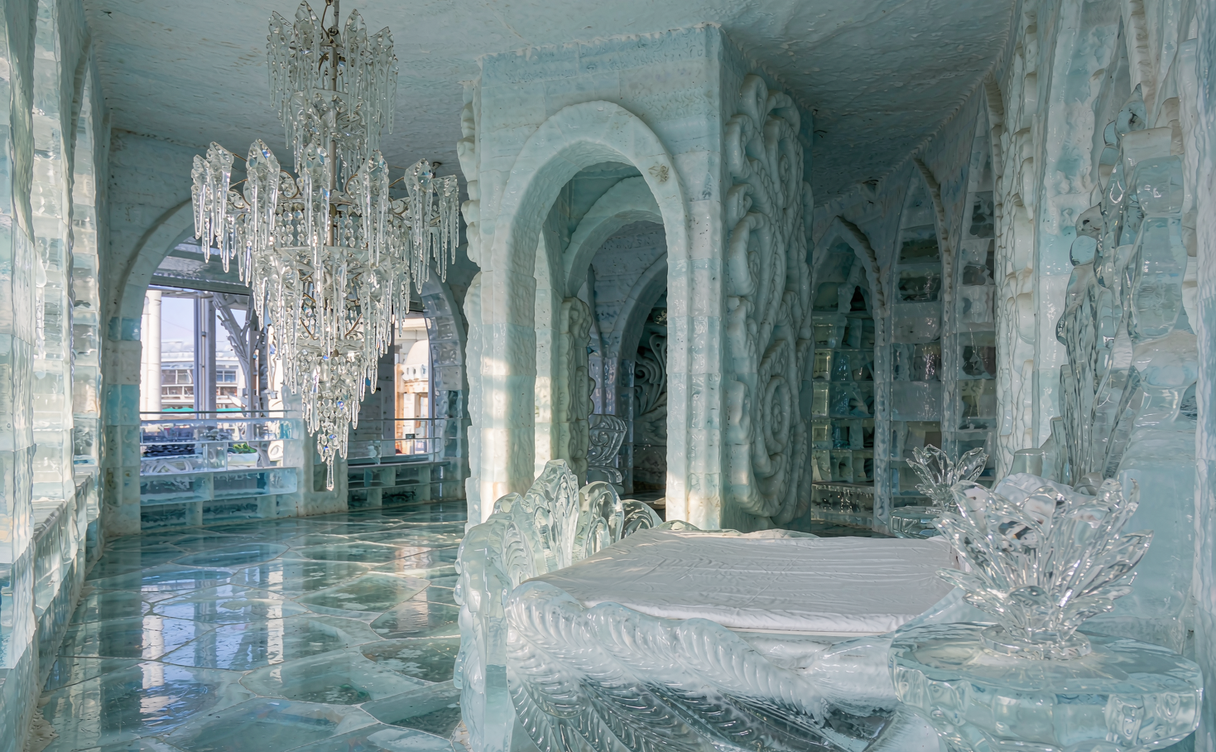
A Harbin ice hotel is not a permanent structure. Each winter, the operators of the Harbin International Ice and Snow Festival (and several private operators on the island) mark out a footprint, flood or level it, and build walls from block ice sawn from the Songhua River — the same blocks that carry the festival’s cathedrals and slides. Furniture is carved from the same ice: a bed platform, a table, a chair, sometimes a frozen chandelier of hanging icicles lit from within.
The walls are around 50–70 cm thick. Behind them there is no heating pipe; warmth is irrelevant to the design. What keeps you alive is a thick mattress on ice, a mummy-shaped thermal sleeping bag, and the parka the hotel lends you at the door. That is the whole system.
Where to find an ice room: Sun Island versus the Ice and Snow World
Two places matter.
Sun Island (太阳岛), across the river and reached by the island shuttle or metro line 2 to Sun Island station, hosts the snow expo and, in most years, one of the clearest ice-hotel setups: a proper small building with a handful of rooms, a frozen bar, and staff who will walk you through the rules. It is calmer, it has more of a village feel, and it is the option we recommend for anyone doing this once.
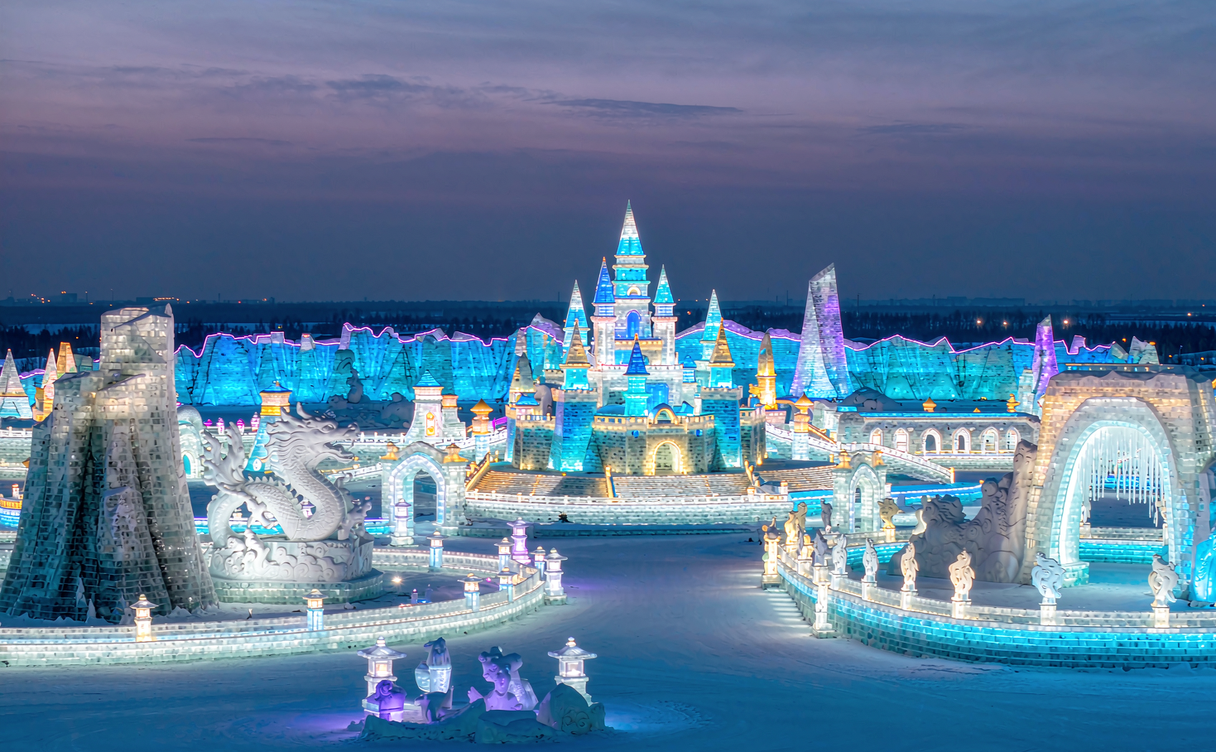
Harbin Ice and Snow World (冰雪大世界), on the northern bank near the festival’s main gate, is the bigger spectacle — illuminated ice towers, a 500-metre slide complex, and the busiest ice bar in China. Here the “ice hotel” is usually an annexe of carved blocks rather than a full hotel. It pairs better with the sightseeing; it is worse for sleep.
Nowhere to stay in Harbin in winter is the question most readers ask us next. If you want a warm, conventional bed as well, city-centre options run the full range and our best hotels in Harbin guide breaks them down by district.
Best time for a Harbin snow festival stay
The festival opens in early December — usually around 20 December — and runs to the end of February. The opening days in early January are when the ice is densest and the whole thing is at its most photogenic, but that is also when domestic crowds peak.
We would pick the second week of January: cold enough that the ice is rock-solid (−18°C to −26°C at night), still before the worst of the holiday rush. Late February is for travellers who want the festival without the queues; the downside is that warmer days (still below freezing, but occasionally −8°C) begin to frost the surfaces.
Avoid Chinese New Year. In 2026 that falls in mid-February, and hotel rates in Harbin nearly double around it.
How to get to Harbin in winter
Harbin Taiping International Airport (HRB) takes direct international flights from Seoul, Tokyo, Moscow, and a handful of European cities in winter. Domestic connections are frequent.
By rail, it is about 4.5 to 5.5 hours from Beijing on the high-speed line, roughly 7 hours from Shanghai, and an overnight sleeper from Shenyang of only 2 hours. Our China high-speed train guide for foreigners covers passport controls at the station and how to pick a sleeper.
Getting to the ice itself: the airport-to-city transfer is 40–60 minutes by metro line 2 or airport bus. From the city centre, metro line 2 runs to Sun Island in about 30 minutes; the Ice and Snow World sits north of the river and needs a taxi (¥30–¥50, 25 minutes from Central Street). Buses 43 and a handful of festival shuttles also run.
What the ice hotel costs
Here is the part nobody states plainly. You rarely book a “hotel room” in the conventional sense.
- A few-hour sleep-in slot: roughly ¥200–¥400 per person. You get dressed, lie in the bag for a couple of hours, and leave before the lights go out.
- A full night: we have seen packages between ¥600 and ¥1,500 per room in peak weeks, climbing sharply around New Year and the festival opening weekend.
- Entrance to the festival itself: ¥330–¥390 for adults in peak days, lower (¥150–¥260) early and late in the season. Children and seniors discount.
Festival tickets buy you the ice town, the slides, and the ice bar. The ice room is priced separately. Book it through the operator’s own mini-program or the hotel front desk — third-party aggregators frequently list rooms that do not exist that season.
Sleeping in a frozen hotel: what to expect at 2 a.m.
You will be cold in the first fifteen minutes. Then your body adapts, and the odd thing is that you also become extremely aware of the cold whenever you sit up.
The rules are simple and the staff enforce them. No walking around in the room. No sitting on the ice floor. No leaving the sleeping bag completely once you are inside it. Phones and camera batteries die fast at −25°C, so keep spares against your skin.
Bring: a thermal base layer, a Buff or balaclava (you will lose heat from your face faster than you expect), wool socks, and lip balm. Leave: anything you would be upset to freeze — water bottles split,岐山-style drinks will burst, and one of our readers destroyed a lens because they set it on the ice block bedframe.
Book your ice-room slot for around 8 p.m. rather than midnight — the light on the ice outside is at its best early, the queue at the entrance is shortest, and the sleeping bags are still cold-stored rather than warmed by a hundred previous guests.
Eating warm before and after
Harbin winter food is heavy and appropriate. 铁锅炖 (iron-pot stew, pork or fish with cabbage and corn, ¥60–¥90 for a large pot) is the standard winter meal. 锅包肉 (sweet-sour pork) and 杀猪菜 (pickled pork belly with blood sausage) follow. Street stalls sell 糖葫芦 (candied hawthorn) and 烤红薯 (roast sweet potatoes) sold from holes cut in the frozen pavement.
After an ice-room attempt, the correct move is a restaurant with a private room and a radiator. Central Street has dozens within 300 metres.
Pairing the ice hotel with the rest of Harbin
Two days minimum if you want the ice and something besides ice. Central Street (中央大街) for the pedestrian Russian-era architecture, Saint Sophia Cathedral for the square in front, Sun Island Snow Expo for the giant snow sculptures, and Yabuli — an hour south by train — if you ski.
If the festival is the whole reason you came, our Harbin Ice Festival travel guide maps the daily programme and the slide queues, and our China winter festivals guide sets this one against the snow towns of northern Heilongjiang.
Who should (and should not) book an ice room
This is a frozen hotel Harbin-style experience that works better for some travellers than others. If you are under about 55, fit, and you have slept cold before, do it once. If you are over 65, on blood-pressure medication, pregnant, or travelling with a child under six, we would take the ice bar instead and sleep in a real bed ten minutes away. There is no shame in the ice bar — you get the photographs, the story, and none of the hypothermia risk.
The rest of the city more than compensates. For the wider list of what to do in a place that spends half the year under snow, see our best things to do in China roundup.
If Harbin winter accommodation is the anchor of your trip, fly in two days early, sleep one night in the ice, and spend the second night in a heated city hotel — the contrast is the point, and it doubles your chances of a good night’s rest.
Final thoughts
An ice room in Harbin is a 90-minute story and an €90 photograph. Sleeping in it is genuinely uncomfortable, briefly frightening, and then — around 3 a.m., when the lamps go down outside and the frozen walls glow faintly blue — surprisingly beautiful. We would do it again. We would also do it exactly once, and we would not send a shy sleeper into it.
Combine the ice hotel with one night on the Songhua river cruise and a morning at the Snow Expo, and you have a Harbin snow festival stay that covers the festival, the river, and the city without ever rushing.