

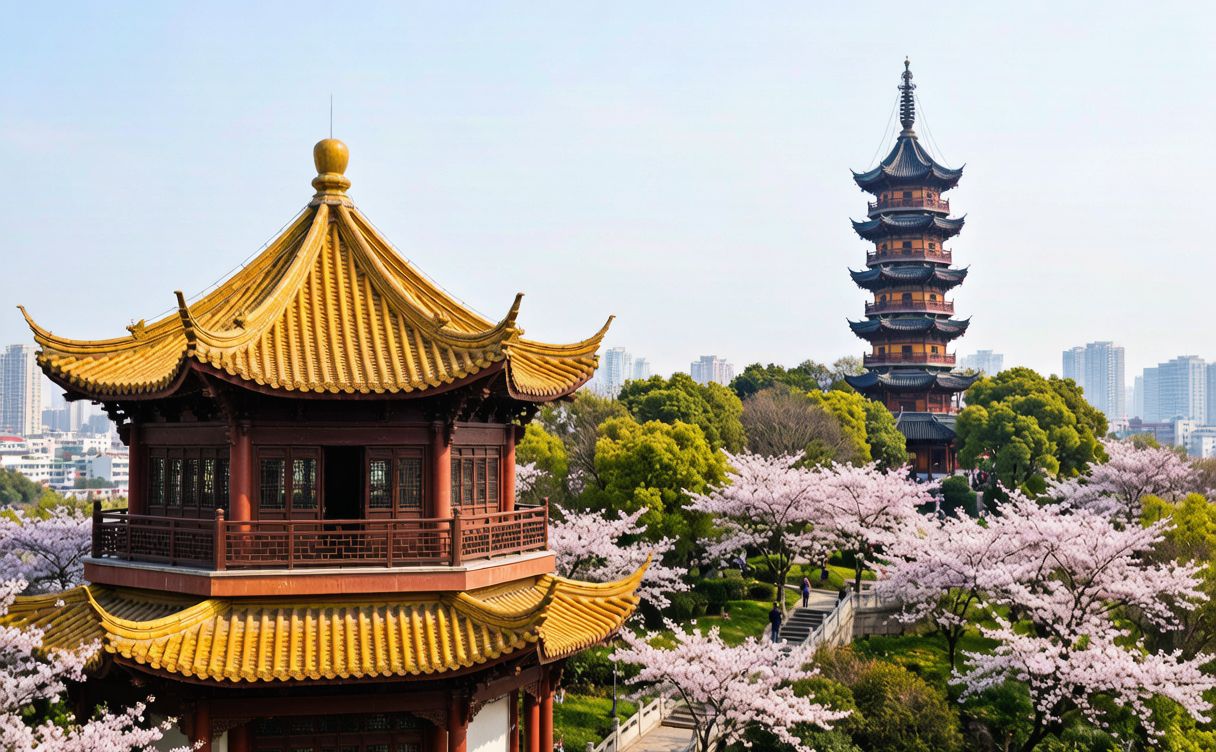
When I first climbed the short slope toward Jiming Temple (鸡鸣寺) on a cool spring morning, I expected a quiet hilltop shrine. What I found instead was a living, breathing piece of Nanjing that has stood watch over the city for more than 1,700 years. Tucked against the eastern wall of Xuanwu Lake and crowned by a slender riverside pagoda, Jiming Temple is the kind of place that rewards a slow visit—the scent of incense drifting through cypress trees, the murmur of pilgrims, and, if you time it right, a tunnel of pink cherry blossoms that turns the approach road into something out of a painting.
If you are building a trip around the city, this temple pairs naturally with the lakeside calm of Xuanwu Lake, and the two sit close enough that you can enjoy both in a single, unhurried half-day.
Getting There
Jiming Temple sits in the Xuanwu district, just northeast of Nanjing’s historic core. I arrived by metro, which I still think is the easiest way for a first-time visitor. Take Line 3 or Line 4 to Jiming Si Station (鸡鸣寺站); from there it is a flat ten-minute walk uphill to the temple’s south gate. The station exit is well signed in both Chinese and English, and the walk itself is pleasant, cutting past the base of the old city wall.
If you would rather take a taxi or ride-hail app like DiDi, simply show the driver “鸡鸣寺” and you will be dropped near the entrance plaza. Buses also stop close by, but the metro saved me from Nanjing’s unpredictable traffic and let me arrive relaxed. One small tip from my own mistake: the temple’s main gate faces south, but most ride apps drop you on the north side near the lake, so give yourself an extra five minutes to loop around.
The temple is also an easy connector on a longer walking route. After you descend, you can follow the lakeside causeway eastward, or slip down to the water for a peaceful finish to the morning.
What to See
Jiming Temple is not a single grand hall but a vertical sequence of courtyards climbing the hillside, so the experience is as much about the climb as the destinations. At the base, the Mountain Gate sets the tone with its curved eaves and red lacquer. From there, a series of staircases leads past the Hall of Heavenly Kings, the Mahavira Hall, and finally the temple’s signature structure, the Pharmacist Pagoda (药师佛塔).
I spent the most time at the pagoda. Rebuilt in the 1990s on the foundations of earlier towers, it rises in clean, pale-gold tiers and offers one of the best elevated views in the city—across Xuanwu Lake to the purple hills beyond. On a clear day you can even trace the green sweep of the Ming Xiaoling Mausoleum woods in the distance, a reminder of how layered Nanjing’s history really is.
Inside the halls, the atmosphere is gently devotional rather than touristy. I watched an elderly local woman light three sticks of incense and bow toward each cardinal direction; no one rushed her. The temple is also one of the few places in Nanjing where you can quietly appreciate centuries of Buddhist, imperial, and modern history without a guide narrating every step.
One unexpected delight was the vegetarian restaurant near the top, run by the temple kitchen. The noodles I ordered were simple, cheap, and genuinely good, and eating them while looking out over the lake felt like a small, earned reward.
Cherry Blossom Season
Ask any Nanjing local when to visit Jiming Temple and the answer is almost always the same: late March to early April, when the cherry trees lining the approach road burst into bloom. The famous “cherry blossom avenue” (樱花大道) runs along the temple’s southern flank, and during peak season it becomes a soft pink corridor that draws crowds from across the province.
I timed my second visit deliberately for this window, and I will be honest—it was busy. But the crowds here are part of the charm. Families spread picnic blankets on the lake bank, students in hanfu pose for photos under the petals, and the whole hillside feels like a festival of spring. The trick, I learned, is to arrive right at opening (around 7 a.m.) before the tour buses. In that first hour the light is soft, the petals drift down like slow snow, and you can stand on the steps of the pagoda almost alone.
If you miss the blossoms, don’t despair. The temple’s cypress-shaded lanes are lovely year-round, and the autumn ginkgo trees turn a startling gold that competes with the spring show in its own quiet way.
Tips
A few things I wish someone had told me before my first visit:
- Buy the combined ticket. Entry to the temple includes a small voucher for a cup of temple tea or a stick of incense, which is a nice touch and saves you fumbling for change.
- Dress modestly. Shoulders and knees covered are appreciated inside the halls, though enforcement is relaxed.
- Footwear matters. The ascent involves many stone steps; comfortable shoes make the climb easy and the descent safe.
- Go early or go late. Mornings are calm and photogenic; evenings, when the pagoda is lit, are romantic but the interior halls may be closing.
- Cash is handy. The ticket booth and small stalls often prefer it, though mobile pay works at the main gate.
- Combine wisely. Pair the temple with the Confucius Temple district later the same day by metro for a full sweep of old Nanjing.
My personal mini-story: on my very first morning here, I got turned around trying to find the vegetarian restaurant and ended up chatting with a monk sweeping fallen leaves near the pagoda. He gestured up the steps and said, in slow English, “Higher, higher, food is higher.” I laughed, climbed, and found both the noodles and a view I still think about. Sometimes the best parts of a trip are the detours you didn’t plan.
Best Time
Nanjing has four distinct seasons, and each paints Jiming Temple differently. Spring (late March to mid-April) is the headline act for cherry blossoms and mild weather. Autumn (October to November) brings cool, crisp air and golden ginkgo foliage, my personal favorite for photography without the spring crowds. Summer is hot and humid, though the lakeside breeze helps, and winter is cold but serene, with occasional dustings of snow that make the pagoda look like a scroll painting.
For comfortable temperatures and manageable crowds, I recommend late March or late October. Weekdays beat weekends almost every time, and the first two hours after opening are always the calmest.
Good to Know
Jiming Temple is open daily, typically from about 7:00 a.m. to 5:30 p.m., with slightly longer hours in summer. The entrance fee is modest (usually under 15 RMB) and covers the incense or tea voucher mentioned above. The site is stroller- and wheelchair-accessible at the base, though the upper courtyards involve steps. Photography is welcome in the open courtyards but discouraged inside the worship halls out of respect.
The temple sits within easy reach of several other Nanjing landmarks, so it slots neatly into a wider itinerary—whether you are tracing republican history at the presidential palace or paying respects at the sun yat-sen mausoleum, both a short metro ride away. For official city information, events, and transport updates, consult Nanjing Government.
I left Jiming Temple the first time feeling lighter than when I arrived—not because anything dramatic happened, but because the place simply invited me to slow down. If you give it a morning, I think it will do the same for you.