

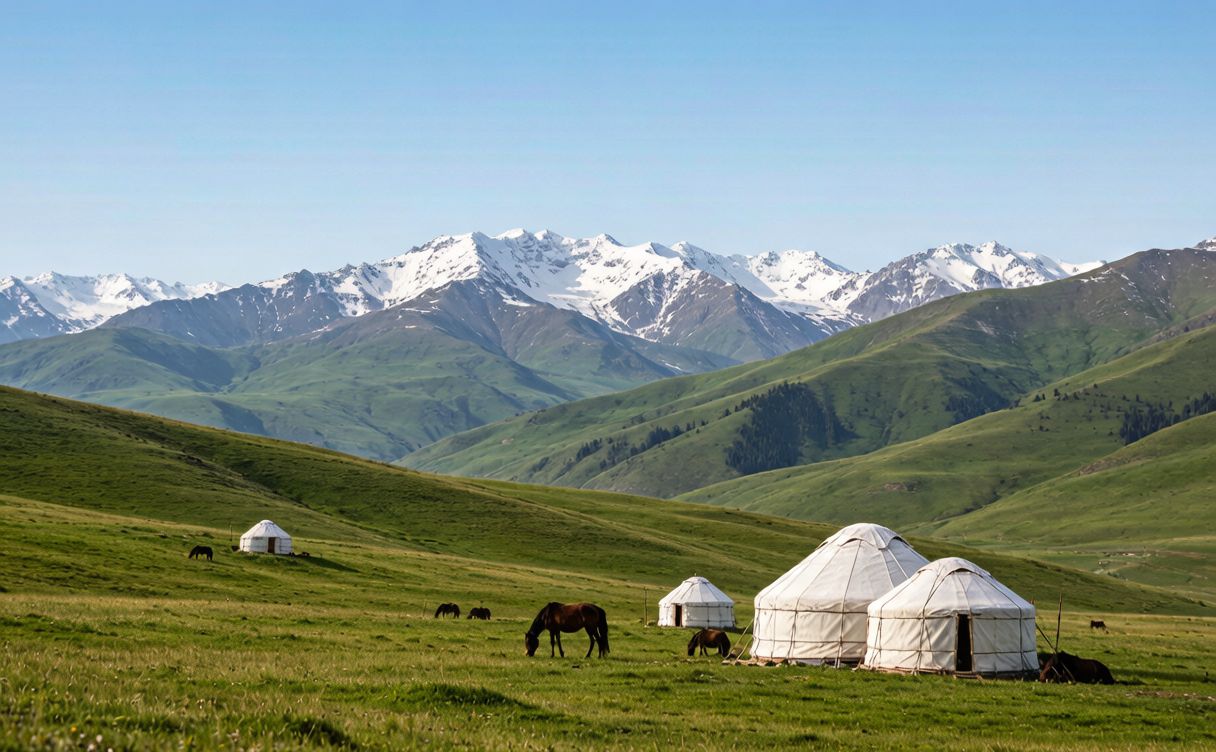
The first time I stepped out of the car at Nalati Grassland, I simply stopped talking. A wall of green rolled up from the valley floor and kept going until it dissolved into a line of snow-tipped peaks. No photo prepares you for the scale. This is the kind of place where the sky feels too close and the grass smells like the inside of a tea box after rain.
Nalati sits in the Ili Valley of northwest Xinjiang, China, where the Tianshan mountains trap enough moisture to keep the meadows lush while most of the region stays desert-dry. It is one of the most accessible alpine pastures in the country, and for a foreign visitor it offers something rare: a chance to actually meet the Kazakh herders who have grazed these slopes for generations.
I spent three days here on my last trip, and I want to share exactly what I did, what I wish I had known, and how you can fit it into a wider Xinjiang, China itinerary without the usual planning headaches.
Getting There from Yili
Most travelers reach Nalati through Yining (also called Ghulja), the main city of the Ili Kazakh Autonomous Prefecture in Xinjiang, China. I flew from Urumqi to Yining — a tight 70-minute hop that saved me a full day on the road. From Yining airport you have three realistic options:
- Private car or driver. This is what I used. The drive to the Nalati scenic area takes about three hours on the G218, and the road itself is half the fun — you pass fruit orchards, the Gongliu poplar belts, and a stretch of the Ili River that turns gold at sunset.
- Bus. Long-distance buses leave Yining for Xinyuan county several times a day. From Xinyuan you grab a local minivan to the grassland gate. Cheaper, but slower and less comfortable with luggage.
- Rent a car. Only if you are comfortable with Chinese road signs and mountain driving. The highways are excellent; the small-town navigation can be confusing.
Buy your entrance ticket and the internal shuttle pass online before you arrive if you can. The gate gets busy in July and August, and the shuttle buses up to the higher meadows run on a schedule that fills fast.
If you are coming from outside Xinjiang, China, the usual entry point is Urumqi Diwopu International Airport, with dozens of daily flights onward to Yining. I sometimes build in a night in Urumqi to adjust to the time zone (Xinjiang runs on Beijing time but locals live two hours behind on the clock) before flying west. It sounds minor, yet that two-hour shift messes with your body for the first day, and Nalati rewards early risers.
One practical note: there is no train station at Nalati itself. Yining has a new high-speed rail link to Urumqi, which is the smoothest way in if you dislike flying. From the Yining station, follow the same road transfer as above.
What to See
Nalati is split into a few distinct zones, and you should plan which one matches your energy level. I covered all three across two days.
The Valley Grassland (Kazakh Village area). This is the postcard view: a broad flat meadow ringed by hills, with wooden fences and yurts scattered like white dots. Easy to walk, full of photo spots, and the shuttle drops you right in the middle.
The Sky Meadow (Aerial Grassland). Higher up, reached by a separate shuttle that climbs in switchbacks. The air gets thinner and the views open into a true alpine panorama. I came here at 7 a.m. and had the ridgeline almost to myself. Worth the early start.
The Forest Park section. A quieter loop through spruce stands and small streams. If you like birdsong and want to escape the crowds, walk this one slowly.
A short hike I recommend: from the Sky Meadow shuttle stop, follow the marked ridge path for about 40 minutes. You will reach a clear viewpoint over the whole Ili Valley. Bring water — the altitude here is around 2,200 meters and the sun is strong.
Photography-wise, the Nalati Grassland Xinjiang light is forgiving at both ends of the day. I shot most of my best frames between 6 and 8 a.m., when low sun rakes across the Ili Valley meadow and the dew catches gold. Midday is flat and harsh, so I used those hours for the Forest Park walk in the shade. A polarizing filter helped cut the glare off the distant snow.
The Meadow & Nomads
The part I remember most is not the view but the people. Nalati is a working summer pasture, not a staged folk park. In June the Kazakh families drive their sheep and horses up from the lowlands and set up round felt yurts called aiyl. I was invited in for milk tea and fresh naan by a family near the Valley Grassland, and we communicated mostly with gestures and smiles.
Horse riding is the real activity here, and it is the best way to feel the place. I paid a local herder about 100 RMB for a slow guided ride along the meadow edge. Nobody rushed me. The horses are small, sure-footed mountain animals, calm with beginners. If you have never ridden, tell the herder — they will pick a gentle one and walk beside you.
You can also arrange to eat with a family: hand-pulled noodles, lamb skewers, and the slightly sour koumiss (fermented mare’s milk) that locals love. Try a small cup even if it surprises you. It is the taste of the grassland.
Please be respectful: ask before photographing people, and tip modestly if a family hosts you. The hospitality is genuine, and a little courtesy goes a long way on the trail.
Tips
A few things I learned the hard way so you do not have to:
- Altitude and sun. Even though it is green and pretty, you are above 1,800 meters. Sunglasses, a hat, and SPF 50 are not optional. I got burned in two hours on a “cloudy” day.
- Layers, layers, layers. Mornings at Nalati can be 10°C; afternoons hit 28°C. I carried a light down jacket and was glad of it at the Sky Meadow.
- Cash for herders. The shuttle and gate take cards and Alipay, but small payments to local families for rides or tea are often cash only. Keep 200–300 RMB in small notes.
- Stay inside the park. There are yurt stays and a few hotels at the gate. I slept in a simple yurt one night — cold feet, unforgettable stars. Booking ahead in peak season is essential.
- Get a local SIM or eSIM. Maps work offline if you download them, but the shuttle schedule app needs data. Roaming was unreliable for me up in the valley.
- Drone rules. Flying is restricted near the borders and crowded zones. Check at the gate; I left mine in the hotel to avoid a fine.
- Food and toilets. The gate area has proper restaurants and clean public toilets; up on the meadows facilities are basic squat toilets and the food is simple herder fare. I packed trail snacks and wet wipes and was never sorry. Bottled water is sold at every shuttle stop.
- Language. Outside Yining, little English is spoken. Download a translator app that works offline and save your hotel address in Chinese characters. A screenshot of “Nalati Grassland” in Mandarin saved me more than once with drivers.
Best Time
The short answer: June through September. That is when the snow has melted, the grass is deep green, and the flowers — wild iris, poppies, and velvety purple gentian — blanket the slopes.
- June is my favorite. The meadows are at their freshest, the herders have just arrived, and the crowds are lighter than mid-summer.
- July–August brings the warmest weather and the biggest visitor numbers, especially on Chinese school holidays. Go early in the day.
- September turns the grass golden and the light becomes photographic magic, though nights get cold.
Avoid late October to May unless you like empty, frozen landscapes — the shuttle mostly shuts down and many yurts are folded away for winter.
Good to Know
Nalati is part of a much larger Xinjiang, China travel story, and I strongly suggest linking it with other stops rather than treating it as a one-off. The Ili region alone could fill a week. For official, up-to-date opening hours, ticket prices, and seasonal alerts, check the Xinjiang Culture and Tourism Department: Xinjiang Culture and Tourism Department. I always confirm gate times there the day before I travel, because mountain weather closes roads without much warning.
Nalati Grassland, Xinjiang, China is not the easiest place to reach, but that is exactly why it stays so honest and beautiful. Go for the green, stay for the tea and the horses, and leave with a view you will describe badly to friends for years — because no sentence does it justice.