

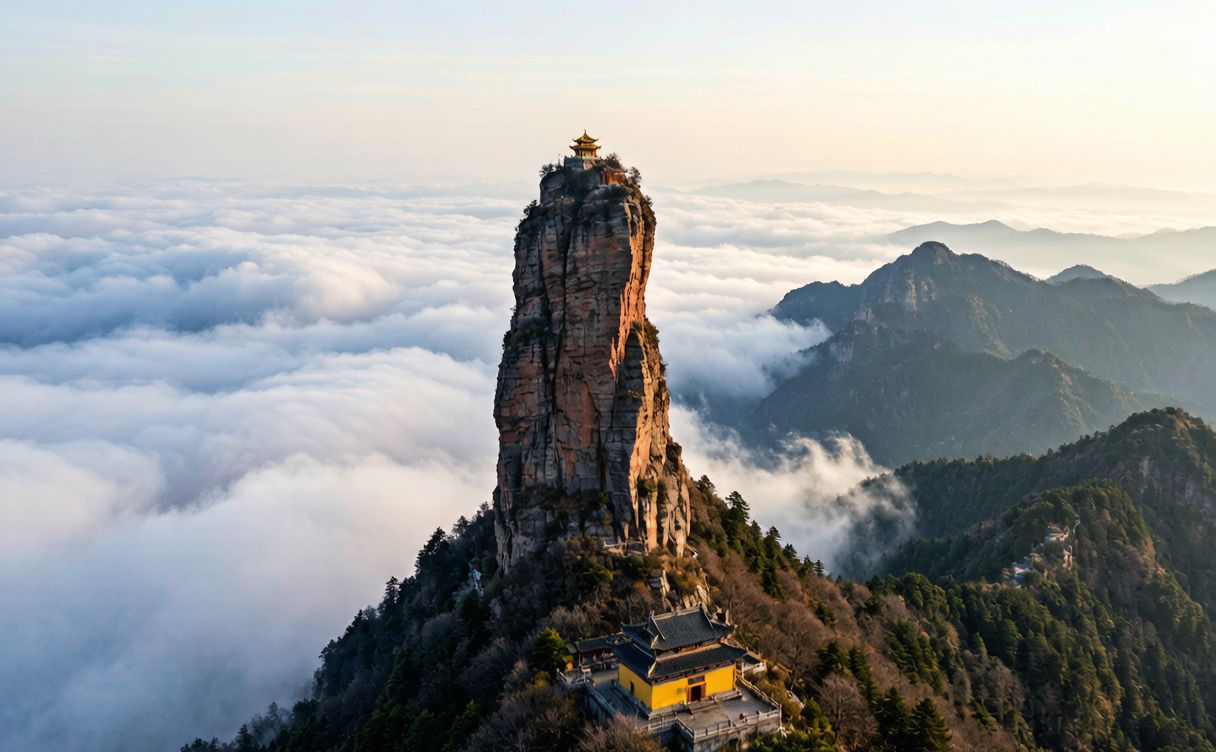
I still remember the moment the cable car broke through the cloud layer and the split peak of Mount Fanjing appeared like a mirage above the mist. Nothing had prepared me for it. Tucked in the remote mountains of eastern Guizhou, Mount Fanjing (Fanjingshan) is one of the most surreal and spiritual landscapes I have ever stood on. It is a sacred Buddhist mountain, a UNESCO World Heritage Site, and quite possibly the most photogenic summit in all of Southwest China.
If you are building a China itinerary and want a destination that feels otherworldly yet deeply peaceful, this is it. Here is everything I learned on my own trip, from getting there to standing on top of the Red Cloud Golden Summit.
Getting There from Tongren
The nearest transport hub for Mount Fanjing is Tongren, a small city in northeastern Guizhou. There is no airport at the mountain itself, so Tongren is your gateway.
I flew into Tongren Fenghuang Airport from Guiyang, which took about an hour. You can also reach Tongren by high-speed train from Guiyang (around 1.5 to 2 hours) or from Changsha. From Tongren city, it is roughly a 90-minute drive to the east gate of the Fanjingshan scenic area. I booked a private transfer through my hotel, but there are also tourist shuttles and Didi rides available.
A practical tip: stay the night in Tongren or in the town of Jiangkou, right next to the entrance. The mountain opens early (around 7:00 am in summer), and the earlier you arrive, the better your chance of clear views before the afternoon clouds roll in.
The park runs a strict daily visitor cap, so book your entry ticket and the mandatory shuttle-plus-cable-car combo online in advance through the official platform or a trusted Chinese travel app. On busy weekends the tickets sell out fast.
What to See
Once you are inside the park, a shuttle bus carries you up a long, green valley to the cable car base. From there the real adventure begins.
The cable car itself is an experience. It climbs for about 20 minutes, swinging above pristine primary forest. Mount Fanjing protects one of the last remaining stands of subtropical evergreen broadleaf forest in the world, and it is a biodiversity hotspot home to the rare Guizhou snub-nosed monkey. As you rise, the temperature drops and the air turns crisp and clean.
At the upper station, you step out onto a high plateau. Most visitors head straight for the two famous summits: the Red Cloud Golden Summit (Hongyun Jinding) and the Old Golden Summit (Lao Jinding). But do not rush past the quieter sights. The Mushroom Stone (a naturally balanced rock formation) and the Ten-Thousand-Book Rock are easy walks near the plateau and make great photo stops while you catch your breath.
If you want a deeper cultural stop, the Fanjing Temple complex near the base of the peaks is the spiritual heart of the mountain and worth a slow wander.
The Red Cloud Golden Summit
This is the reason most people make the trip, and it did not disappoint. The Red Cloud Golden Summit (Hongyun Jinding) is a narrow, vertical pillar of rock rising more than 100 meters. At the very top, the peak splits into two sides connected by a tiny bridge, each side crowned with its own small temple — one dedicated to the Buddha of the present, one to the Buddha of the future.
Climbing it is not for the faint of heart. After the cable car, you still face a steep ascent of hundreds of stone steps, and the final stretch is a near-vertical metal staircase bolted into the cliff face. I am reasonably fit, and my legs were shaking by the top — but the view stopped me in my tracks. On a clear day you look out over a sea of rolling peaks. On a misty day, which is more common, the temples seem to float above an ocean of clouds.
Take your time. The stairs are narrow and busy, so there is no pushing. Gloves are handy in winter. And if the summit is closed due to ice or high wind — which happens often outside summer — do not be too disappointed; the plateau and Old Golden Summit still reward you with spectacular scenery.
Tips
A few things I wish I had known before going:
- Wear proper shoes. The steps are steep, wet, and sometimes slippery. Trainers with grip are the minimum; hiking shoes are better.
- Pack layers. It can be 30°C in Tongren and 15°C on the summit. The weather changes fast up there.
- Bring snacks and water. There are basic food stalls, but options are limited and pricey. I carried a refillable bottle.
- Go mid-week if you can. Weekends and Chinese holidays are crowded and tickets sell out.
- Start at opening time. Clear mornings are your best shot at the famous sea of clouds.
- Mind the altitude and fitness. The climb is short but intense. If you have knee or heart issues, the cable car helps, but the summit stairs are unavoidable.
One more thing: signal is weak on the mountain, so download maps and your ticket QR code before you leave town.
Best Time
I visited in late spring and found it lovely, but each season has a different personality.
- April to June: Mild weather, lush green forest, and frequent misty “cloud sea” mornings. My favorite window.
- July to August: Warmest and busiest, but also the most reliable for climbing, since ice closures are rare.
- September to October: Cool, clear, and less crowded after the summer rush. Great light for photography.
- December to February: Cold, sometimes snowy, and the summit often closes. Beautiful if open, but check conditions daily.
If seeing the sea of clouds is your dream, aim for a humid morning after rain — that is when Mount Fanjing puts on its most magical show.
Good to Know
Mount Fanjing was inscribed as a UNESCO World Heritage Site in 2018 for its outstanding biodiversity and unique mountain ecosystem. You can read the official description and conservation details directly from the UNESCO Fanjingshan World Heritage listing. It is worth understanding why this remote peak is considered one of the most important refuges for rare plants and animals in the world.
A few logistics to keep handy: the scenic area enforces a daily visitor limit, so advance booking is essential; the full visit from Tongren takes a full day; and there is almost no English signage, so a translation app is your friend. Cash is rarely needed, as mobile payment dominates even at the mountain stalls.
If you are chasing the most extraordinary sights in the country, Mount Fanjing absolutely belongs on the list. Explore our roundup of China bucket-list attractions to see how this sacred summit fits into a once-in-a-lifetime trip.
Final Thoughts
Standing on the split peak of Mount Fanjing, with a temple bell ringing softly below and clouds drifting past my knees, I understood why pilgrims have come here for centuries. It is equal parts natural wonder and spiritual refuge. The climb is tough, the weather is unpredictable, and the logistics take some planning — but the reward is a view and a feeling you will not find anywhere else in China.
However you get there, give Mount Fanjing a full day and an open mind. It was one of the quietest, most memorable mornings of my entire time in China — and I think it will be for you too.