

I still remember the moment I stepped off the shuttle bus at Baodingshan and rounded the first bend in the path. There, carved straight into a gray limestone cliff face, was a thousand-year-old Buddhist scene glowing softly in the morning light. I had seen photos of the Dazu Rock Carvings before my trip, but nothing prepared me for how intimate and human they feel in person. Unlike the crowded cave complexes up north, these Tang and Song dynasty reliefs sit in the open air on quiet hillsides outside Chongqing, and you can walk right up to them.
Before this trip I had debated whether Dazu was worth the detour versus the famous northern grottoes. The answer, for a first-time visitor with limited time, is yes — Dazu is compact, walkable, and its mixed Buddhist-Confucian-Taoist themes make it far more approachable than the purely monastic caves farther north.
If you are planning a trip to southwest China and want a UNESCO site that is both deeply spiritual and easy to reach, the Dazu Rock Carvings deserve a full day of your itinerary. In this guide I will share exactly how I got there, what surprised me most, and the practical tips that made my visit smooth.
Getting There from Chongqing
The carvings are about 1.5 to 2 hours southwest of central Chongqing, in Dazu District. I left my hotel in Yuzhong around 8 a.m. and was standing in front of the cliff sculptures before 10. You have three realistic options, and I tried two of them.
The easiest for most travelers is the direct tourist bus from Chongqing’s Caiyuanba or Longtousi area, or a ride-hail to the Chongqing West railway station followed by a high-speed train to Dazu Nan station. From Dazu Nan, a short taxi or local bus gets you to the Baodingshan scenic area entrance. The train takes roughly 40 minutes and costs very little, and honestly the stations are modern and stress-free.
If you prefer maximum flexibility, book a private car or use a ride-hailing app for the full door-to-door trip. The drive is mostly on good expressways, and you pass through classic Sichuan Basin countryside — terraced fields, noodle stalls, and the occasional misty hill. I paid a bit more for the private car on the way back so I could stop at a roadside restaurant for lunch, and it was worth every yuan.
Dazu town itself is worth a slow stroll if your schedule allows. I grabbed a bowl of Dazu-style noodles near the station and wandered the old streets for twenty minutes before catching the shuttle. It is a small, lived-in place, not a tourist bubble, and that contrast made the sacred cliff art feel even more special.
One thing I wish I had known: buy your combined ticket online in advance during holidays. The on-site queue can get long, and the scan-in gate is faster with a pre-booked QR code.
What to See
The Dazu site is not one single cave. It is a collection of more than 50,000 statues spread across several cliff groups, with the two main ones being Baodingshan and Beishan. I focused my energy on Baodingshan because it holds the most complete and dramatic works, but if you have a second half-day, Beishan’s quiet evening light on the smaller niches is magical.
Beishan, a short drive from Baodingshan, rewards patience. Its reliefs are smaller and more worn, but the evening slant of light brings out details the midday sun flattens. I spent about ninety minutes there on my second morning, and the quiet was a welcome change after the busier main cliff.
What struck me first was the storytelling. These are not just isolated Buddhas. They are carved narratives — scenes of filial piety, local legends, and everyday Song-dynasty life rendered in stone. You will see peasants, musicians, and even a nursing mother, which is almost unheard of in formal Buddhist art. As someone who usually finds religious sculpture a little distant, I found these figures warm and relatable.
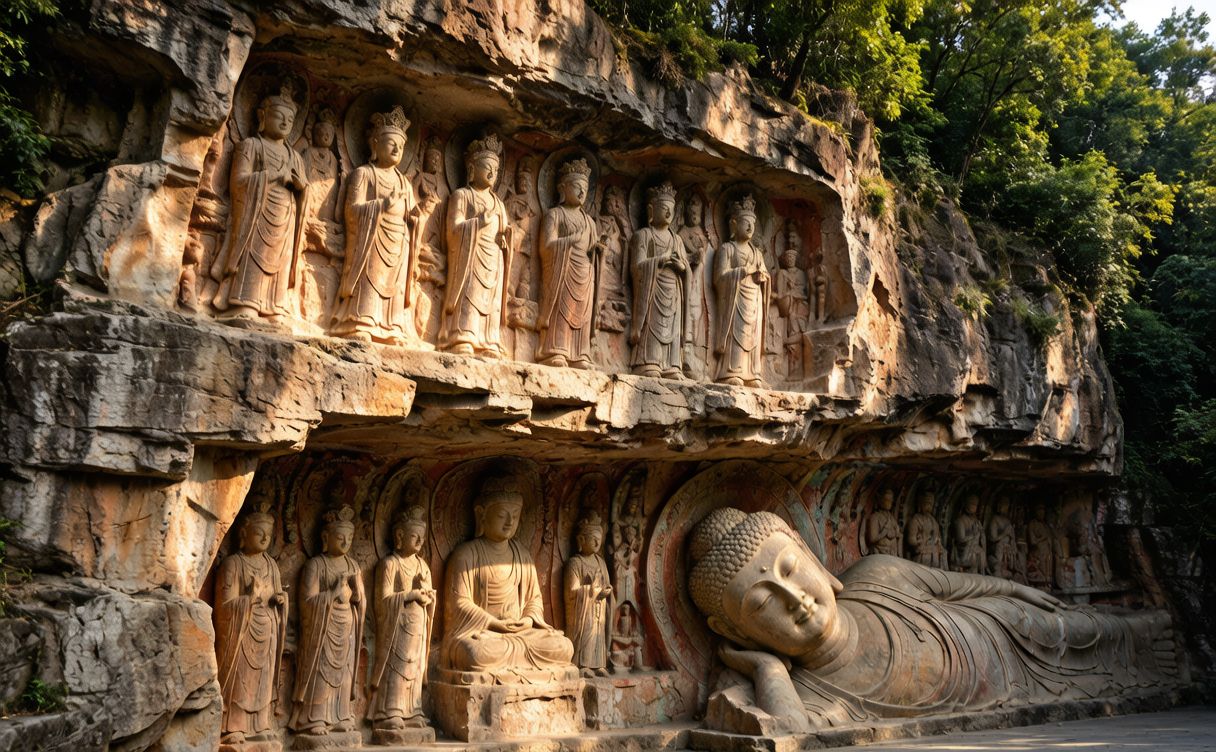
The preservation is remarkable. Because the carvings were largely forgotten for centuries and sit under natural rock overhangs rather than in open exposure, the original pigment traces and crisp detail have survived far better than at many older sites. Bring a pair of binoculars or just use your phone zoom; the facial expressions reward a close look.
The Baodingshan Cliff
This is the heart of the visit, and where I spent almost three hours. The Baodingshan cliff forms a sweeping U-shaped gorge, and a paved walkway lets you circle the entire rock face at a respectful distance. The standout for me was the Reclining Buddha — a 31-meter-long sculpture of Sakyamuni entering nirvana, calm and monumental, with his disciples and guardian figures arranged around him in quiet grief. Standing at the foot of it, I felt the scale of a thousand years of devotion.
Just past the Reclining Buddha is the dazzling “Thousand-Armed Guanyin,” a single figure with what looks like hundreds of delicate arms radiating outward like a fan. Up close you can count rows of tiny hands, each one individually carved. It is one of the most photographed works in all of Dazu, and for good reason.
I also loved the “Wheel of Life” and the “Hell Scroll” reliefs, which use vivid, almost comic-book sequencing to teach moral lessons. As a writer, I appreciated how the carvers used visual storytelling long before printed books were common here. The whole cliff reads like a stone manuscript of medieval Chinese values.
One niche stopped me cold: a relief of a mother tenderly holding her child, labeled with a sermon on parental love. In a thousand-year-old Buddhist cliff, this ordinary human warmth felt like the carvers winking across the centuries. It is these small, specific moments that separate Dazu from every other stone site I have visited.
Do not rush the lower section either. The “Nine Dragons and the Bath Prince” fountain, a working stone water channel carved so that water once flowed from a dragon’s mouth, shows how practical engineering met devotion here. Children on my visit loved it, and I did too — it is a reminder that these cliffs were never just museum pieces but part of daily worship.
Take your time on the upper loop. The shade from the rock overhangs makes it pleasant even in summer, and there are benches where you can simply sit and watch the light move across the stone.
Tips
A few things I learned the hard way so you do not have to:
- Wear real walking shoes. The paths are paved but involve steady uphill sections and a lot of steps. My sneakers were perfect; a friend in sandals regretted it.
- Go early or late. I arrived right at opening and had the upper cliff almost to myself for the first hour. By noon tour buses rolled in and the main viewpoints got crowded.
- Hire the audio guide or a local guide. The carvings tell stories, and without context you miss half the meaning. The official app guide is solid and cheap.
- Pack water and a snack. There are stalls near the entrance, but prices rise inside the scenic area, and the walk is longer than it looks.
- Combine with Chongqing city. Dazu makes an easy half-day trip, so pair it with a couple of days exploring the city itself.
Photography is allowed and encouraged, but leave the tripod at home on busy days since the walkways are narrow. A polarizing filter helped me cut glare on the polished stone. And if you are traveling with older family, note that electric carts run partway up, which saved my mother’s knees.
Best Time
I visited in late spring and the weather was ideal — mild, green, and not too humid. The best windows are March to May and September to November, when temperatures sit comfortably in the teens and twenties Celsius and the light is soft for photography. Summer is workable but hot and busy with domestic tourists; winter is cold and gray but wonderfully empty if you do not mind the chill.
Avoid the first week of October (National Day) and the Spring Festival week if you can. I made that mistake on an earlier China trip elsewhere and will never do it again — the crowds at popular UNESCO sites can be overwhelming.
Rain is the wildcard in summer. A sudden downpour sent me into a teahouse for an hour, and I ended up chatting with a local carving enthusiast who explained how the site’s microclimate actually protects the art. Sometimes the unscripted moments are the best part of travel.
Good to Know
The Dazu Rock Carvings were inscribed on the UNESCO World Heritage List in 1999 for their outstanding representation of Chinese Buddhist, Confucian, and Taoist art over several centuries. The official UNESCO page remains the most authoritative source if you want the scholarly background before you go. You can read the official description here: UNESCO — Dazu Rock Carvings.
The site is well managed, with clear signage in English and Chinese, clean restrooms, and a small museum near the entrance that explains the restoration work. Budget at least half a day, and ideally a full day if you add Beishan.
The on-site museum displays replica tools and explains the painstaking 20th-century restoration that stabilized crumbling sections. I found the short film there genuinely moving — it shows conservators working inch by inch to preserve what we now walk past in minutes.