

The Bowl That Arrives Boiling and Cooks Its Own Lunch
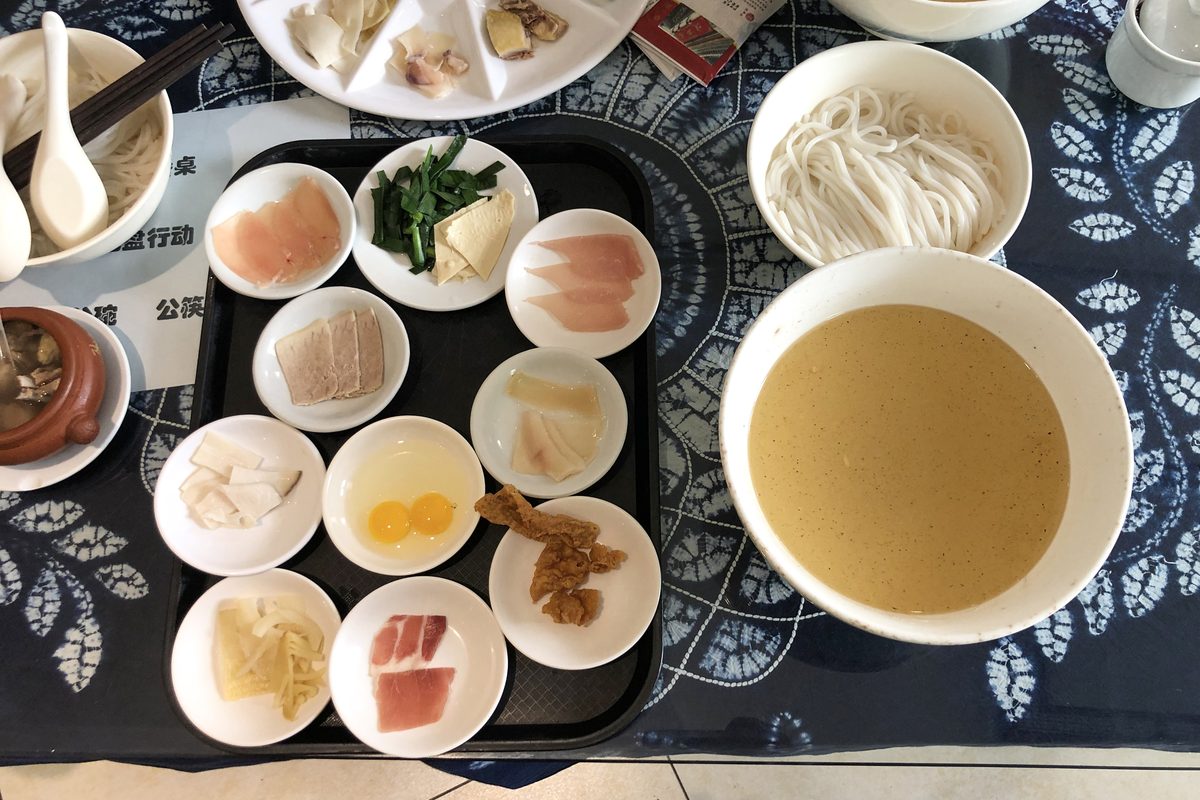
The first thing you notice is not the noodle. It is the silence of the steam. A waiter sets down a stoneware bowl of broth so hot that the surface barely trembles, then arranges around it a lacquer tray of raw things: paper-thin slices of pork, a quail egg still in its shell, a curl of fish fillet, chrysanthemum petals, a handful of bean sprouts. Nothing is cooked except the soup. You are about to do the cooking, at the table, in about ninety seconds, and the only skill required is knowing what goes in first.
That is the whole premise of crossing-the-bridge rice noodles. The dish is a delivery problem solved by thermal physics: how do you get a bowl of soup from a kitchen across a bridge to a person studying on an island, and have it still arrive hot enough to poach meat? The answer Yunnan came up with is a layer of chicken fat floating on top of the broth, acting as a lid you cannot see. Everything underneath stays near boiling for a surprisingly long walk.
What Crossing-the-Bridge Rice Noodles Actually Are
A proper bowl of crossing-the-bridge noodles is three components that meet only at the moment of eating. There is the broth, simmered for hours from chicken and pork bones and often a ham hock, kept screamingly hot. There is the rice noodle, thick and slippery, made fresh daily from a fermented rice slurry rather than dried. And there is the platter of raw or blanched toppings that the diner slides into the broth in a specific order, from the things needing the most heat to the things needing the least.
The noodle matters more than people expect. Real Yunnan mixian is not the thin dried vermicelli that travels well in packets. It is a soft, slightly elastic strand somewhere between a udon and a wide rice stick, with a faintly sour, almost fermented undertone from the rice having been left to culture before milling. In texture it is closer to fresh rice cake than to the wheat noodles most visitors associate with northern China. If you want to understand where this sits among China’s regional noodle traditions, it helps to know that the wheat-and-water continuum stops roughly at the Yangtze and rice takes over south of it.
The name is usually rendered two ways in English: crossing-the-bridge rice noodles, or by its pinyin, guoqiao mixian. Both refer to the same bowl. In Kunming they are served all day, but breakfast is the traditional hour, and locals eat a lot of them.
Where the Name Comes From: A Scholar, an Island and a Long Walk
The story every restaurant in Mengzi will tell you goes like this. A scholar sat for the imperial examinations on a small island in a lake, studying in a pavilion with his meals carried out to him. His wife found that by the time her noodle soup reached him across the bridge, it had gone lukewarm and the noodles had swollen into paste. So she separated the components. She sent the broth in a vessel insulated under a thick skin of chicken fat, kept the noodles in a separate container, and packed the meat and vegetables raw. He assembled it himself at the far end of the bridge, and the broth was still hot enough to cook everything.
Whether or not that particular scholar existed — and the tale has the polished feel of a marketing department — the technique it describes is genuine and it genuinely works. The floating fat layer slows evaporation and convection dramatically. Anyone who has ever skimmed the oil off a hot stock knows how much faster it cools once you do.
Mengzi, in Honghe Prefecture in southern Yunnan, is the town that claims ownership, and it takes the claim seriously. You can still visit the restaurants there that trace their lineage back to the nineteenth century, and the local version tends to be more austere than the Kunming version: a darker broth, less garnish, and an insistence that the bowl be large enough to be slightly absurd.
Guoqiao Mixian Ingredients: What Goes on the Platter
The classic arrangement is served as a set of small dishes, and the number of dishes is how a shop signals its ambition. A basic order has maybe six; a grand one can have twenty.
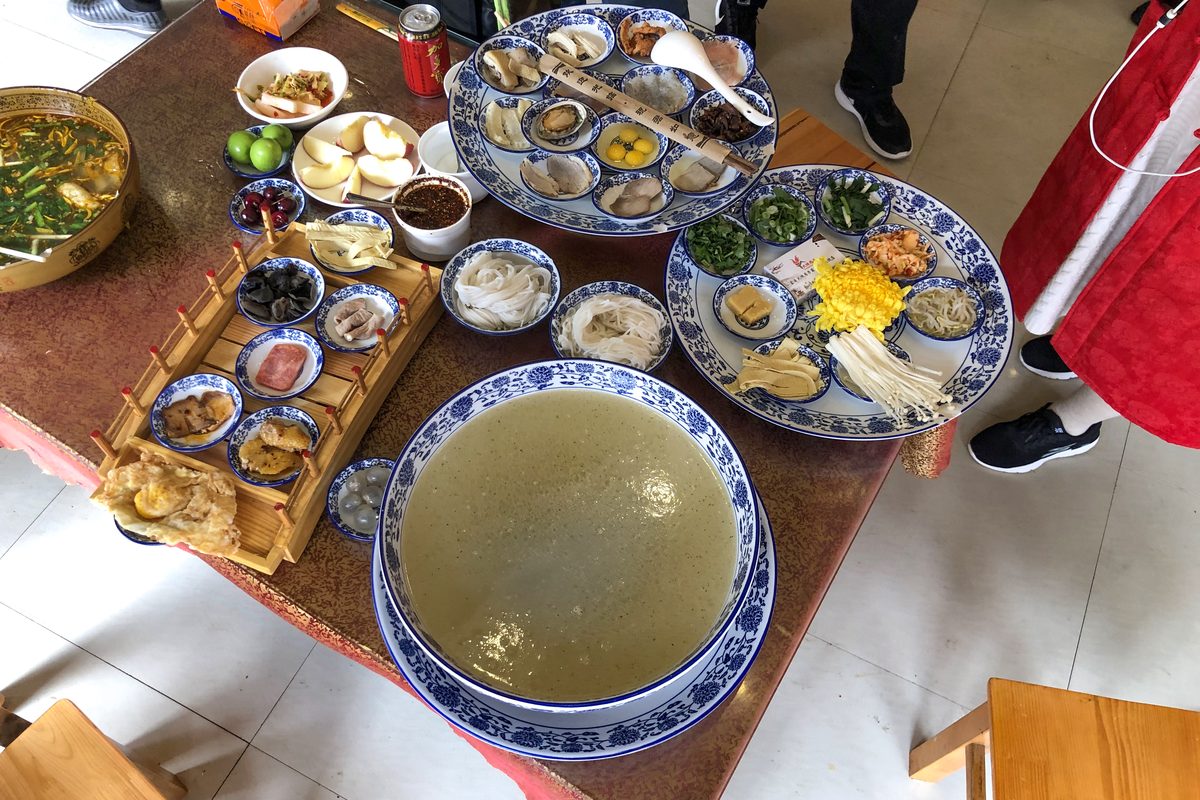
- Sliced pork loin, cut translucent and shaved across the grain so it cooks instantly
- Chicken breast slices, usually lightly coated in starch
- Fish fillet, often grass carp or a local lake fish, sliced on the bias
- A raw quail egg, cracked into a small dish and slipped into the broth whole or beaten
- Yunnan ham (the dry-cured, saline relative of Jinhua ham)
- Tofu skin, fresh bean curd sheets or dried ones that soften in the soup
- Chrysanthemum petals — edible ones, slightly bitter, added at the very end
- Bean sprouts, wood ear fungus, and chopped scallion
- Chili oil and pickled mustard greens on the side, added to taste rather than by default
For a home version you do not need all nine. Four or five toppings and a good broth will get you most of the way, and honestly the homemade version succeeds or fails on the broth alone.
How to Make Crossing-the-Bridge Rice Noodles at Home: Step by Step
To make crossing-the-bridge rice noodles at home you are really making two things — a stock that can hold heat, and mise en place — and then combining them at the table.
- Build the broth. Cover one chicken carcass, 400 g pork ribs and a 30 g slice of Yunnan or Jinhua ham with cold water. Bring to a bare simmer — never a rolling boil, which emulsifies the fat and clouds the soup — and hold it for 2½ to 3 hours, skimming the grey scum only in the first twenty minutes.
- Protect it. Strain, then leave about 3 mm of rendered chicken fat floating on the surface. This is the insulating lid and it is not optional. Season with salt and a little white pepper only; you do not want anything that will turn bitter under heat.
- Bring it to a hard boil just before serving. The broth must be at or very near 100 °C when it hits the table, because every topping you add drops the temperature. Use a heavy stoneware or cast-iron bowl if you have one, and preheat it with hot water first.
- Set out the platter. Slice pork, chicken and fish as thinly as you can — freezing the meat for 30 minutes first makes this achievable with a normal knife. Keep everything cold until the moment it goes in.
- Sequence the additions. Egg and meats first, stirring them into the centre where the broth is hottest. Then fish and ham. Then tofu skin, wood ear and sprouts. Noodles just before you eat. Chrysanthemum petals last, off the heat.
- Par-cook the noodles separately. Fresh mixian needs about 40 seconds in plain boiling water; dried needs 4 to 6 minutes. Rinse briefly so they do not carry cold water into the broth, then slide them in.
- Eat immediately. This bowl has maybe three minutes of peak quality in it. It is not a dish to photograph at length.
Ordering at a Yunnan Noodle Shop: What to Say and What to Do
The ordering ritual is casual and slightly bureaucratic at the same time. In most Kunming shops you pay first at a counter, choose a size — small, medium or large refers to noodle quantity, not broth — and sometimes a broth base, then carry your ticket to the pickup window. Toppings may be fixed, or you may point at what you want from a chilled display case.
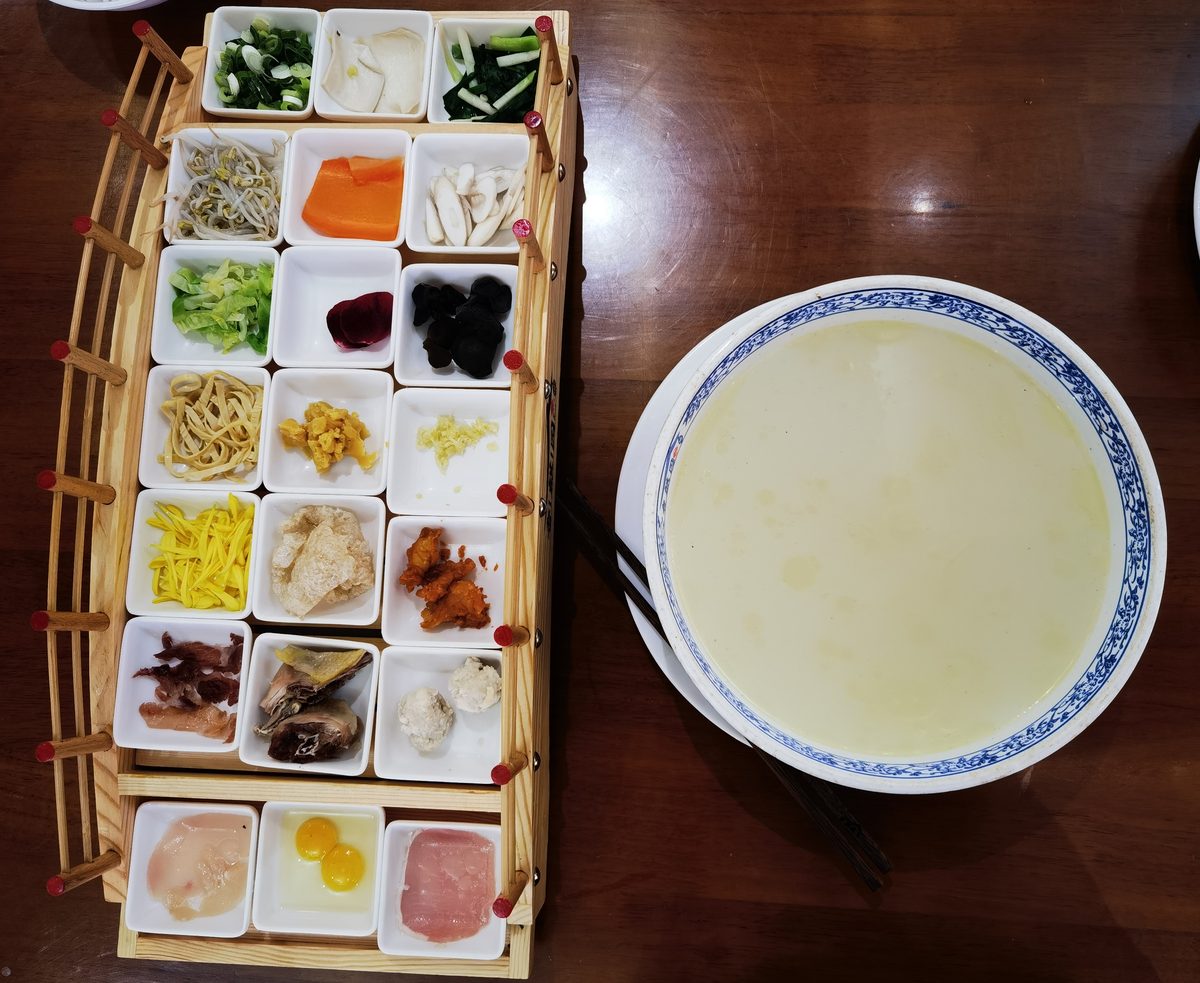
Nobody will explain the sequence, so here it is: anything raw goes in first and you push it under with your chopsticks; anything already cooked goes in later. Add chili oil and pickled vegetables to taste only after you have tasted the broth plain, which is the point of the exercise. Slurping is not rude. Leaving the bowl half-finished because you got distracted is, mildly, because it is a dish with a short window.
Prices in Kunming tend to run from about 12 yuan for a plain bowl to 40 yuan or more for the full-platter versions with Yunnan ham and lake fish. The genuinely traditional shops still use the nori-like black pottery bowl from Jianshui, which holds heat noticeably better than ceramic.
Crossing-the-Bridge Noodles vs Other Chinese Noodle Soups
What separates this bowl from its relatives is that it is assembled rather than plated.
- Versus Lanzhou hand-pulled beef noodles: Lanzhou arrives fully cooked, clear broth, wheat noodles pulled to order. Crossing-the-bridge arrives unfinished and finishes itself.
- Versus Wuhan hot dry noodles: Different family entirely — sesame paste, no broth, served warm rather than hot.
- Versus Beijing zhajiangmian: A fried soybean sauce stirred through cold-then-warm wheat noodles. No soup at all.
- Versus luosifen: Both are southern rice-noodle soups with assertive identities, but snail noodles are built on fermented bamboo and a deliberately challenging aroma, while crossing-the-bridge noodles are deliberately clean and clean-finishing.
If you want to keep going down this particular road, our full guide to Yunnan rice noodles covers the other styles of mixian you will run into across the province, and the Kunming food guide has the neighbourhood shops worth getting out of bed for.
Calories, Nutrition and Who Should Be Careful
Nobody orders crossing-the-bridge noodles for their health, though it is a less punishing bowl than it looks. A standard serving runs roughly 450 to 650 calories, depending mostly on how much fat stays on the broth and how much ham you order. Protein is genuinely high — 25 to 35 g is typical given the volume of meat and egg — and the vegetable component is real if you order the sprouts and greens.
Three cautions are worth naming. The broth is salty, sometimes very salty once Yunnan ham is involved, so anyone managing hypertension should ask for the plain version and add nothing at the table. The entire premise of the dish depends on residual heat rather than a flame, so the meat is briefly poached rather than thoroughly cooked — a consideration if you are pregnant or immunocompromised, and a reason to buy from a shop with high turnover. And the broth itself is served at a temperature that will cause real scalding; this is the single most common minor injury associated with the dish.
Practical Tips, Regional Variations and Shortcuts
- The fat layer is the whole trick. If your homemade broth cools too fast at the table, you skimmed it too clean.
- Freeze meat before slicing. Thirty minutes in the freezer turns an impossible cut into an easy one.
- Fresh mixian freezes well. Buy it in quantity from a Chinese grocer and portion it.
- Kunming versus Mengzi. The prefecture town version is darker and plainer; the provincial capital version is lighter, sweeter and more garnished. Neither is wrong.
- Vegetarian adaptations work better than you expect. Mushroom and soybean broth thickened with a little tofu skin carries the same ritual, and the chrysanthemum petals do a lot of aromatic work.
- The instant packet is a different food. It exists, it is fine at midnight, and it is not this dish.
Frequently Asked Questions
Why is the broth for crossing-the-bridge noodles served so dangerously hot?
Because it is the cooking medium, not just a soup. Every topping you add pulls heat out of it, so it must start near boiling to finish cooking the pork and egg. This is also why the traditional serving bowl is stoneware or heavy ceramic rather than thin porcelain — thermal mass keeps the broth hot through the sequence of additions.
Can you make crossing-the-bridge rice noodles without Yunnan ham?
Yes. The ham contributes salinity and a distinctive funky depth, and leaving it out will make a flatter bowl, but a good chicken-and-pork-bone broth still works. If you want the closest substitute, a small piece of Jinhua ham, prosciutto bone or even a smoked ham hock gets you most of the way. Salt more carefully at the end if you do.
What is the difference between mixian and other Chinese rice noodles?
Mixian from Yunnan uses rice that has been fermented or soured slightly before milling, which gives it elasticity and a faint tang you do not get from standard dried rice vermicelli. It is also sold fresh rather than dried, so the texture is softer and slightly sticky. Dried rice noodles make an acceptable substitute in a pinch; rice vermicelli does not.
How many calories are in a bowl of crossing-the-bridge noodles?
Typically 450 to 650 calories for a standard serving, rising past 800 for the grand versions with multiple meats, ham and egg. Most of the variation comes from fat in the broth and added chili oil rather than from the noodle itself.
Is crossing-the-bridge rice noodle soup safe to eat if the meat arrives raw?
At a reputable shop, yes — the broth is close to boiling and the slices are cut thin enough to cook through within seconds. That said, poaching at the table is inherently less thorough than cooking in a pan. If you are pregnant, immunocompromised, or travelling with small children, either stir the meat longer than the server suggests or ask for a fully cooked version, which most places will prepare on request.
Where does the best authentic guoqiao mixian come from?
Mengzi in Honghe Prefecture is the acknowledged birthplace, and the old shops there still serve the least ornamented, most seriously-made versions. Kunming is a close second and far easier to reach, with its own tradition of larger, more elaborate platters. In both places the best indicator is turnover — a shop packed at 7 a.m. with locals is doing something right.
A bowl of crossing-the-bridge rice noodles is one of the few Chinese dishes where the diner does the final cooking, and the reason it still works after a century or more is that the technique solves an actual problem rather than decorating one. Somewhere along the way to your table, someone decided that the last ninety seconds were yours, and the whole dish is built around that transfer.
Photographs: “Crossing the Bridge Rice Noodles at Jian Xin Yuan, Tangzixiang” by N509FZ and “Crossing the Bridge Rice Noodles in Mengzi” by N509FZ (CC BY-SA 4.0), “Crossing Bridge Rice-noodles in Xiangqi Yuan, Mengzi” by Luyuan (CC BY-SA 4.0), via Wikimedia Commons.