

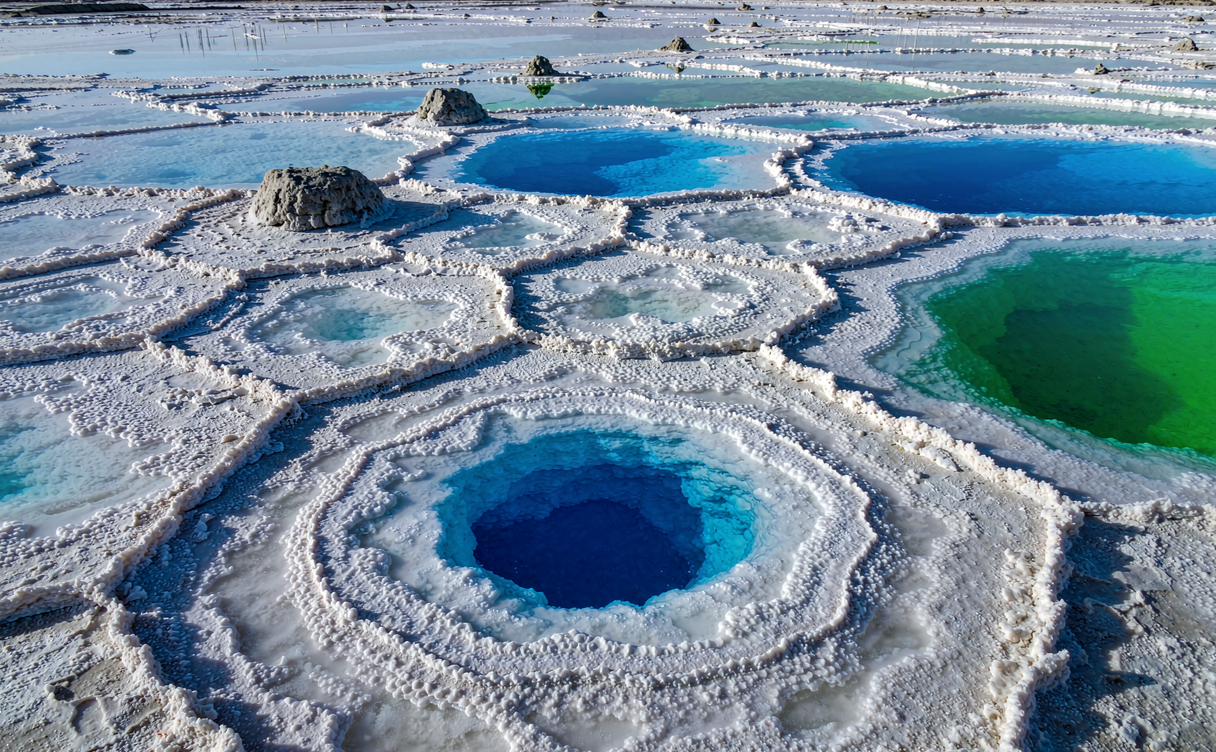
Pull off the highway in the middle of the Qaidam Basin and you will see a sheet of water the colour of a swimming pool in southern Spain, ringed by grey salt crust and low brown hills. That is Dongtai Jinair Lake, and it is the most photographed salt lake in Qinghai after Qinghai Lake itself. This Dongtai Jinair Lake guide covers how to reach it, when the water turns that impossible blue-green, what is actually worth doing once you arrive, and how to slot the lake into a wider Qinghai salt lake itinerary without burning a day on the road.
The lake lies in Haixi Mongol and Kazakh Autonomous Prefecture at roughly 2,700 metres, on the northern edge of the basin between Dachaidan and Huatugou. You do not need a permit here, which is not true of every high-altitude destination in the region. What you do need is a vehicle, decent light, and a plan, because there is very little shade, very little English signage, and the road in runs through some of the emptiest tarmac in the country.
[CTA] If you are routing a Qinghai road trip this season, work through our Qinghai Lake guide first to compare the big lake with the basin lakes, then tell us where your loop starts.
Bring cash, water and a windbreaker — the wind will ruin a haircut and a camera lens in about ten minutes.
[/CTA]
Where Dongtai Jinair Sits, and Why the Colour Happens
Dongtai means east terrace and Jinair is a Mongol name for the salt marsh behind it. Paired with Xitai Jinair Lake to its west — the one with a half-sunk island in the middle that people wade out to at dusk — it forms a pair of terminal lakes fed by runoff from the rivers running off the Qarhan hills. The colour is not a filter. It comes from dissolved salts and mineral algae suspended in shallow water, and the concentration shifts from season to season, which is why visitors describe it variously as milk blue, jade and teal depending on when they came.
That variability is the honest thing to say about it: nobody can guarantee the exact shade on your arrival day. What you can plan for is the general pattern. In late spring the water is rising and the far horizon reads pale silver. By high summer the lakes are at full volume and the strongest blue appears. In autumn the colour deepens again and the air clears. In winter the shallows freeze and the whole place turns into a vast white mirror.
How to Get to Dongtai Jinair
How to get to Dongtai Jinair is really a question of where your loop begins. From Xining, the usual approach is a flight or train to Delingha or Golmud followed by a long overland run south across the basin — realistically seven to nine hours by car, with the last two hours on open road. From Dachaidan it is a little under 100 kilometres south, roughly an hour and a half, which is the easy option if you are already sleeping in Dachaidan.
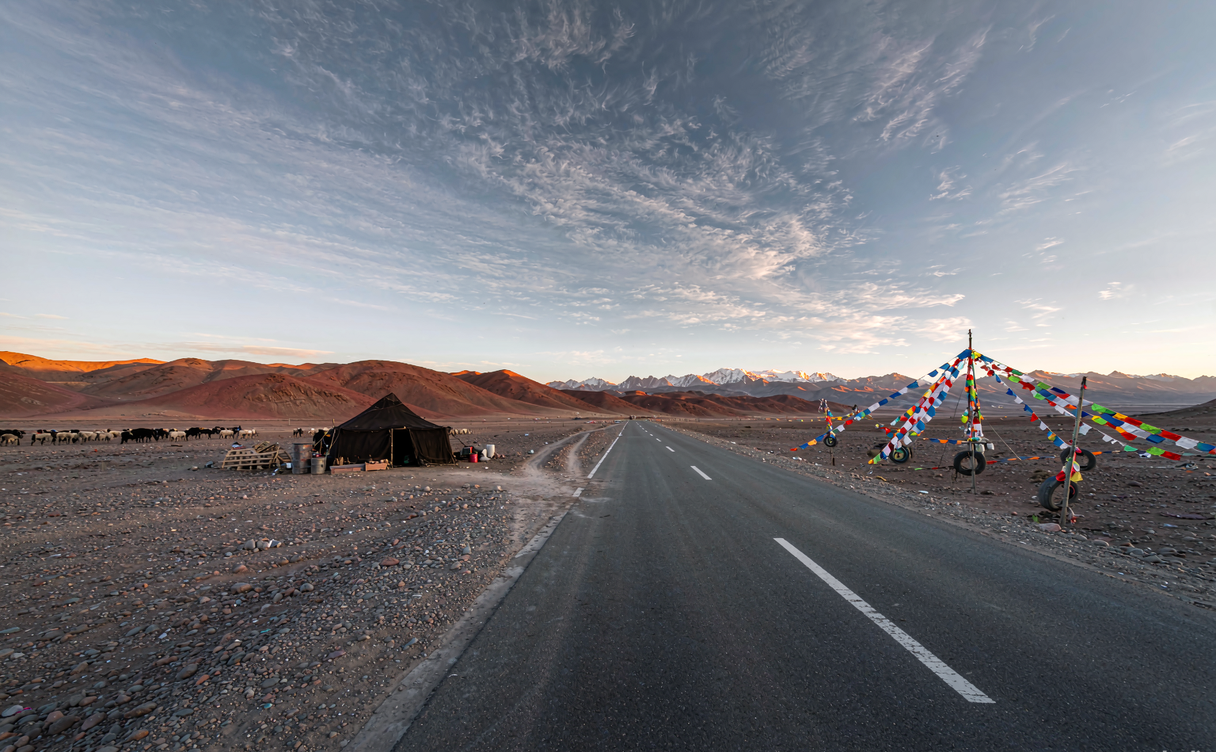
The road itself is the attraction for some people. G315 crosses the basin and passes salt flats, gas flares, and occasional herds of sheep herded by kids on motorbikes. Fill up in Dachaidan before you go. Mobile coverage thins out badly on the southern stretch, so download offline maps the night before.
[CTA] Running the same road in the other order? Compare the logistics in our Dachaidan travel guide and the Chaka salt lake guide — most itineraries pair three lakes across three or four days.
Pick the order that keeps you heading west at nightfall, not east.
[/CTA]
Best Time to Visit Dongtai Jinair
The best time to visit Dongtai Jinair is late June through early October, with September my own preference. July and August bring the deepest blue and the warmest afternoons, but also tour buses from Xining and a car park that fills by eleven in the morning. September thins the crowds, hardens the nights, and gives you long golden evenings when the whole lake surface goes copper.
Winter turns it into a different place. From roughly December to March the shallows ice over and the site is stunning in a bleak monochrome way, yet several visitor facilities shut and the wind on the exposed shore is severe. If you want photographs of people in wetsuits standing on salt crust, come in August. If you want an empty mirror at sunrise, come in October and bring more layers than seems reasonable.
Things to Do at Dongtai Jinair Lake
Things to do at Dongtai Jinair Lake are simpler than the list implies, and that is a good thing. The main activity is walking the salt shoreline to find a clean ledge where the water reads blue against white crystal. Wear closed shoes — the crust is sharp in places. The second activity is the short drive west to Xitai Jinair Lake and its island, reachable on foot across the shallows at low water, though only with care because local guides know exactly where the mud goes soft.
The third is photography at the two golden ends of the day: a small viewing platform on the north side faces the water toward the low sun at sunset. The fourth is simply driving the triangle, Dongtai, Xitai and the East Taijinar salt works, which takes half a day and very little fuel.
Building a Qinghai Salt Lake Itinerary
A workable three-day shape goes Xining to Chaka Salt Lake on day one, Dachaidan and Dongtai on day two, then Dachaidan to Golmud or Delingha on day three. Four days adds the detour to Emerald Lake with its pale mint terraces, a morning on the Qinghai Lake shore, and an afternoon of nothing in particular.
If you are continuing into Gansu, the Qinghai Gansu loop itinerary sequences the whole clockwise circuit with daily distances and overnight stops, and it is worth reading before you commit to a rental car. Most people underestimate how much altitude they will lose and gain on the same day.
Where to Stay and What to Eat
Dachaidan is the practical base: a small mining town of guesthouses, business hotels and a handful of honest restaurants, sitting under two hours from Dongtai Jinair. Rooms run from about 150 RMB in low season to 400 RMB in August for a standard twin, and the newest hotels book out first.
Eat where the plate tells you the altitude: hand-pulled noodles, hand-cut flat noodles with mutton, Tibetan-style stewed beef, yak cheese, and butter tea that will either convert you or not. For a fuller rundown of what to order and how to order it, the Qinghai cuisine guide covers regional specialities across the prefecture.
Mistakes That Ruin the Day
Three things catch people out. First, arriving at midday in high summer, when the light is flat and the car park is full — set out from Dachaidan by two in the afternoon if you can. Second, underestimating the wind, which arrives without warning and carries grit. Third, expecting English signage; there is almost none, the ticket office may be a single small building with one notice board, so have small notes ready.
Also shoot from the shaded east side when the sun is low in the west, and never walk onto crust that looks firm near the waterline. Salt crust does fail, and the mud underneath is worse than it looks.
Timing the Whole Trip
For a first-timer, aim for the second half of September: nights near freezing, days in shirtsleeves, empty beaches and that deep blue. Book the car a week ahead, keep the passport in the glovebox because police checkpoints on G315 are routine, and treat the lake as a half-day stop rather than the whole point of the trip. The drive out and back through the Qaidam Basin is the part people keep talking about afterwards. For background on the plateau, the Lonely Planet Qinghai province guide is a useful pre-trip read.
[CTA] Ready to build the route? Start a Qinghai salt lake itinerary with us and we will help you sequence the lakes, the altitude and the light.
Send us your flight date and we will tell you honestly whether September suits you better than July.
[/CTA]